


On the evening of November 27, 2016, we flipped the switch on the new blogTO website.
It had been a long time coming. The Playground redesign had failed. For years, the site had been a patchwork of mismatched templates with different visual languages across desktop, mobile, and newer sections. We had been making incremental improvements, but everyone knew we needed a complete overhaul. And we needed it to work this time.
The new site wasn’t just a new look. It was an entirely new infrastructure. For the first time in the site’s history, we had a responsive design that worked across every device and browser. We had a custom CMS built specifically for our needs. And we were finally free of Movable Type, the antiquated publishing system we had been working around since 2004.
It was the result of years of work, and it felt like a turning point.
The year before, we had moved offices.
On May 1, 2015, we relocated to 250 University Avenue, a new second location for iQ Offices on the other side of the Financial District. The pattern was familiar by now. The original space at the Dineen Building was now full. The new one needed tenants. I negotiated a barter arrangement where part of our rent was offset by advertising on blogTO. The new office was larger, which we needed as the team had grown. Even though most of the team didn’t work from the office, I went in most days, as did Derek and the staff responsible for our breaking news coverage.
Around the same time, I was introduced to Frank Maidens and Vivian Hui, the husband-and-wife team behind Studio Function, which they ran from their home in Little Italy. By the summer of 2015, we had finalized the scope of work for them to redesign the blogTO website.
The project included a full visual overhaul and a brand identity refresh: a new logo, business cards, stationery, and an updated Best of Toronto window decal. Studio Function approached the work with professionalism and care, making the experience a pleasure from start to finish.
The web design prioritized the reading experience across devices, with particular attention paid to individual article pages, which had become more important than the homepage since most readers were now arriving at the site via search, Facebook, or our newsletters.
While Studio Function handled the design, Taylan and his team of developers, now led by the brilliant Yiğit Güler, built the front-end templates and finalized the backend infrastructure. They were joined by Kevin and Abraham for additional support. The new CMS was built as modules, each customized to blogTO’s specific needs. It gave us capabilities that an off-the-shelf system like WordPress simply couldn’t provide: a sophisticated events system, deep business directory functionality, integrated listicle tools and a number of APIs that powered our growing family of apps.
I had scaled back some of the features that had made the Playground project challenging. We also removed the Streams section from the site since it hadn’t gained the traction I had hoped for, though we kept the underlying functionality that powered user-uploaded photos for restaurant and business listings.
The project went smoothly. Frank and Vivian delivered exactly what we needed, on time and to a standard I was genuinely happy with. In the years that followed, we continued working with Studio Function on further enhancements to the website, graphics for our growing social media and video operations, and other design projects.
The new site went live after extensive testing to make sure everything looked and worked as intended. The launch involved the usual late nights, but overall it went well, with only the minor issues you would expect from any major website launch.
The changes weren’t just cosmetic. The new CMS resolved a long list of pain points that had frustrated our team for years. We had built the system from the ground up, customized entirely to our workflow, and it fit like a glove. It was also a competitive advantage. We regularly received inquiries from local media publishers around the world asking what we were using to power the site. They were looking for similar functionality for events and business directories, the kind of thing you couldn’t get from WordPress. We briefly considered licensing the CMS but decided against it. While it could have been lucrative, it would have put us in a completely different line of business.
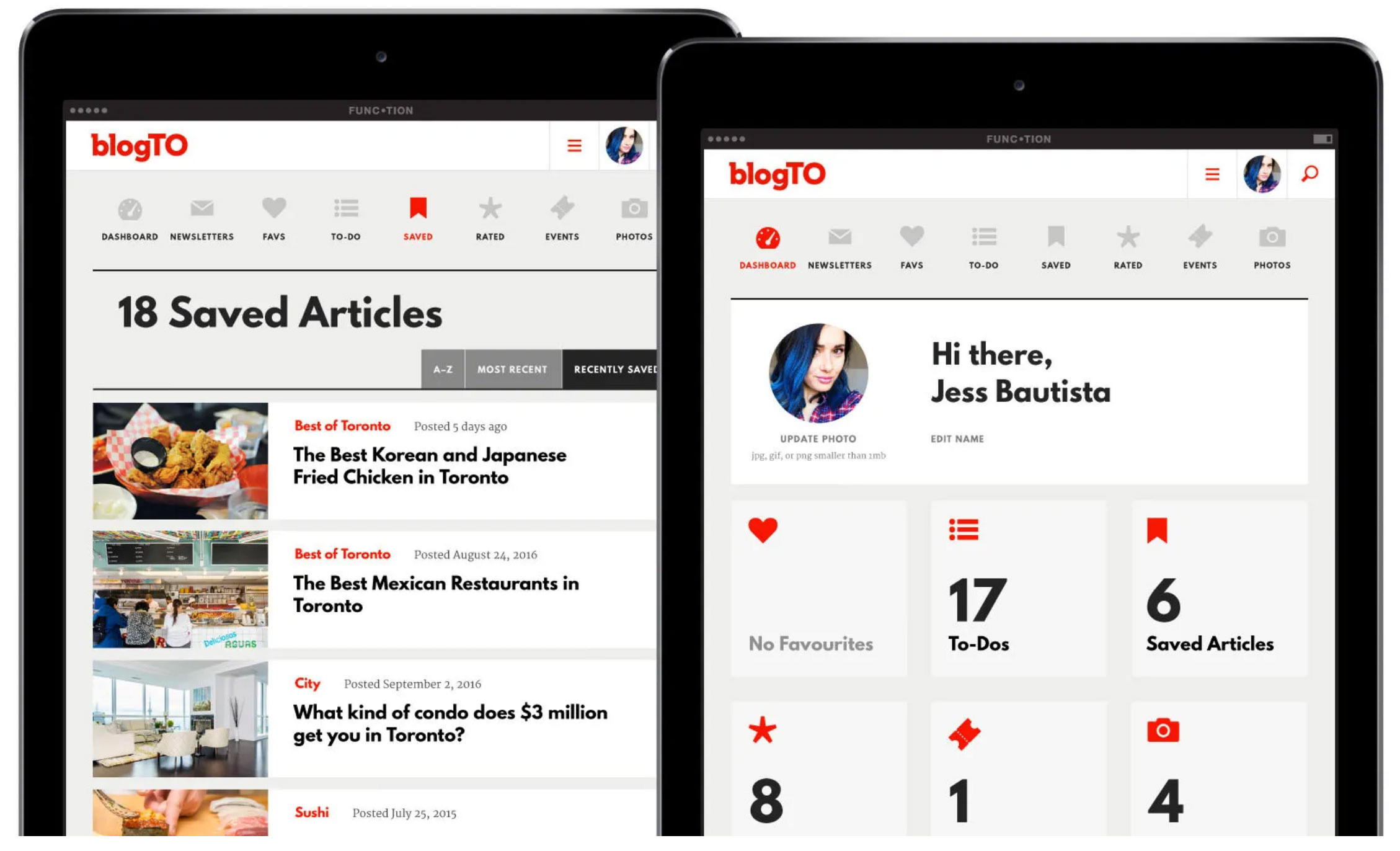
For our readers, the new site introduced features we had been building toward for years, some of which had already been available in the iPhone app. We now had a rich user profile system that allowed users to save articles and lists for future reference, rate restaurants and other businesses, build to-do lists of places to visit and save events to their calendar. Our neighbourhood and directory pages were now much richer, updated so readers could more easily discover places to visit, and the website supported bigger, higher-resolution photos that greatly improved the visual experience.
There were many other new features and enhancements, too, but I don’t want to bore you with the full list.
The team continued to evolve during this period. Some people left to pursue opportunities with more responsibility and better pay, but new contributors stepped in and made an immediate impact.
Amy Grief joined the staff as a writer in 2015 and quickly became one of our most capable and versatile contributors. She assisted Derek with copyediting and editorial tasks while producing a wide range of content, from an ongoing series profiling unique office spaces in Toronto to posts about the city's high rankings in various annual reports and studies. These ranking posts performed exceptionally well on Facebook. People loved celebrating Toronto's achievements and would share them widely.
Amy was also writing about long lineups in Toronto, which tapped into a powerful mix of FOMO and outrage. People who wanted to check out whatever was drawing the crowd would share the post with their friends. People who hated that Toronto lined up for everything would rage in the comments. Either way, the engagement was enormous.
Hector Vasquez started as a photography intern, working under and eventually alongside Jesse Milns, our staff photographer. Hector stayed on the team for years, collaborating with our writing team and supporting the growing demand for photos on Instagram. He also worked with our writers to produce extensive features packaged as photo-driven listicles. Posts like our top 50 brunch restaurants in Toronto were built to capture ongoing search traffic and could generate substantial page views month after month. We would refresh most of these features every year or two to keep them current, updating the content and publish date while preserving the original URL to maintain our search rankings.
Jaclyn Skrobacky was now our Community Manager, having taken on the role for both blogTO and Toronto Food Trucks. She was instrumental in the growth of our Instagram account and Facebook pages during this period, while also contributing to the site with posts that ranged from the story of Toronto’s obsession with a flying peanut sculpture to a guide to the city’s top food photographers on Instagram.
One of the most memorable pieces of content from this period wasn’t even real.
In 2016, we decided to publish an April Fools post and chose a topic we knew would resonate: the Rogers Centre was being renamed back to the SkyDome. We put the post up early that morning, before most people had clued in to the date. We immediately circulated it across our social feeds and watched the numbers climb on Chartbeat. People were ecstatic. Many people in Toronto still refused to call the stadium anything other than the SkyDome, and they shared the post on Facebook and Twitter to celebrate the news. It took most readers a while to realize it was a joke. We updated the article later that morning to let everyone know.
It was one of the year’s highest-performing posts, and it taught us what makes a good April Fools article. The story had to be believable. It had to be something a lot of people genuinely wanted to happen. And we needed a convincing photo to accompany it. If we had a good concept but no suitable image, it wouldn’t work. We also avoided writing anything about specific companies or individuals that could create legal issues, though we considered the government, transit, buildings and infrastructure fair game.
It became a tradition. The previous year, we tested the format with a post about Toronto getting its first baby-food bar for adults. In the years that followed, we published April Fools posts about public drinking being legalized in Toronto (which actually came true years later), the TTC offering refunds for major subway delays, a pilot program for a 24-hour subway, and Ontario mandating a four-day work week.
Most people seemed to appreciate the jokes. But not everyone. For some readers, the posts were simply too cruel. We had given them hope and delivered the news they had dreamed of, only to reveal it was all a hoax.
The competitive landscape was always evolving, and these years were no different.
In 2015, Toronto Life launched the 12:36 newsletter, a daily digest of Toronto news and culture. The project was led by David Topping at St. Joseph Media, with content written by Marc Weisblott, who had run the blog Better Living Centre back when blogTO was getting started. Derek and I respected Marc and enjoyed reading the newsletter, but we didn’t see it breaking out beyond a niche audience. It never did.
The more significant competitive development was the arrival of Daily Hive in Toronto in 2016. The company had rebranded from Vancity Buzz, the Vancouver-based site that had gained traction after we shelved Beyond Robson. Their national expansion was ambitious, and renaming themselves Daily Hive gave them a brand they could use across multiple Canadian markets rather than the city-specific naming approach I had taken.
I knew the expansion was coming because they had poached one of our writers. Liora Ipsum had been writing for us for years. She was on contract with us but wasn’t a full-time employee. Daily Hive offered her more money and full-time employment. Liora came to talk to me about it directly. It was an open and cordial conversation. I didn’t blame her for taking the job. It was a better offer than we were willing to match.
We weren’t fans of Daily Hive. Beyond hiring one of our core team members, they were going after our audience with content we didn’t think was particularly original. Our internal joke was that whatever we published on blogTO today would be on Daily Hive tomorrow. They seemed to be copying not just our content strategy but the actual content itself.
By this point, blogTO’s reputation had grown well beyond our readership. Organizations that would have previously partnered with legacy media were now coming to us.
In 2015, the organizers of WayHome, a major new music and arts festival at Burl’s Creek in Oro-Medonte, reached out before the public announcement to bring us on as a media sponsor. This was a high-profile event headlined by Neil Young, Kendrick Lamar and Sam Smith, and they chose blogTO over the Toronto Star, Now Magazine and every other media outlet in the city. I attended the inaugural festival with Bronwyn and our two kids. On opening night, our children had an up-close view of Neil Young, though of course they don’t remember.
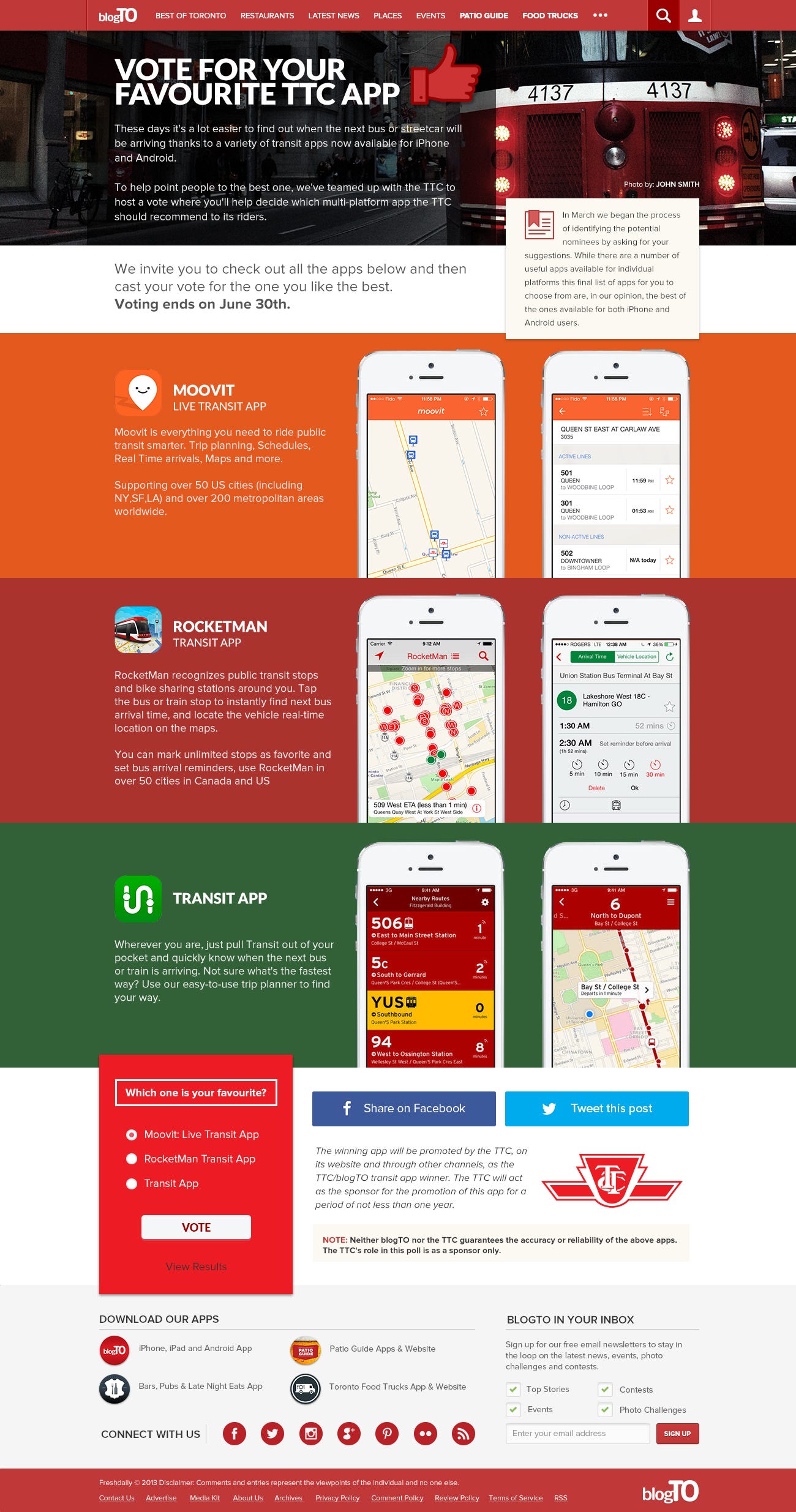
Around the same time, the TTC approached us to partner on a public vote for the city’s best transit app. They could have gone to any media outlet, but chose us. We set up a poll on the site featuring three finalists, Moovit, Rocketman and Transit App, and readers voted on which one the TTC should officially recommend. Transit App won, and the TTC promoted it on their own channels for the following year.
The TTC partnership also led us to evaluate a potential acquisition. Transit Now, another Toronto-based transit app, reached out about selling their product to us. I had always liked the idea of owning or integrating with a transit app. Our data was already organized so that users could find restaurants and other places by subway station. Embedding blogTO content, local news, events and business recommendations into a transit app experience felt like a natural extension.
The app had a solid user base and strong ratings, but it was Android only, which meant we would have had to build an iPhone version from scratch. We also weren’t confident we had the resources to keep pace with more focused competitors like Transit App and Rocketman, or with Google, which was increasingly moving into the space. We decided not to proceed, though the idea stayed with me, and I revisited it with a different transit app years later.
As our audience grew, so did the volume of reader feedback. Most of it was positive. For newcomers to Toronto, blogTO was often where they turned to get to know the city, from our coverage of local businesses and neighbourhoods to our lists, events and daily news.
The emails from local business owners were particularly rewarding. “I just wanted to say a big ‘THANK-YOU’ to everyone at blogTO,” wrote Louise Cooper, the owner of The Cat’s Meow, a vintage store on Avenue Road. “Your site has sent so many customers my way. You really help small businesses flourish.”
People also randomly sent us unsolicited redesigns of our logo. “Hey, pretty random, but I was bored and had an idea for a new logo for you guys and worked on it,” one person wrote. It happened regularly over the years. People loved the brand enough to take their own stab at the logo in their spare time. We always appreciated the effort, although we thought our logo was already great.
We’d sometimes hear from readers insisting we never covered their part of the city. I’d usually respond with links to recent articles from the exact area they were complaining about. I understood the feedback. We published so much content that no single person could keep track of it all. Our headline strategy didn’t help. We had learned early on that putting a specific neighbourhood name in a title limited engagement on Facebook.
People in Toronto were stubbornly territorial about geography. I’d hear from people on the west side who said they never crossed the DVP. Some didn’t know the city had amalgamated. So we generally used “Toronto” in our headlines unless the piece was a dedicated neighbourhood guide. It gave the content greater reach but made it less visible to readers who just skimmed headlines and assumed we were ignoring their area.
And then there was the person from the BlackBerry team who wrote to let us know the site didn’t render properly on their browser. I politely wrote back that we would look into it.
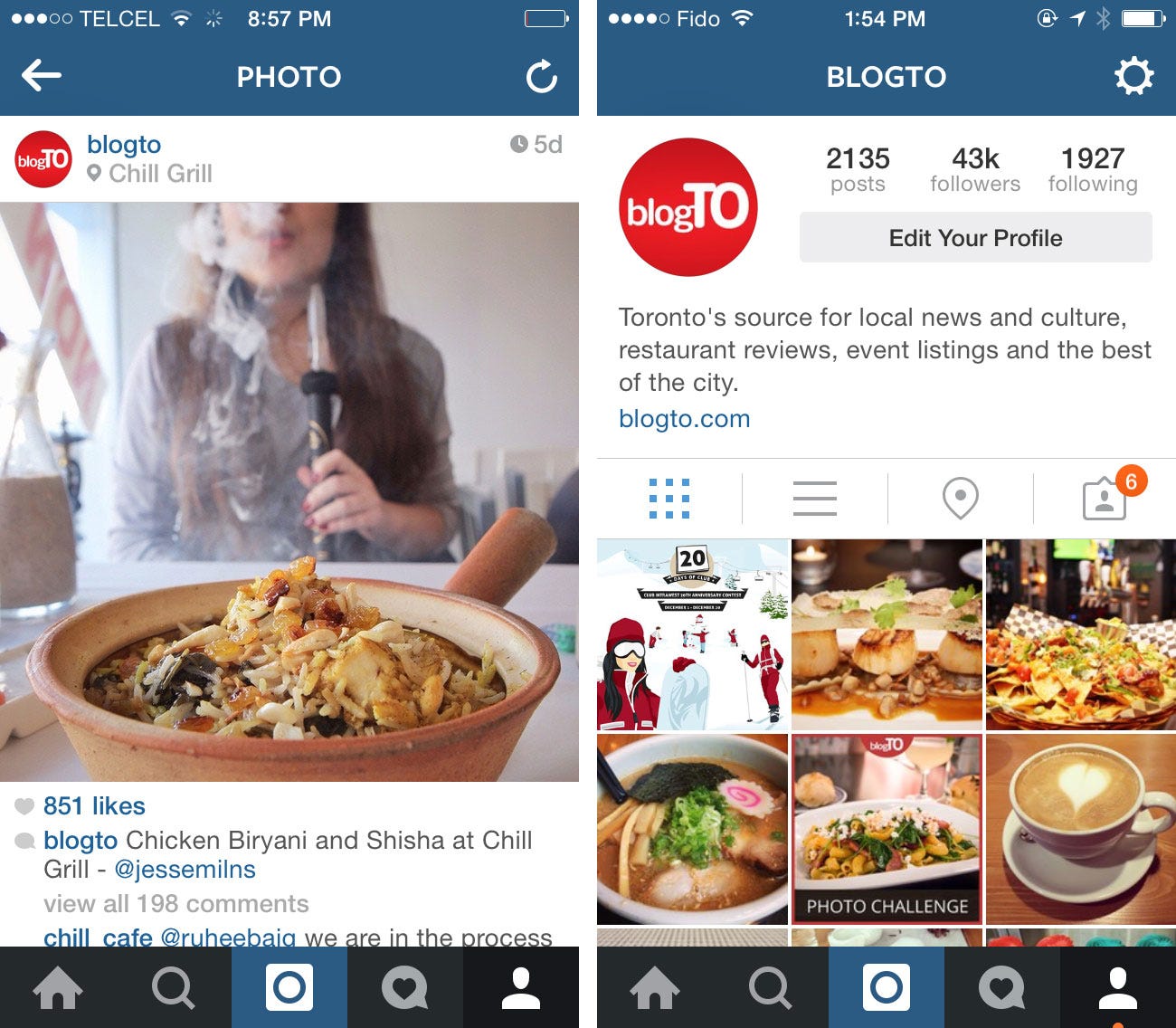
On Instagram, we had begun generating meaningful revenue, mostly through image-based advertising. Our content strategy on the platform remained centred on photos and Stories, with video playing a relatively small role. Suite 66 asked for permission to offer paid Instagram boosts to advertising clients that year. I said no. I felt that using paid promotion would interfere with our organic reach and the algorithm’s treatment of our account. We had more followers than any other media account in Toronto, and possibly in Canada. Our organic reach was already substantial. I didn’t see the need.
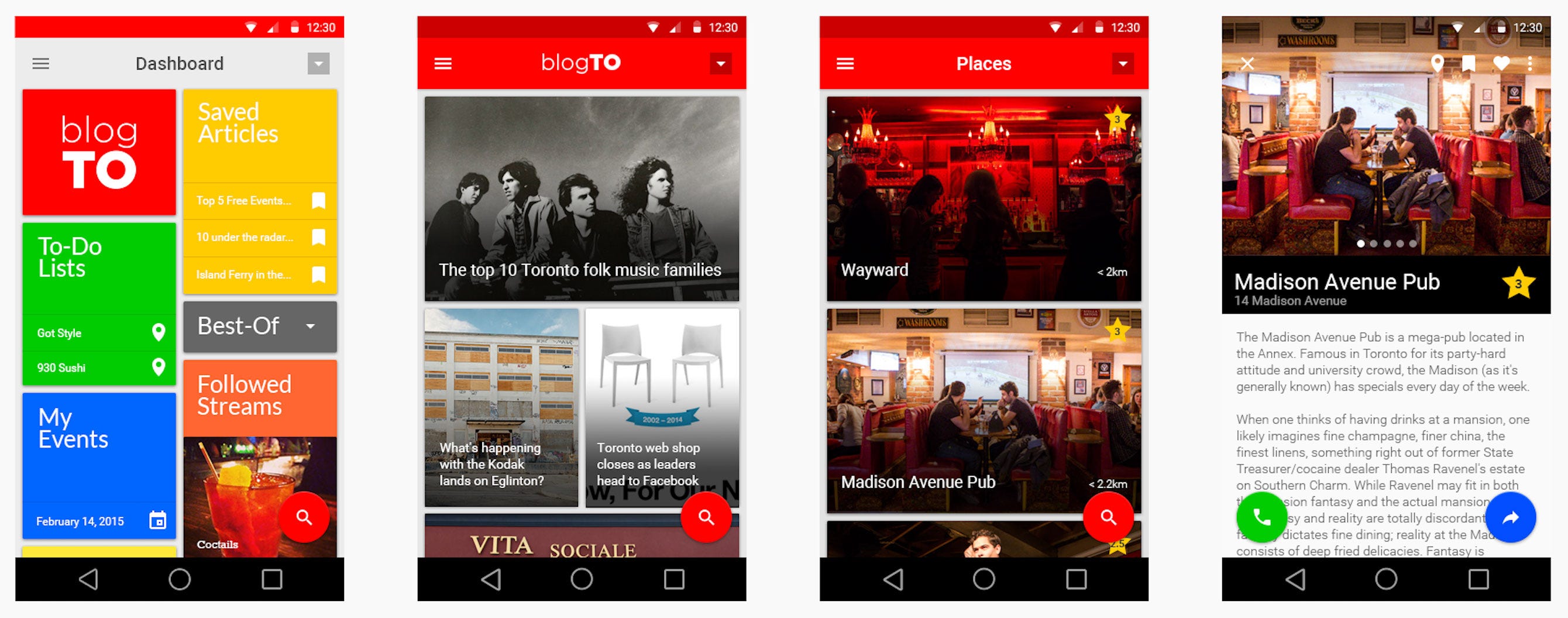
The Android app, meanwhile, remained on hold. Sleeklabs had completed the Toronto Food Trucks Android app, but the main blogTO project still needed a fresh start. So much time had passed that replicating the existing iPhone app no longer made sense, especially since the iPhone version itself now needed a major update to match the new website design. The readers who had been emailing us about it for years would have to wait a little longer.
The new website represented the end of a chapter that had started with the Playground redesign years earlier. We had spent money, made mistakes, started over, and finally built something we were proud of. The site now had a cohesive design, a responsive layout, a powerful custom CMS, and an infrastructure capable of supporting the growth that would soon come.
In a future post, I’ll get into how we built out our video operations across Facebook and Instagram, and the role that video content was starting to play in our next phase of growth. But before I do that, I want to circle back to a story I started telling earlier in this series: what happened to Midnight Poutine.
Took a small hiatus but I’m back and loving it! Is there a documentary in the works?