


On August 15, 2005, about eight months after blogTO launched in Toronto, we went live with a sister site on the other side of the country. Beyond Robson was our Vancouver blog.
The team I assembled was small but enthusiastic. Ariadna Peretz, the site’s first Managing Editor, brought a group of contributors: Degan Beley, Fainne Martin, Leann Prain, Richard Murray, Rowan Lipkovits, Sean Orr, and statusq. Together, they wrote a site description that captured its spirit: “Beyond Robson is about the obscure and obvious of Vancouver. You’ll find information on everything that affects the citizens of this city, be it the next demonstration, the latest fashion event or the least comfortable park bench.”
Statusq posted first, recounting his experience at a beginner-friendly triathlon. Other early posts included a sushi restaurant roundup, a Pearl Jam concert review, a guide to running in Stanley Park, coverage of SWARM (Vancouver’s annual gallery hop), and an update on safe injection sites.
One early contribution to the music section opened with the words “Hot Loins” repeated more than 80 times, followed by a link to a MySpace page.
Like the other Freshdaily sites, we curated a sidebar full of links we called “Useful Stuff,” pointing readers to everything from the Anti-Poverty Committee and BC Ferries to the David Suzuki Foundation. We linked out to local media outlets such as The Province, Vancouver Magazine, The Westender, and Adbusters, and listed arts and culture organizations, including the Playhouse Theatre Company and the Vancouver Folk Festival. There was a blogroll linking to dozens of the city’s most popular blogs, including Darren Barefoot, Kris Krug, and Van Ramblings. The site’s sections were leaner than those on blogTO or Midnight Poutine: Arts & Film, Eat & Drink, Fashion & Style, Music, City, and Weather.
From the start, Beyond Robson had the same features and functionality as the other Freshdaily sites and quickly developed a lively community of commenters, Flickr pool participants and readers who regularly sent in tips, suggestions and feedback. The local blog community noticed right away. One person called Beyond Robson a “halfway decent looking Vancouver blog” with a layout that left “almost everything to be desired.” We took what we could get.
The opportunity in Vancouver was the same as it was in every other Canadian city at the time. The local digital media space was wide open. The incumbents, primarily The Georgia Straight, weren’t paying much attention to the internet. And readers were actively seeking out blogs and websites for local news, culture and information.
Unlike Toronto, there wasn’t any meaningful digital competition when we launched. The most popular local blog was likely Miss 604, a one-woman operation run by Rebecca Bollwitt. The site is still around today, and in 2025, Bollwitt received a well-deserved Award of Excellence from the City of Vancouver for her contribution to the city’s arts and culture. There was also The Tyee, a website founded by former Vancouver Sun journalist David Beers that had pioneered a non-traditional funding model years before non-profit-funded digital journalism became more commonplace. We didn’t view The Tyee as competition. Its scope was broader, its tone drier and more traditional, and its focus was on longer-form investigative reporting.
It wasn’t until 2008, three years after our launch, that Beyond Robson got any real digital media competition when Bob Kronbauer founded Vancouver is Awesome.
Ariadna did an admirable job running the site day-to-day with the tools and resources available to her. She recruited new contributors, managed the team, ran meetings and was my primary point of contact for everything from editorial feedback and traffic stats to design updates and technical issues. She stepped down at the end of 2006, and Sean Orr and Peter Pimental took over as co-editors.
By that point, Beyond Robson was pulling in about 40,000 page views a month, roughly a third of blogTO’s numbers. Revenue was negligible, mostly from Google AdSense, though Beyond Robson would soon be included in the largest Freshdaily network advertising deal to date, a campaign for the launch of the Mini R56. Like Midnight Poutine, the fundamental problem was audience size. We simply didn’t have enough readers to attract advertisers. I told the team we needed to reach at least 100,000 monthly page views in the near term, and well past a million within a few years, if we were going to generate meaningful revenue.
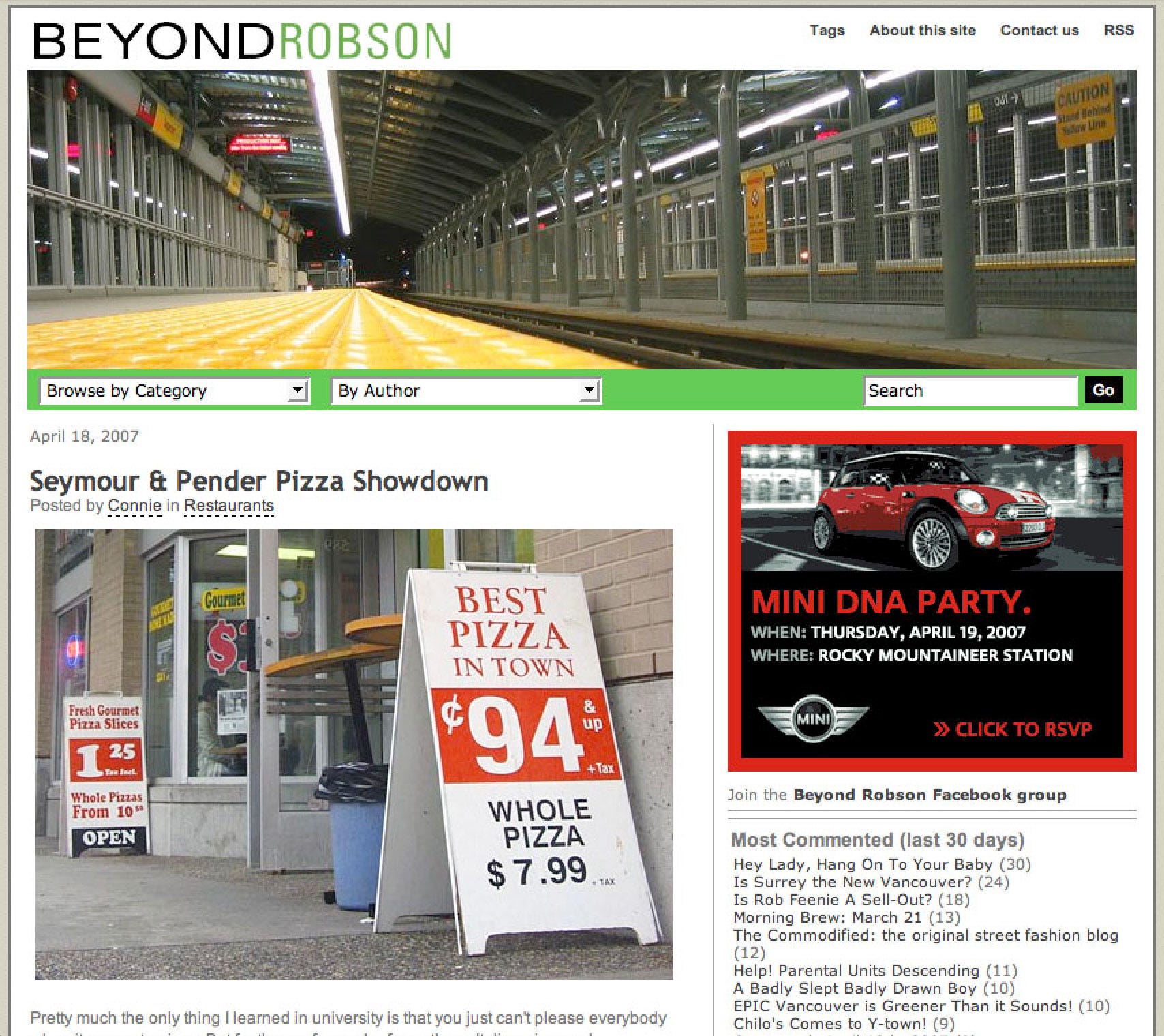
Before the end of 2006, we refreshed the website with a new logo and design, mirroring the same template updates we’d rolled out on blogTO and Midnight Poutine. A year after that, we updated it again, leveraging the Web 2.0 design and development being pushed out from Toronto to all the Freshdaily sites.
The previously generic Beyond Robson logo was replaced with one featuring a darker green, bolder typography, and a mark that combined a bird with the letter B.
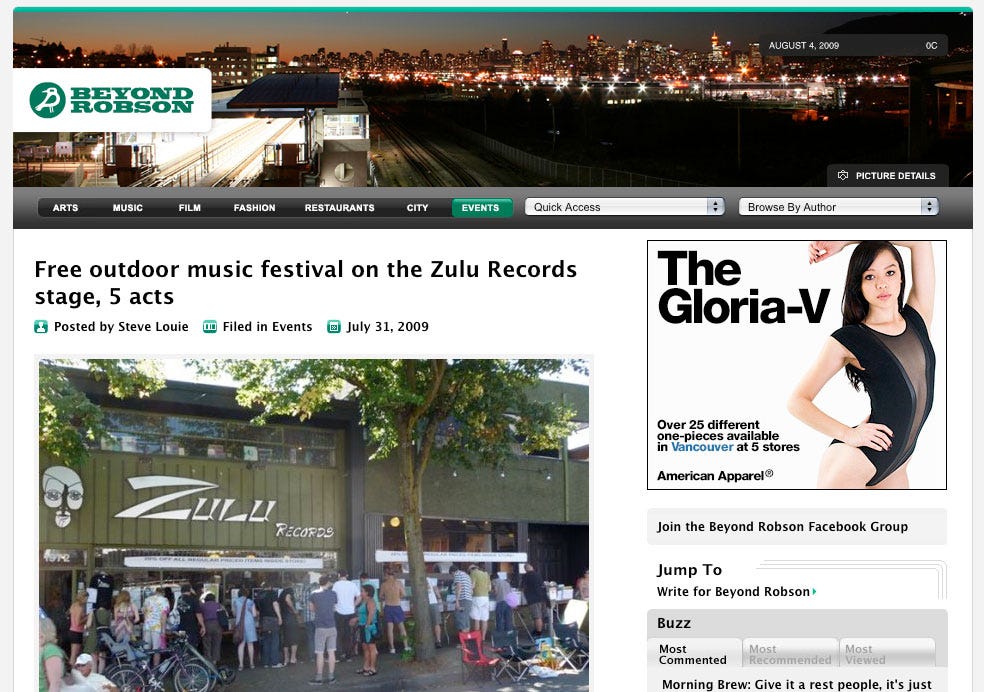
We expanded the Filmmakers section, sponsored by Sony, added movie showtimes and trailers for a short time, rolled out a more robust events section and launched new directory sections for restaurants, bars and local businesses.
In 2007, we surveyed our readers. The response was encouraging in some ways and sobering in others. People genuinely liked what Beyond Robson was doing, but they wanted more of it, more frequently, across a wider range of topics.
Contributors evolved over the years. Ami Sanyal, Duran Cheung, Kristin Cheung, Jon Hilderman, Jenn Perutka, Steve Louie, Ryan Weal, Amanda Henry, Jake Tobin Garrett, Chelsea Johnston, Jenn Laidlaw, Melody Fury, Skot Nelson and J.Z. Garrod were some of those involved. I’m grateful to everyone who gave their time to Beyond Robson.
The compensation model mirrored the other sites. We used the same points system, which eventually evolved into a flat rate of $10 per post with bonuses based on page views. If a post hit 5,000 views, the writer earned $50. If it hit 10,000, it was $100.
Despite the low pay and the fact that every contributor had a full-time job or studies in addition to Beyond Robson, we ran into an unexpected problem: some people were writing too much. We were getting almost magazine-style submissions running thousands of words. I introduced a 500-word limit and asked the editors to enforce it, with exceptions for restaurant and store reviews, listicles, event previews, concert round-ups we called “Hot Ticket” posts and the Morning Brew.
Like blogTO, we gradually introduced more structure, tracked analytics more closely and leaned into SEO. Over time, we figured out what worked: listicles, coverage of major festivals and events, local news, posts about development and gentrification, and food content. The strategy I pushed was straightforward. We needed two types of posts: ones that would spark conversation and drive traffic the day they went up, and ones with staying power, like restaurant coverage and listicles, that would keep pulling in readers for months. I asked the team to stop spending time on topics that our data showed weren’t connecting with readers.
The data also made clear that a small number of star performers were carrying the site. These were the writers who posted consistently, whose work was well-formatted and whose posts routinely met or exceeded traffic targets. The majority of contributors struggled with consistency, had recurring issues with formatting or photos, or both.
Of all the contributors, Sean Orr stood out. He was getting a wide following for the Morning Brew, Beyond Robson’s equivalent of the recurring news round-up that had become a staple on blogTO. Alongside his curated links to local news stories, Sean added sharp, sometimes blistering, commentary. In a July 2008 post, next to a link from the newspaper 24 Hours with the headline “Tattoos aren’t just for bikers, inmates and rock stars anymore,” Sean wrote: “You’ve got to be kidding me. How many times has this article been written? SARAH ROWLAND YOU ARE THE WORST FUCKING WRITER EVER.”
This kind of thing did not go unnoticed. The Georgia Straight once took aim at Sean in a blog post, after he’d been openly critical of their coverage of Vancouver in his Morning Brew round-ups. Their response was to call him bitter and extend an invitation to join their “now defunct Bitter Lactose-Intolerant Asian Youth Group,” despite the fact that Sean wasn’t Asian and they weren’t sure if he was lactose intolerant.
Sean’s career took an interesting turn after Beyond Robson. In April 2025, he was elected to the Vancouver City Council. Earlier this year, he filed a defamation suit against Vancouver Mayor Ken Sim after Sim publicly accused him of distributing illegal drugs on Christmas Day. The guy who used to write all-caps takedowns of local journalists in the Morning Brew now sits at the table where Vancouver’s civic policy gets made.
By 2008, the Beyond Robson team had begun hosting concerts featuring local indie bands. A show that November featured The Bicycles, Hot Panda, The Clips and Gang Violence at DiMetric Studios on East Pender. Tickets were $10. These events were a bright spot. They connected the brand to the community in a tangible way and reminded everyone involved that there was something real behind the website.

In early 2009, I flew to Vancouver to meet with the team in person. We gathered at Salt, a restaurant in Gastown. It was an energizing meeting. The team felt that we’d built a strong foundation over the previous years and that there was still a massive opportunity for Beyond Robson to become Vancouver’s go-to destination for local news and culture. The alt-weeklies still hadn’t made any serious moves in the digital space, and there were no dominant digital-native competitors.
The optimism was real, but so were the cracks forming behind the scenes.
At some point, Kat Braybrooke took over as Managing Editor and held the role until the summer of 2010. Kat was enthusiastic, capable and effective. Traffic doubled while she was running things. But the volume of work was more than any one person could handle, given the compensation we were offering. She repeatedly asked for detailed style and formatting guides for each type of post we published, and I didn’t provide anything adequate. Instead, I sent emails to the team with formatting corrections and SEO tips, when what they needed was comprehensive documentation, structured onboarding, and real training.
The fact that we were on opposite sides of the country didn’t help. If we’d been working together in an office, things would have been far simpler. But we weren’t, and the communication gap was real.
When Kat left, she went back to school to continue her studies. Jordan Petryk, who had been Associate Editor under her, stayed on briefly but was also stretched thin, holding down a part-time job and taking seven courses in his final year of university. At one point, he wrote to tell me it had been “hell” trying to balance his duties at Beyond Robson with everything else.
We tried reorganizing around section editors rather than a single Managing Editor, but the budget wasn’t there to pay them what the work warranted. The events section alone was becoming unmanageable, with hundreds of submissions pouring in every week and not enough people to moderate them. The traffic numbers were encouraging but insufficient. Monthly page views had finally surpassed 100,000. It was real growth, but still nowhere near enough to sustain the site financially.
And then there were the technical headaches. Beyond Robson was plagued by the same problems we had on blogTO, nearly all of them rooted in the aging Movable Type CMS. At one point, the photo upload function broke entirely, forcing us to run posts without images. Comment moderation remained an unsolved problem. After Kat left, I took over recruiting new writers myself.
I also finally put together the proper onboarding materials. New contributors now had access to a wiki with resources and background on the site, along with editorial guidelines, SEO best practices, photo standards, instructions for navigating our CMS and advice on writing headlines. It was years overdue.
But the structural problems were getting worse.
The entire model behind Beyond Robson and Midnight Poutine was built on a simple premise: develop something in Toronto, then push it out to the other cities. New designs, features and tools would flow from blogTO to Vancouver and Montreal. In theory, this was efficient and scalable. In practice, the technical problems piling up in Toronto turned this approach from an advantage into a burden. Designs sat finished but never went live. Features were built, but couldn’t be deployed. The pipeline that was supposed to accelerate the other sites ended up starving them.
Meanwhile, blogTO was consuming nearly all of my attention. It was the largest of the three sites by a wide margin, with the most traction among both readers and advertisers. With limited time and resources, I felt I had no real choice but to prioritize what blogTO needed, even if that meant sacrificing the vision I’d had for the Freshdaily network and the potential of Beyond Robson.
I wasn’t able to give Beyond Robson the attention and resources it needed and deserved. The execution of the Freshdaily strategy wasn’t good enough. That’s on me.
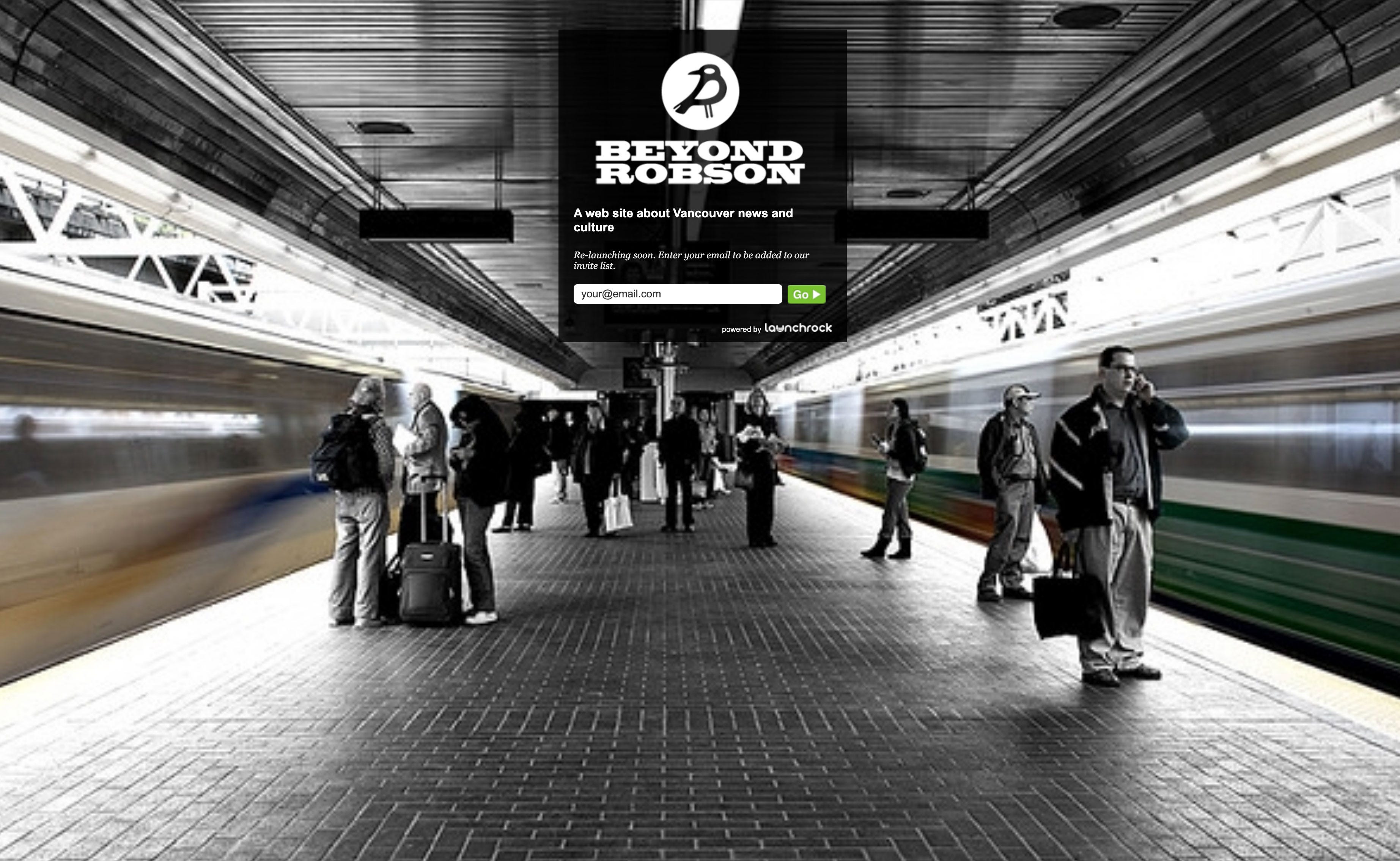
In 2011, I decided to put Beyond Robson on hold while we worked through the technical issues in Toronto. The plan was to come back with better tools, a stronger infrastructure and the time to do it right. I replaced the website with a splash page that invited readers to leave their email addresses so we could notify them when Beyond Robson relaunched. I reached out to our contributors, thanked them and told them I’d be in touch within a month or two.
I believed it at the time.
It never happened.
In July 2011, someone wrote to ask if we actually had plans to bring the site back. If not, they said, they’d be interested in acquiring it. I didn’t respond to their email.
The failure in Vancouver stayed with me. The opportunity had been real. The demand for a site like Beyond Robson was there. And the fact that we hadn’t been able to capitalize on it was entirely on me. I had let the team down. I had let the readers and the community down.
After Beyond Robson went dark, other Vancouver sites stepped in and captured the audience we had been trying to build. The biggest winner was VanCity Buzz, which had launched in 2008 alongside Vancouver is Awesome. VanCity Buzz grew rapidly, particularly in 2010 when the Winter Olympics created a surge of local enthusiasm that their team rode to a major spike in traffic. They later rebranded as Daily Hive, expanded into other Canadian cities and were acquired by ZoomerMedia in September 2022 for $16.4 million. That was eight months after ZoomerMedia had bought blogTO.
We held onto the beyondrobson.com domain for years. When ZoomerMedia acquired blogTO, the domain transferred along with the other assets under the parent company, Freshdaily Inc. At some point, ZoomerMedia appears to have let the registration lapse. If you visit beyondrobson.com today, you’ll find something called the Beyond Vancouver travel guide.
In 2013, Scout Magazine included Beyond Robson in its Vancouver Lexicon, defining it as “a now defunct Vancouver website (run from Toronto) that tried to tackle life in Vancouver through the prism of twenty-somethings. Also, an expression of irony calling out bourgeois, juvenile enthusiasms.” They included a usage example: “That gallery opening was so Beyond Robson...”
I can think of worse ways to be remembered.
In the next post, I will circle back to blogTO in Toronto. It was the fall of 2011, and we were about to move into our first real office space.