


The idea to expand beyond Toronto was there from the start. If this model worked in one Canadian city, it could work in others. Gothamist was already proving this in the United States, expanding from New York into LA, Chicago, and San Francisco. But nobody was doing it in Canada. Outside of Toronto, there wasn’t a single digital publication trying to cover a Canadian city the way blogTO and Torontoist were starting to cover Toronto.
Montreal was always part of the plan. I’d spent four years there as a student at McGill, my father had grown up in the city, and a lot of his family still lived there. I had a connection to Montreal that went beyond opportunity.
In August 2005, the same day we launched Beyond Robson in Vancouver, I reached out to two friends from university who were still in Montreal. John MacFarlane and Hannah Hoag had both gone into journalism after McGill. They were both immediately interested and brought along a mutual friend, Sara Falconer, to round out the founding editorial team.
A few name options were floated, but Midnight Poutine stuck. Sara’s reasoning was simple: it was “something we all eat way too much of.”
To connect the publications, I created a brand called Freshdaily. The sites would be sold together as a bundle to national advertisers looking to reach audiences in Toronto, Montreal and Vancouver simultaneously. The sites would share a CMS, design and development teams, meaning certain functions would be centralized, which would, in theory, create efficiencies. Documents such as media kits and guidelines would be created once for blogTO and then adapted for the other cities. New features could be tested in one market before rolling out to the others.
The only thing that wouldn’t be centralized was editorial. Each site would have its own team of editors and contributors, all of whom lived in the city they were covering. I understood even then that you couldn’t build a credible local publication with writers based elsewhere. This seems like an obvious point, but in the years that followed, plenty of sites tried exactly that. It never worked.
Midnight Poutine launched on September 28, 2005, timed to coincide with that year’s POP Montreal festival. Coverage of the indie music scene would become a defining part of the site’s identity over the coming years.
Aside from John, Hannah and Sara, the initial team consisted of Andrea Allen, Ange-Aimee Woods, Anna Lambton, Cat Macpherson, Omer Rashid, Dave Hill, Drew Daniels, Francois-Xavier Tremblay, Josh Dobbs, Kate Irvine, Mike Irvine, Matt Silver, Mog Hewings, Robyn Fadden, Roxanne Arseneault, and Shawn Petsche.
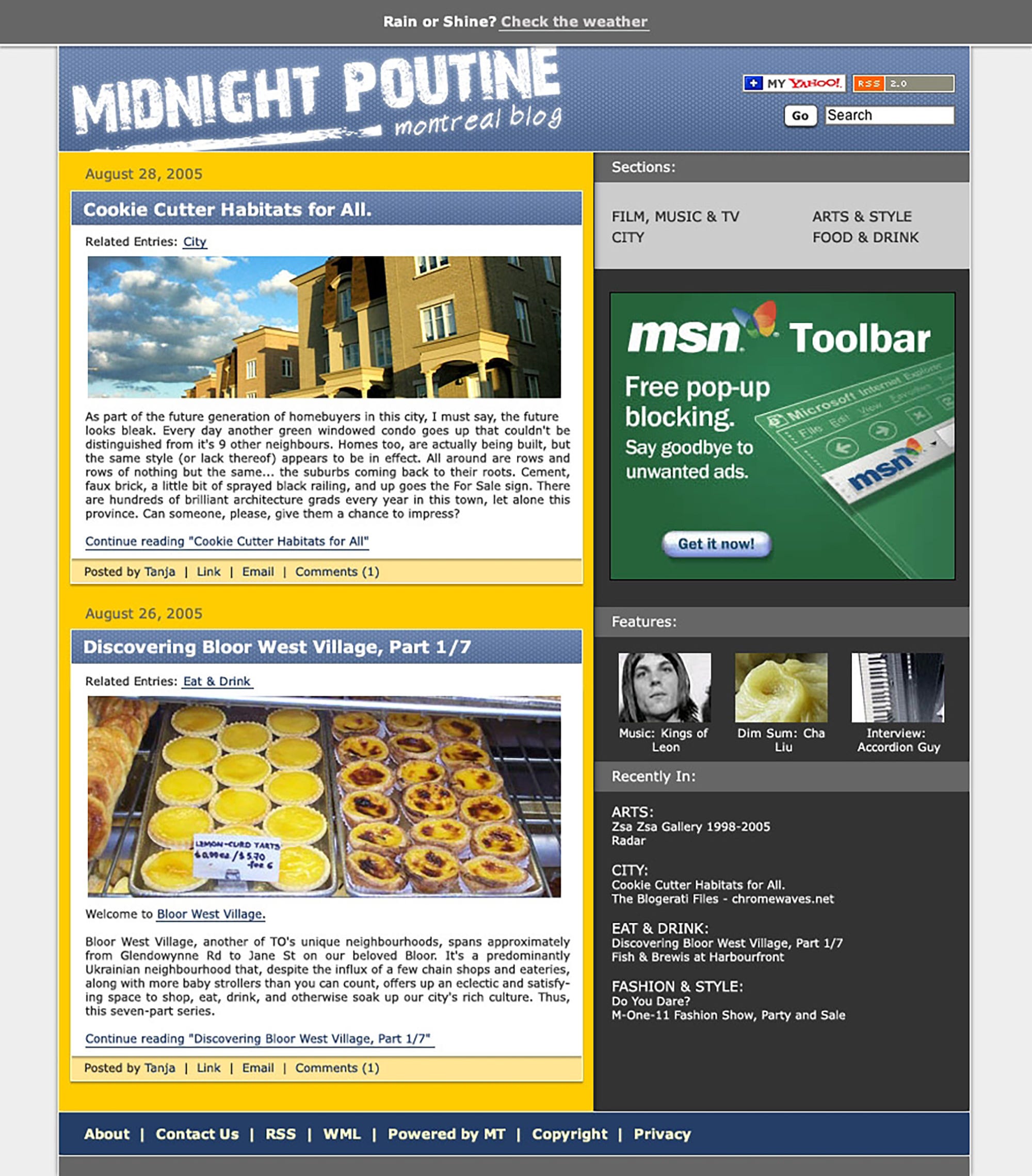
Petar Stoilov, who had designed the blogTO logo, created the original look for the Montreal website: dark blue text on a yellow background. The CMS gave us the flexibility to define unique content sections, so Midnight Poutine launched with categories such as Celebrity, Sex, Chips, and Science & Health, alongside the usual Music, Arts, Film, Fashion, and Food.
John knew many young English-speaking writers in Montreal, many of them aspiring journalists looking for a place to publish. He attracted a roster of hungry, talented people eager to get their names on bylines. Getting published in the city’s established media outlets, such as the Montreal Gazette, The Mirror, and Hour Magazine, was difficult. Midnight Poutine offered something those publications couldn’t: you could write something and see it online immediately, with your name on it.
What struck me about the early writing was how much personality it had. One contributor reviewed a cafe located above a funeral home on Saint-Laurent, reporting that the coffee had “an eerily toasty roast” and was served at a temperature she described as “a wee bit post-mortem.” She was charmed by the place despite the watery lattes.
The site’s sex column was introduced by a writer whose only self-described credential was that he knew roughly a hundred people he cheerfully described as “slutty”, and because he stayed out of the fray himself, they all told him their stories.
A recurring series called First Dates reviewed Montreal restaurants through the lens of whether you’d want to take a date there, combining practical food criticism with the anxiety of first impressions.
And then there was Metro Roulette, the site’s most popular recurring feature, where contributors picked a metro station at random and spent the day exploring the surrounding neighbourhood.
John once visited the Préfontaine station in Hochelaga-Maisonneuve, discovering breast-shaped ashtrays in a head shop, a storefront for a certified clown service, and what he was confident was a top-five all-time poutine at a greasy spoon called Davidson Lunch that had been serving the neighbourhood since 1954. The series was an excuse to wander, eat, and pay attention, and it captured something essential about Montreal: a city of wildly distinct neighbourhoods that rewarded curiosity.
This was the kind of writing that made people love Midnight Poutine. It was funny, specific, and unmistakably Montreal.
Like blogTO, the Midnight Poutine editors organized team meetings and social gatherings. They’d send me an invoice for the food and drinks, which I’d cover, along with meeting notes, questions and action items.
Some of the early contributors went on to notable careers. Asmaa Malik is now head of the Journalism Program at Toronto Metropolitan University. Susan Krashinsky Robertson is a reporter at The Globe & Mail. Hannah became a prominent science journalist and now holds a senior role at the CBC. John also worked at the CBC, served as editor at MTL Blog, and is now a Senior Reporter at Yahoo Finance.
John started the site’s podcast, and when Jeremy Morris took it over, he transformed it into the music show it became: the Midnight Poutine Weekend Playlist. Jeremy was a PhD student in communications at McGill who had been contributing written roundups of upcoming shows. He started stringing together songs from bands playing small Montreal venues, added his own voice between the tracks, and a format was born. About an hour of music each week, with Jeremy talking about the artists and where to see them live.
Jeremy eventually became the site’s Music Editor and then Managing Editor. Sara left at the end of 2006. Hannah and John departed the following year. Jeremy kept the podcast going, often by himself, eventually bringing in co-hosts. The show ran for over 300 episodes. He later wrote a book about podcasting and is now a professor of Media and Cultural Studies at the University of Wisconsin-Madison. I loved listening to the podcast from my apartment in Toronto. It made me feel connected to a city I cared about but no longer lived in.
The podcast was a passion project. It never generated much revenue, and its audience, while devoted, never grew beyond a niche. But for the people who listened, it was a window into Montreal’s music scene that didn’t exist anywhere else.
About a year after launch, Midnight Poutine got a redesign from Jay Delmarr. He came up with a few logo concepts for us to choose from. One laid out the name horizontally in a dreamy, organic style.
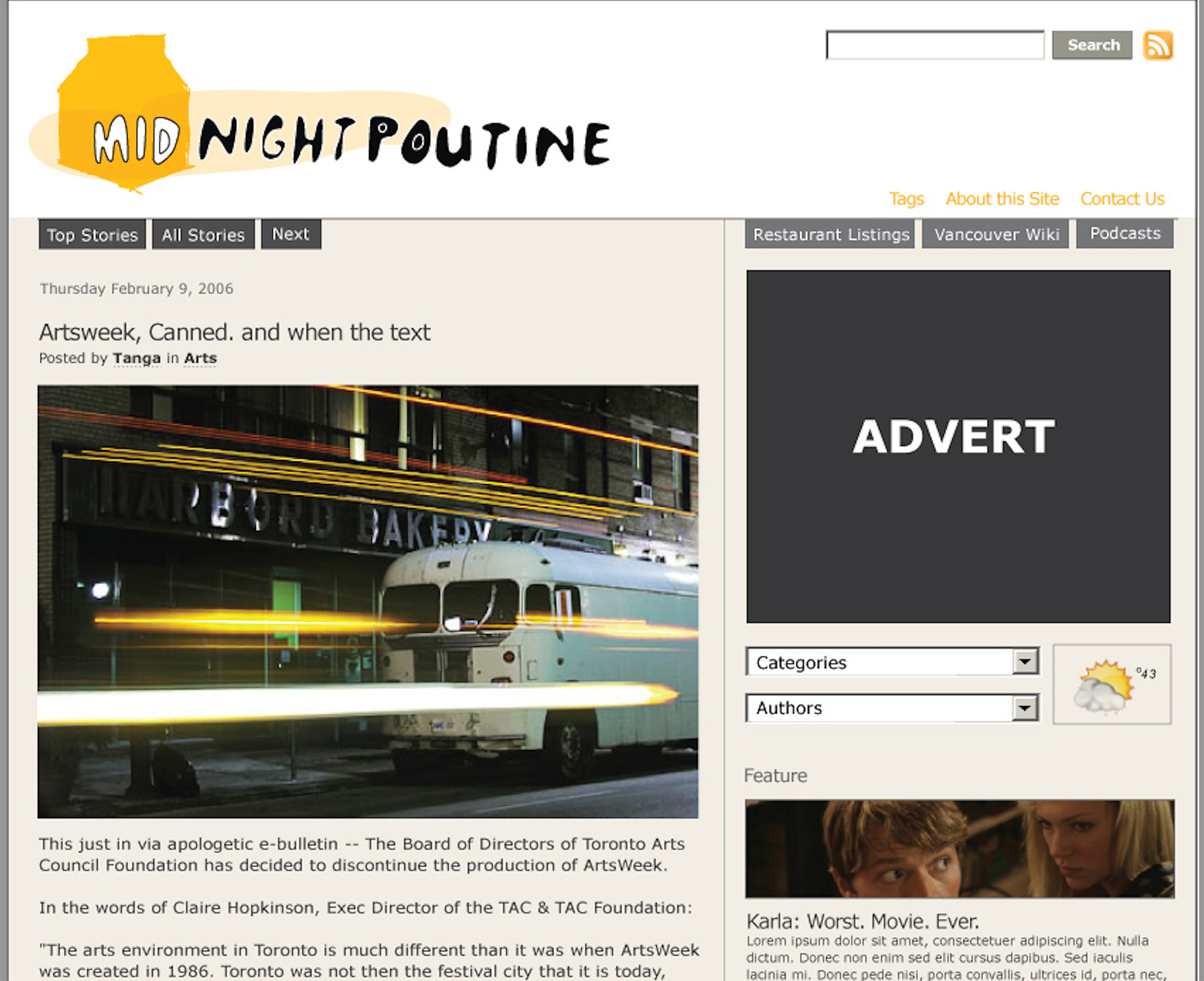
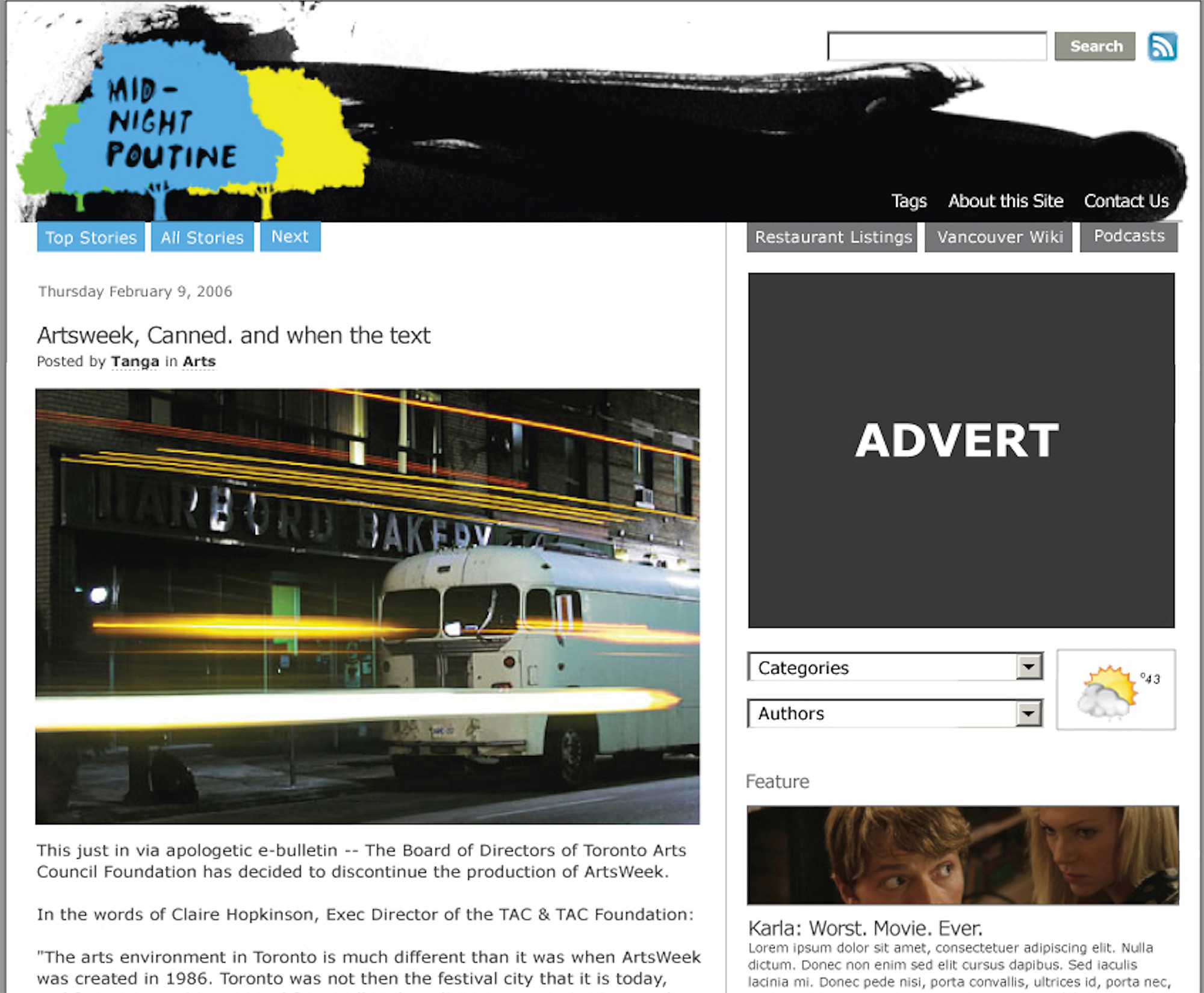
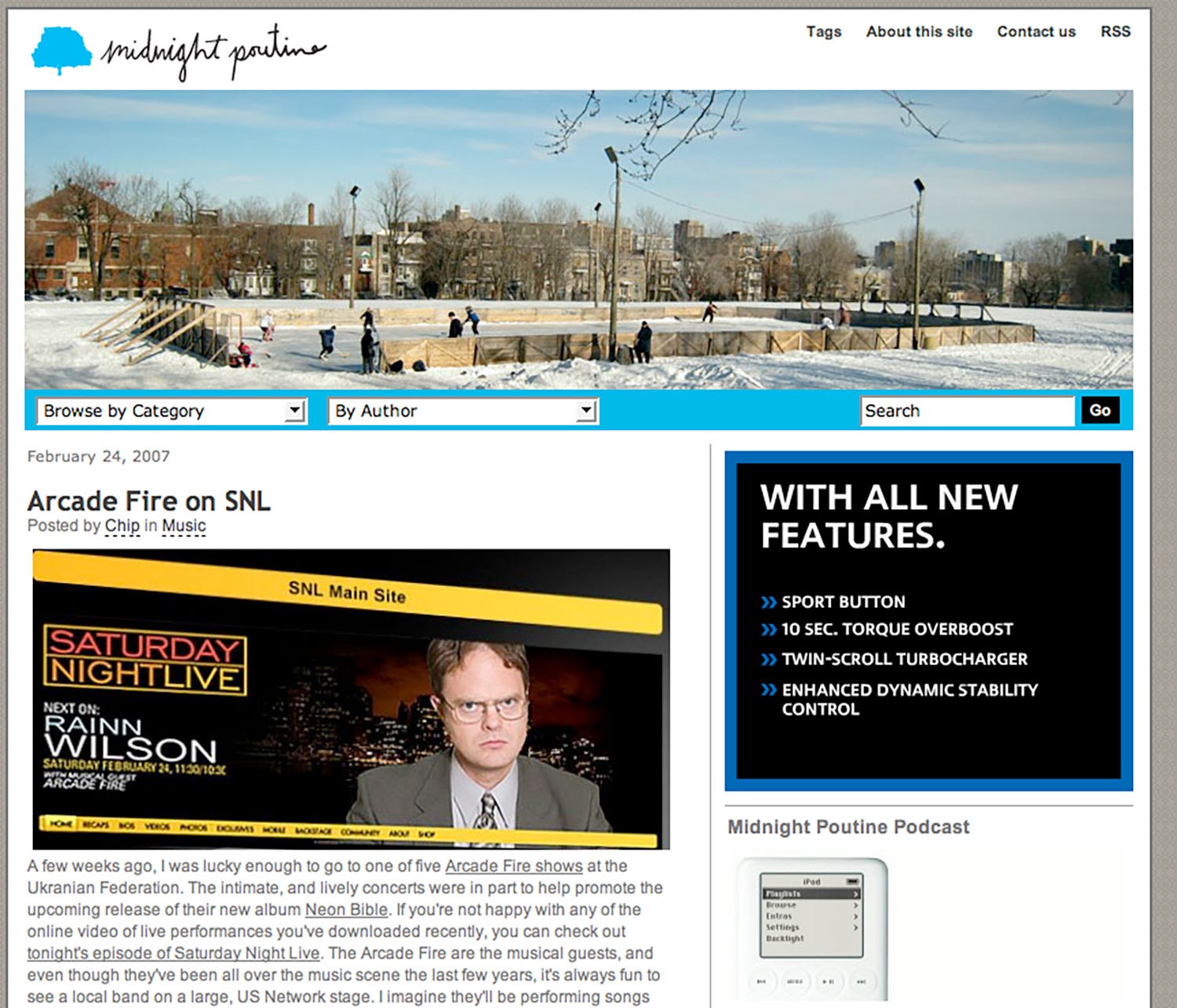
Another stacked the words vertically. We went with a third option: the site’s name in lowercase script alongside a blue tree, which, as best I recall, was a nod to the greenery that covered the city, particularly the trees on Mont Royal.
Despite the quality of the writing and the strength of the podcast, the numbers were a persistent challenge.
Midnight Poutine consistently generated the lowest traffic among the three Freshdaily sites. Posting frequency was inconsistent. Contributors would go quiet for stretches, pulled away by day jobs, personal issues, or the simple reality that there was no meaningful pay to keep them motivated over the long term. The incentives that seemed to mobilize the blogTO team in Toronto didn’t carry the same weight in Montreal. And unlike Toronto, I couldn’t fill gaps by producing content myself. I was in another city.
I wasn’t involved in Midnight Poutine’s editorial decisions. I left that to the team but read the site every day, reviewed stats weekly, and occasionally sent notes with feedback and insights. The team was receptive, but the fundamental problem was structural: everyone had a day job or was looking for one, their available time was limited, and the initial excitement that had drawn people to the project gradually wore off, especially as we introduced more guidelines and structure.
Montreal was also a challenging market for a reason unrelated to effort. Midnight Poutine was an English-language publication, and the English-speaking audience in Montreal was considerably smaller than in Toronto or Vancouver.
In November 2006, I laid out the situation plainly in an email to the editors. October traffic had been roughly 16,000 page views. November was tracking even lower. Daily visitors were fewer than 250. For context, blogTO was approaching 117,000 page views that same month. I told them our goal for blogTO was 1,000,000 page views per month by the end of 2007. Midnight Poutine was on a completely different trajectory.
The compensation model mirrored blogTO’s: revenue was shared with contributors. But with traffic this low, there was almost nothing to share. At one point, I calculated that even if we sold all our ad inventory for the entire year, we’d bring in only $6,000. The issue wasn’t finding advertisers willing to spend. It was that not many advertisers saw value in a site that got so few page views every month.
Despite the discouraging numbers, there were some early signs that the Freshdaily network model could work from an advertising perspective. I was starting to sell campaigns across all three sites as a bundle. American Apparel was one of the first bigger brands to buy in, though as I later discovered, they didn’t always pay their bills on time. I eventually had to write off some of the receivables when they filed for bankruptcy years later.
But the reality was that very little of this revenue trickled down to Midnight Poutine’s contributors because the site delivered so few of a national campaign’s overall impressions.
People genuinely liked the Midnight Poutine brand. They liked Metro Roulette, the music and arts coverage, and the Weekend Playlist podcast. But they wanted more from us. More frequent posts. Broader coverage. We still didn’t have enough of the content that was starting to drive traffic on blogTO, such as restaurant reviews and best-of posts. Indie music coverage served a niche audience and wasn’t an effective growth engine.
By the end of 2007, most of the initial team had moved on. The original content categories had been trimmed down. A smaller, younger crew was covering mostly music, arts, film and food. The challenges were compounding: audience growth, the limited English-language readership, the struggle to shift the content model toward something that could generate real traffic, retention problems as motivation waned, and ongoing technical headaches with the CMS. And my own time and resources were increasingly consumed by blogTO, which was setting new growth records every month.
Despite all of this, Midnight Poutine had something that numbers alone couldn’t capture. People in Montreal genuinely loved the site. The content was fun, interesting, and clearly a labour of love. The community understood what we were trying to do and appreciated it. As John told me recently, he thinks about the contrast between Midnight Poutine’s positive reputation and what eventually replaced it in the Montreal market. MTL Blog, which became the dominant English-language blog in the city a decade later, was, in his words, “despised for lots of good reasons” by the people who lived there.
I think about the people who built Midnight Poutine more than I think about the site itself. They gave their time to something they believed in, in a market that made success challenging. I wasn’t able to support them the way I wanted to or the way they deserved.
I’ll come back to what happened next with Midnight Poutine in a future post. But before I do that, I want to circle back to Toronto, where blogTO was about to go head-to-head against some well-funded competition.