


Navigate the Streets was winding down, and I was back in a cubicle. It was the summer of 2004, and I was working full-time at MacLaren McCann, one of Toronto’s biggest advertising agencies, as an Account Supervisor in their digital division. Online advertising was still in its infancy. The toolkit consisted primarily of banner ads, rich media, and paid search. Programmatic advertising and social media didn’t exist yet. Nobody knew yet what digital advertising would become.
I was assigned to a single client, one of the agency’s biggest: Microsoft. This was three years before the iPhone, and Microsoft owned the PC and office productivity software spaces. Apple was gaining momentum with the iPod and had launched retail stores, but was still tiny in comparison. But Apple was turning into a brand that resonated with consumers in ways Microsoft didn’t. We all told our client they should watch out for them. They laughed it off, dismissing them as a niche competitor.
Having decided not to continue with Navigate the Streets, I was looking for my next entrepreneurial thing. I knew I didn’t want to live the corporate life in the advertising world forever. Blogs had started to become big in the digital space. A lot of people used Blogger or LiveJournal for personal musings, but there was also a growing collection of professional blogs, part of a new wave of digital media companies.
I was inspired and influenced by what was happening in New York. Nick Denton had launched Gawker in 2002 and was building Gawker Media, a network of blogs covering gossip, technology, sports, and politics. Lockhart Steele had started Curbed, a real estate blog. Jason Calacanis was assembling Weblogs Inc., a portfolio of niche blogs he’d later sell to AOL. Jake Dobkin and Jen Chung launched Gothamist, a New York City blog, and had already started building a network of local sites with the same template and tone.
Blogs were becoming a significant part of my media diet. They were fun to read and less constrained than magazines and newspapers. The economics were different, too. You didn’t need printing presses or distribution trucks. You needed a blogging platform, a point of view, and enough passion and perseverance to keep going.
Toronto didn’t have anything like what was happening in New York. There were some smaller Toronto blogs that touched on the city. Marc Weisblott, a local journalist, had a blog called Better Living Centre. Rannie Turingan was a popular photoblogger who ran GTA Bloggers. But there was nothing with the scope or ambition to cover the city the way it deserved to be covered.
At the same time, traditional media in Toronto was pulling back from exactly the kind of coverage that made a city feel like a city. Both the Toronto Star and Globe & Mail had recently scaled back on Toronto lifestyle and culture coverage. They also weren’t doing much of anything online. And there was an obsession across news media with leading on negative stories: crime, murder, hard news. The Toronto I read about in newspapers didn’t reflect my day-to-day experience of actually living here, or what I felt most people around me cared about.
The alt-weeklies were a different story. Now Magazine and Eye Weekly were still the go-to publications for anyone who wanted to know what was happening in Toronto. They had event listings, restaurant reviews, arts coverage, film and music roundups, and nightlife. If you were a certain age and lived in Toronto, you picked up one or both of them every week. They were free, they were everywhere, and they had the audience and the advertisers that came with being the default source for local culture.
But they were also complacent. Both publications were making serious money from their print editions, which included thick classified sections and pages of personal and sex ads at the back. Their websites were afterthoughts. They published once a week. The internet was reshaping how people found and consumed local information, and Now and Eye didn’t seem to be paying attention.
I looked at all of this, and the opportunity seemed obvious. The blogs coming out of New York were proving the model. There was a gap in Toronto’s digital landscape. The alt-weeklies were sitting on their hands. More and more people were consuming content online. The blogging platforms had eliminated the barriers to entry. Someone was going to start a digital publication for Toronto.
I decided that someone would be me.
I chose Movable Type as our blogging platform because many of the most popular professional blogs were using it at the time. It turned out to be one of my first mistakes, and we’d eventually rip it out and replace it with a custom CMS, but in the fall of 2004, it seemed like the right call.
I needed a name and a team. I started reaching out to people in Toronto I respected who were doing interesting work at the intersection of culture and media. I invited them to the party room on the top floor of my condo building on Charlotte Street, in what was then known as Toronto’s Club District. The pitch was straightforward: there’s an obvious gap in Toronto’s digital media landscape, here’s what’s happening in New York, we should build something like this here.
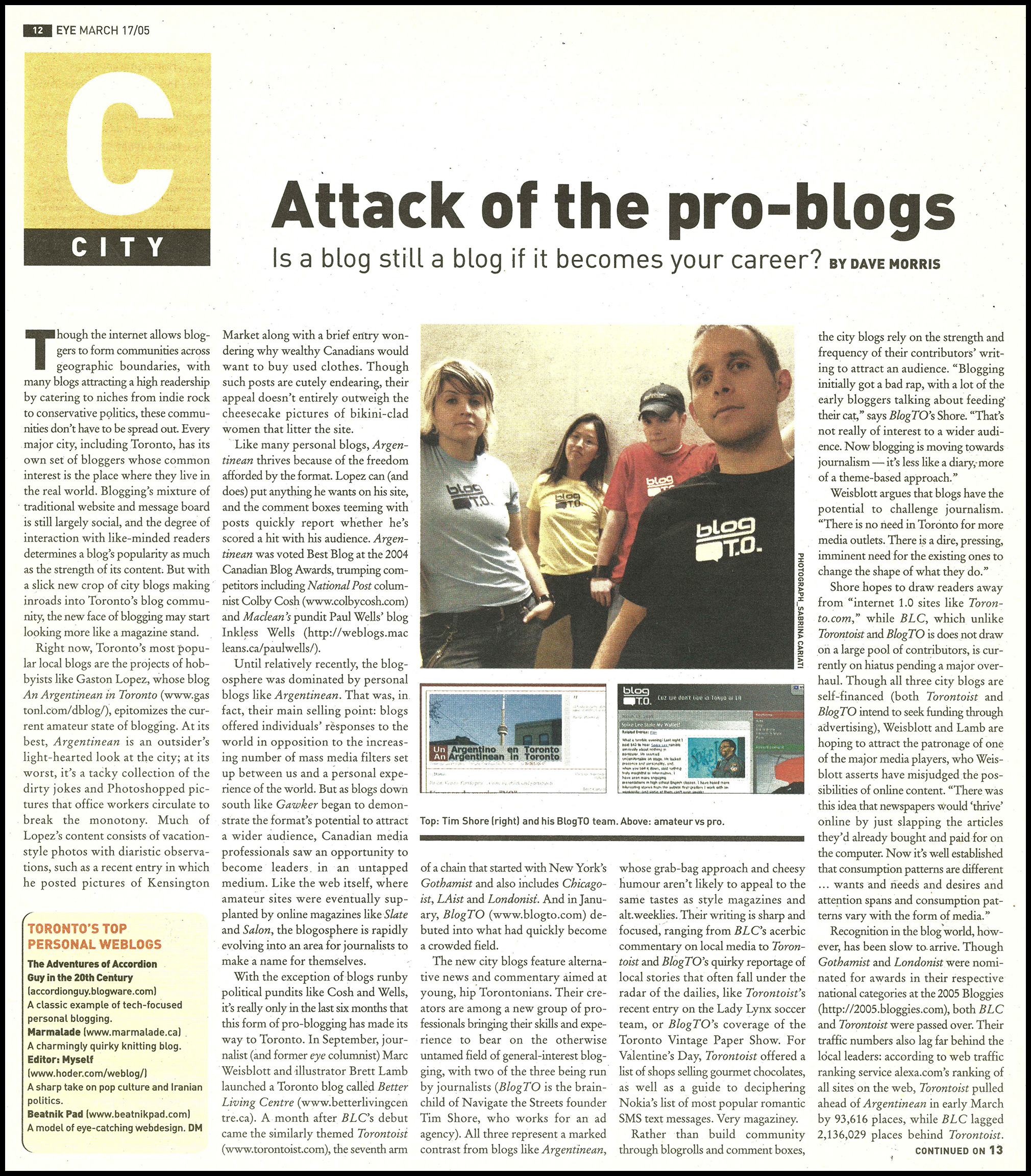
Everyone at the meeting recognized the opportunity. The problem was that most of them wanted to do their own thing. Matt Blackett and Shawn Micallef of the recently launched Spacing Magazine were there. I wanted them to join me, but they were committed to Spacing. I had some notoriety among this group for having won the best local blog award from Eye Weekly for Navigate the Streets, which was sort of a joke since it wasn’t really a blog about Toronto. But I worked in digital advertising and understood how the business model would need to function. That was my real credential.
We discussed names at the meeting. People liked blogTO, though I had reservations. Not because I thought blogs were a passing fad, but because I could see this growing into a larger media company and didn’t want the name to pigeonhole us as just a blog. But everyone liked the “TO” element. Toronto didn’t yet have the habit of appending TO to everything, as it does now, so it felt fresh. I think we can claim some credit for starting that trend.
Many talented web designers worked with me on the Microsoft account at MacLaren McCann. I asked two of them, Chris Halminen and Petar Stoilov, to help me with the design. Petar created the logo. Chris did the web design.

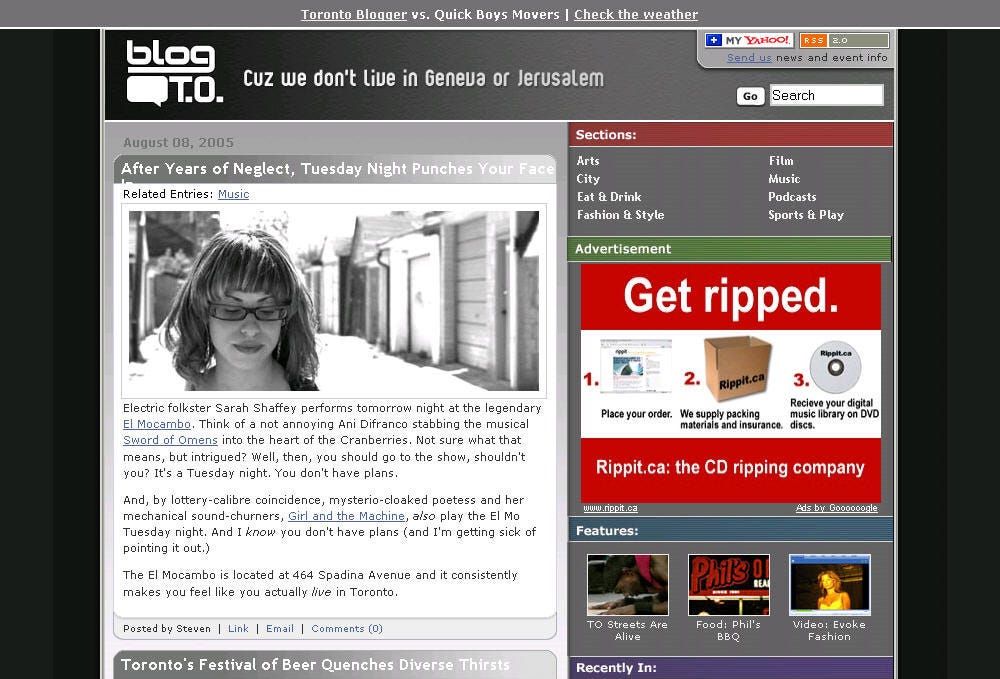
I don’t remember exactly what I paid them, but it wasn’t much. The first version of the site featured a white logo on a black-and-grey background. There were rotating taglines: “Cuz we don’t live in Tokyo or LA” and “Cuz we don’t live in Geneva or Jerusalem.” They were simple statements of intent. We wrote about Toronto because that’s what we knew and where we lived. We discontinued the taglines a year later.
Then, about a month before we were set to launch, I found out that Gothamist had expanded to Toronto with a site called Torontoist. Plans for blogTO were already well underway, so nothing changed. But it meant we’d have competition from day one.
I pressed ahead.
blogTO launched on December 13, 2004. The first post was written by Timothy Comeau and titled “Vs. at the Latvian House.” It was a review of a local film screening at 491 College Street. Not exactly the kind of thing that screams future media company, but it was a post, it was live, and the site was real.
Aside from Timothy and me, the initial team consisted of Christine Miguel, Darius Byrne, Deirdre Swain, Jennn Fusion, Justyna Lorenc, Lars Paronen, Matt Alexander, Paul Fler and Catherine Farquharson.
We had an RSS feed, because RSS readers were how serious internet users kept up with their favourite blogs in 2004. And we had a comment section on every article, which would turn out to be one of the biggest reasons people kept coming back.
The site was organized like the sections of an alt-weekly. Food, Arts, Music, Film, Fashion, Sports. We also had a section for Podcasts. In our first year, we launched a film podcast, an indie music podcast, and an arts podcast. There was a video section too, though it was rarely populated, just the occasional clip we’d shot at a local event on whatever camcorder model was popular at the time.
Our original crew was 10 contributors, each with their own beat, each doing this almost entirely as a passion project. There was no set posting frequency, no comprehensive style guidelines, no editorial standards document and no copy editing. Everyone had their own CMS login and published whenever they felt like it. Nobody, including me, ever knew what was going up on a given day. A post might appear at 9 a.m., 11 p.m., or not at all. It was chaotic in a way that would horrify anyone who’s ever run a real newsroom, but it also gave the site an energy that felt spontaneous and authentic. You never knew what you’d find when you visited blogTO, and neither did we.
It wasn’t until June 14th, six months after launch, that I posted something formally introducing our team and what we were doing. The description was deliberately loose: “blogTO is a blog about Toronto. We cover music, film, the arts, bars, restaurants, people, places and an assortment of random but hopefully interesting things happening in the city we call TO. This is a blog. We invite you to post comments, disagree with us, flatter us and otherwise tell us what you think.”
That last part was important. The comment sections became communities. People argued about restaurants, bands, and neighbourhoods. They had opinions about everything, wanted to share them, and argued with other people’s opinions. The comments gave the site a sense of life that the posts alone wouldn’t have.
Growing the team wasn’t difficult, which surprised me. We offered minimal to no pay at the beginning, and people still wanted in. The appeal was a combination of things. People wanted to belong to a community. They liked having a platform where they could write about whatever interested them without someone editing the personality out of their work. The site was growing fast enough that contributors could see their work being read and discussed. For some, blogTO was a stepping stone, a place to build a portfolio and a byline that might lead to better-paying work somewhere else. For others, it was just fun to be part of something that felt new and different, something the city hadn’t had before.
By the end of the first year, we were pulling in 28,000 unique users and 300,000 page views a month. We’d grown from 10 contributors to 18 and had added an event listings section. The roster included some people who’d go on to do unexpected things. Stephen Amell was one of our contributors. At the time, he was an aspiring actor living in Toronto. He later moved to Los Angeles and became well known for his role as Oliver Queen in the superhero series Arrow. Jenny Yuen was another early contributor who went on to become a respected reporter at the Toronto Sun. Tanja-Tiziana Burdi came on board as our first Managing Editor, giving the operation the structure it desperately needed.
Meanwhile, I was still at MacLaren McCann during the day, overseeing digital advertising campaigns for Microsoft, then came home to work on blogTO at night and on weekends. The site had a traditional media monetization strategy from launch. We ran advertising, aiming to grow the audience large enough to attract advertisers and deliver enough page views and impressions to make the model work. I understood this well because I was living it professionally. I spent my days managing digital campaigns for one of the world’s largest companies and working closely with the media-buying team on ad placements for clients that an agency like MacLaren McCann represented. In the evenings, I was trying to build the kind of site those same types of clients might eventually want to advertise on.
The challenge was that we needed scale, and scale takes time. You can’t sell meaningful advertising against a site that gets a few hundred visits a day.
In the early days, we used Google AdSense to backfill our unsold ad inventory. I still remember the day our first revenue cheque from Google arrived in the mail for $75.36. It wasn’t life-changing money, but it was proof the model could work. I took Bronwyn out for dinner to celebrate.
We still needed to grow. We needed more content, more contributors, and more reasons for people to come back every day instead of once a week. The alt-weeklies had spent decades building their audiences. We were trying to do it faster, bootstrapped on my own savings and pay cheques from my day job.
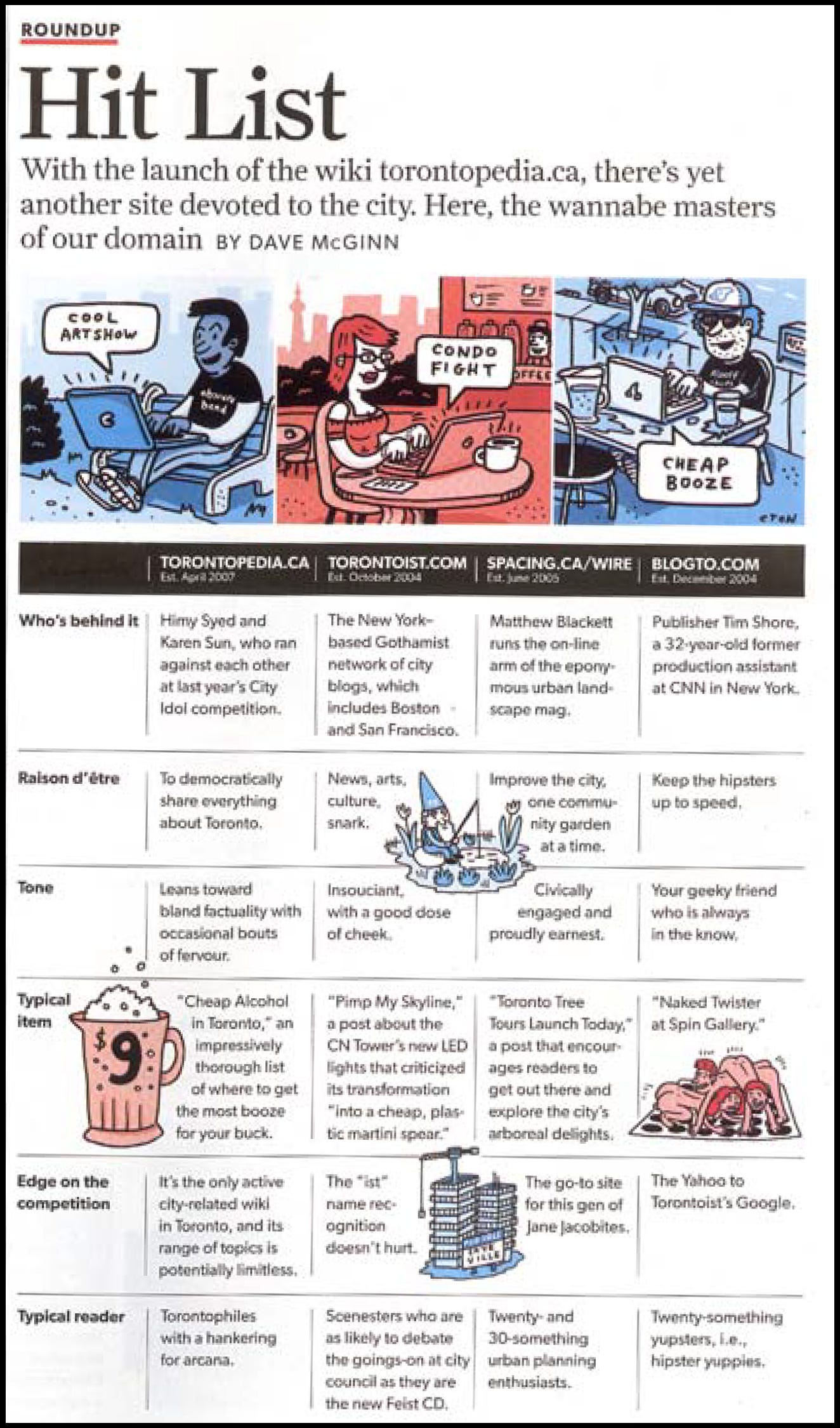
The competition with Torontoist was immediate. People in Toronto’s media and blogging circles quickly framed it as a rivalry. Readers chose sides. You were a blogTO reader or a Torontoist reader, the same way people were a Now reader or an Eye reader. It would take years for the outcome of that competition to become clear.
But Torontoist wasn’t what kept me up at night. Now Magazine and Eye Weekly were the real benchmarks. That’s where everyone in Toronto went for the kind of information we were producing: event listings, restaurant reviews, arts coverage, things to do this weekend. They had the readership and the advertising revenue, and we’d need both to turn blogTO into a real business. I knew there was an opening because I could see what they weren’t doing. They were committed to weekly print schedules while we published daily. They treated their websites as afterthoughts while the web was our entire existence. They were protecting a legacy business model while we had nothing to protect and everything to gain.
I wasn’t worried about the other digital competitors. They didn’t have the audience or the advertisers. The fight that mattered was against the incumbents, and the incumbents didn’t seem to realize they were in one.
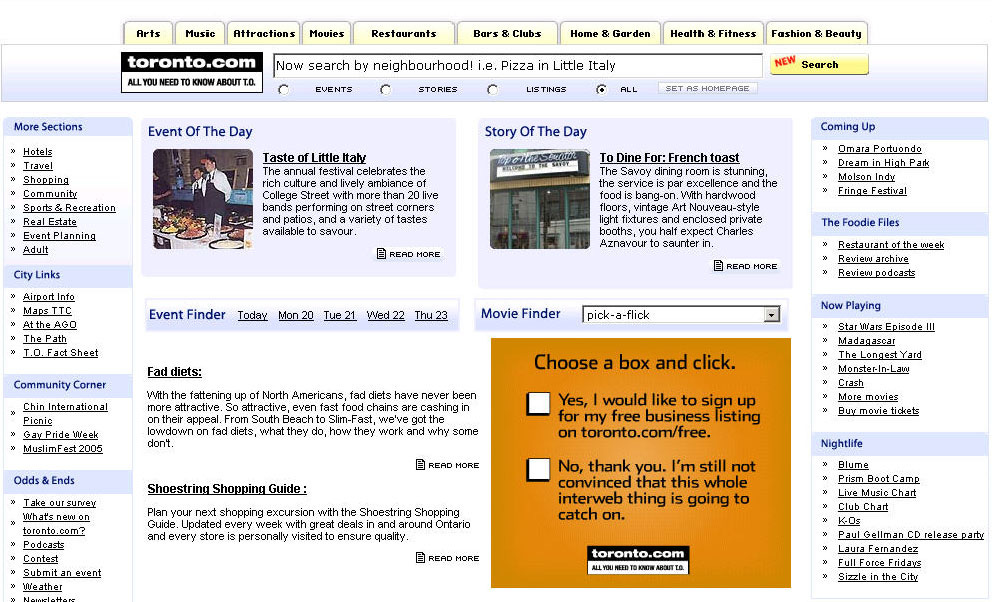
One day, a headhunter called. Torstar Digital was unhappy with Toronto.com’s performance and was looking for someone new to run it. Was I interested? I took the meeting. I listened. Then I told them I was going to stick with blogTO. I don’t think they saw blogTO as a serious competitor at that point. They certainly didn’t know I thought Toronto.com was a waste of a great domain, or that making it irrelevant was part of my plan.
On December 5, 2006, a package arrived in the mail from Now Magazine. Inside was a letter and a window decal congratulating blogTO on winning the Readers’ Choice Award for Toronto’s Best Blog.
I read the letter. Now Magazine, the publication whose audience and advertisers we were going after, was congratulating us.
By the end of the first year, blogTO was still small. Still scrappy. Still a side project I ran from my apartment while working a full-time job at an ad agency. We had a team of writers who genuinely loved Toronto and wanted to write about it. We had a comment section that people treated like a town square. We had a monetization model that I understood from my day job. And we had the single biggest advantage any upstart can have: the incumbents weren’t paying attention.
For now, it was enough to know that the thing I’d started in the party room of a condo building on Charlotte Street was becoming something real.
The irony of: “Eye didn’t seem to be paying attention”
Really loved this read Tim! As a former colleague at MacLaren McCann, I didn’t recall you started BlogTO in parallel. I love the chutzpah and fearlessness. Many would have backed down when hearing Torontoist launched or jumped at the security of a Toronto Star backed Toronto.com … you bet on yourself … and rightly so. Well done! P.s. Oscar is jonesing for some ping-pong!