


On May 25, 2019, blogTO posted its first video to TikTok. It was four seconds long and showed a crowd of Raptors fans at Jurassic Park outside Scotiabank Arena during the NBA playoffs. One of the fans was holding a giant cardboard cutout of Drake’s head. It got about 2,000 views.
It wasn’t much of a debut, but getting even that four-second clip posted had taken weeks of prodding. To explain why, I need to back up a bit.
By this point in blogTO’s history, we had long since abandoned the IRL events, printed neighbourhood maps, magazine and other non-digital initiatives we had flirted with in the early years. Now, we were focused on building blogTO as a digital media company, with the view that our future success depended entirely on whether we could lead in digital channels rather than in legacy ones.
But being a digital media company didn’t mean everything revolved around the website. We recognized early on we needed to diversify across multiple digital publishing and distribution channels so we could reach audiences where they spent time and avoid dependence on a single platform. Some of these channels supported the website. Some of them did not; instead, they ran in parallel with no expectation of driving traffic to blogto.com. The content we made for Instagram, for example, was native to Instagram. It was common for us to cover topics there that never appeared on the website, and we had no expectation that an Instagram follower would become a regular website visitor.
This was not conventional thinking at the time, particularly among legacy media, who seemed to see little point in investing in platforms unless they drove traffic back to their websites. For them, the website sat at the centre of their digital ecosystem. For us, it did not.
So I spent a good deal of my time paying attention to emerging platforms that were catching on with our core target audience of 20- to 35-year-olds, or those who would soon age into it.
One platform I kept hearing about was Musical.ly. I took notice when it hit the number one spot on the Apple App Store in the summer of 2015, and again when it sold itself to ByteDance for $1 billion two years later. The app was popular with teenagers, who, in a few years, would be in their twenties and squarely in blogTO’s target audience, but it was best known as a place where people showed off coordinated dance moves or lip-synced to music.
In the summer of 2018, the app was merged and rebranded as TikTok. By that fall, I was reading article after article about how TikTok was becoming the most popular video-sharing app in North America. Its users were still mostly teens, and there was no advertising in the app, but for me the strategy was clear. If this was where digital audiences were going, and video was becoming increasingly important to blogTO, we needed to be on TikTok. And we needed to get there before the opportunity became obvious to other Canadian media brands, none of which seemed to have any presence on the platform.
I remember the first time I brought the idea to the team. We were in one of our weekly meetings, reviewing stats from our recent videos and talking through the shoots planned for the coming weeks. I told them I thought we should expand to TikTok, that I had created a blogTO account, and that I’d like to see them post something that week. I left the choice of what to post up to them, and said we’d review the stats at the following week’s meeting and discuss what we learned.
The response to the directive was underwhelming. Nobody thought posting on TikTok was a great idea. Few on our team used the app themselves, and their perception was that it was a place for dance trends, not the kind of content that made sense for blogTO.
By the meeting the following week, there was still no TikTok video, so I brought it up again and encouraged them to post something that week. Another week went by. Still nothing. It took many weeks for that first video of Raptors fans outside Scotiabank Arena to finally go up.
But that wasn’t the end of the struggle. While we continued to post multiple videos a day to Instagram, Facebook and Twitter, our third video on TikTok, this one from the Raptors championship parade, didn’t materialize until nearly a month later. The first TikTok video featuring someone from our team on camera wasn’t posted until the end of July. It showed Deepa ripping open a spinach pie.
None of these videos got more than a few thousand views. We followed them with a series of food-related videos, but still nothing came anywhere close to the numbers we were seeing on other platforms until we posted footage of celebrities we spotted at TIFF that September. Our first video to surpass 500,000 views came from the World Poutine Eating Championship in October. And on November 23, a simple video we posted of someone making samosas at A-One Catering in Mississauga was our first to reach 1 million views.
It had taken six months of persuasion, posting and encouragement, but by late fall, TikTok was beginning to work. So we started hiring. We posted that we were looking for TikTok creators and applications poured in.
The Raptors run that supplied our first TikTok video was arguably the biggest story in the city that year. Toronto won the NBA championship in June, and everyone in the city was along for the ride. We devoted significant resources to covering the playoffs, the finals and the parade across all of our platforms. I remember being out on the street documenting the parade, where an estimated crowd of millions packed the route to Nathan Phillips Square. The parade went right by our office. People were hanging from trees and climbing on street signs to get a better view. The fake Kawhi Leonard and a Raptors fan who came to be known as Plant Guy were both just steps from our building’s front door.
The Raptors’ most memorable season coincided with another defining story from 2019. In February, a video went viral showing a young woman throwing a chair off the balcony of a downtown condo above the Gardiner Expressway. Police identified her as Marcella Zoia, and what followed was a story that kept producing new twists and turns all year: the memes, her expulsion from school, her court appearances, her guilty plea in November and her appearance courtside at a Raptors game days later. Lauren wrote most of our Chair Girl posts. The posts performed so well that we just kept following the story.
Not everyone approved. Over the course of the year, we were flooded with comments and emails complaining about the coverage. One reader wrote that we were “making these people famous” and that “she committed a serious crime and blogTO should take that seriously instead of showcasing her as a wannabe celebrity.” Another was convinced the posts had to be undisclosed sponsored content, because why else would we write about Chair Girl’s birthday?
The complaints were one data point, but the analytics told a different story. Readers had an insatiable appetite for the topic. We let analytics guide our decisions about which topics to pursue, and in this case the data was unambiguous: the story was generating significant views and engagement, so we kept covering it.
Cannabis was the year’s other recurring theme. Ontario’s first legal cannabis stores opened that spring, and the first one in Toronto drew a massive lineup. The city was soon filling up with both legal and illegal weed shops. It seemed like every day brought a new store opening, and that every neighbourhood had at least one per block, while the city struggled to shut down the illegal ones.
There was no shortage of things to cover, and the digital tools and analytics at our disposal made it easier than ever to home in on the topics that mattered to our audience. In doing so, we continued to phase out more of the content that had shaped blogTO in our first decade, including in-depth coverage of local music, arts, film and fashion. Our editorial resources were increasingly shifting toward what aligned well with the social media algorithms of the day.
Among them were topics that sparked outrage or tapped into hot-button issues, such as the rising cost of living in Toronto and the staggering increase in rent. Misha’s latest recurring column, Rental of the Week, was just one example of this. Her selections often shocked readers with just how bad Toronto’s rental options had become. One week, it was an East York basement whose “kitchen” amounted to a hot plate in the boiler room and a mini fridge shoved under a particleboard counter. Another week, it was a furnace room near the Junction marketed as a “funky micro studio,” with the building’s plumbing running through it. Posts like these made people question whether they still wanted to live in the city or should just pack up and move to Hamilton.
We were still doing all of this without a Managing Editor. As I wrote in my previous post, the search for Derek’s replacement was challenging, and the role wouldn’t be filled again until the fall of 2020. In the meantime, Lauren continued to step up. She was now managing a group of reporters we had started referring to as the news team, and that team grew considerably in 2019.
Mira Miller joined in the spring as a news reporter. Working alongside Lauren, she helped expand our coverage of breaking news and what we sometimes called social news, writing up whatever was trending or going viral, like the time someone filmed a bizarre standoff between a turkey and a motorcyclist.
Hannah Alberga came on that summer while completing her Master of Journalism at Ryerson. She mostly worked with Lauren and Mira on news, but also dipped into other topics, covering everything from a Ford Fest in Etobicoke to a traffic box painted as an optical illusion to massive lineups at the first-ever Tim Hortons innovation cafe.
Olivia Levesque also covered news for us as a freelancer, writing up stories like a woman being charged after a viral video showed her hurling racial slurs in a parking lot, Shawn Mendes and Camila Cabello spotted making out at a Toronto restaurant, and the vandalism of the Old City Hall cenotaph one day after Remembrance Day. We wanted to bring her on full-time, but she left to take a job with the CBC in Thunder Bay.
Becky Robertson joined near the end of the year and settled in quickly alongside Lauren and Mira. Her early posts captured the range of our news coverage, from a dog’s final walk that left readers heartbroken to Toronto saying goodbye to its last old TTC streetcars.
On the photography side, our team took on a different shape. We needed fewer photographers covering things like concerts and art shows, and more shooting restaurants, pop-up shops and food festivals. As some of our long-standing freelance photographers moved on, we brought in new ones.
One of these new photographers was Fareen Karim. She was a friend of Deepa’s and had previously shot assignments for Daily Hive. We brought her on to handle editorial shoots for the website and social media, as well as sponsored Instagram shoots. Fareen mostly collaborated with Amy and Tanya, but she also worked directly with Jaclyn, who, by this point, was increasingly busy organizing paid content initiatives across our social platforms.
With Lauren running news, I helped out by getting more involved in editorial operations focused on food, lifestyle and events, working closely with Amy, Tanya, Lisa and our freelance team. That included planning weekend content for the website, which we would write, edit and schedule in advance, since we usually didn’t have staff scheduled to edit and publish new content on weekends unless it was time-sensitive.
I also led many of our weekly team meetings, where we reviewed analytics, pulled competitive insights from CrowdTangle and other sources, reviewed our highest- and lowest-performing content, discussed new pitches, and planned for the coming weeks. These were integrated meetings across the web, video and social teams, plus Dani on the podcast. Eventually, they ran too long, so we split them into two: one we referred to as the video meeting and the other a broader editorial meeting.
As our audience and influence grew, so did the volume of complaints about our coverage. People left negative comments on our Instagram posts or aired their grievances on Reddit, Twitter and in Facebook groups. DMs and emails arrived in a steady stream.
The complaints took many forms, but a few types came up again and again.
One of the most common was complaints from businesses about what we wrote about them. When Amy wrote a negative post about GarfieldEATS, the Garfield-themed restaurant that had opened on Bloor St., a publicist working on the restaurant’s behalf emailed to ask that the article be taken down. I asked whether there were any factual inaccuracies in the article that needed correcting. The response was a lengthy email accusing Amy of ill intent, character assassination and a personal vendetta. A few weeks later, another employee of the restaurant emailed to ask whether there was “a fee associated with the article for its removal as so-called crisis management fee,” which they were prepared to arrange in addition to spending money with us on advertising. There was not.
Another frequent type was complaints that we hadn’t covered a business at all or had left it out of one of our listicles. The most memorable came from a restaurant in Leslieville. When Amy published her picks for the top new restaurants in the neighbourhood, a manager there sent us a string of late-night emails calling us corrupt, accusing us of promoting only places that paid us, threatening to fight back with lawyers, and declaring that blogTO was no longer welcome at his venue.
I replied that I wasn’t sure why he was sending such aggressive and hostile messages, and that disagreeing with something someone on our team wrote didn’t warrant that sort of behaviour. A few weeks later, the restaurant owner emailed me an apology. He said he had just learned about the emails, and let me know the manager had left the restaurant and was no longer associated with it. He invited us to come in and give the restaurant a second chance. I thanked him and told him the restaurant had been shared with our team for consideration, noting that we received many similar requests but couldn’t visit every restaurant in the city.
There were also complaints that our travel coverage was making places too popular or too crowded. I remember when the Grey Sauble Conservation Authority asked us to remove a post Katherine wrote about Eugenia Falls. Their issue was that Instagram photos we had embedded in the article showed people in out-of-bounds areas. There had been a recent fatality at the falls, as well as a separate serious fall, both tied to that kind of unauthorized access. I explained that removing a post went against our editorial practices and that a better resolution was to swap some of the photos and update the post with an Editor’s note.
And then there were complaints that we had covered something we shouldn’t have. A woman who had worked for ten years next door to a boutique hotel on College St. once wrote asking us to delete our article about it and print a retraction, describing at length the criminal activity she said she had witnessed around the property over the years and arguing it was not a place anyone should be encouraged to visit. Among the things she claimed to have seen with her own eyes were drug deals, beatings of both women and men, and police executing search warrants and emerging with laboratory equipment. We left the article intact, but made a note not to feature it in any future neighbourhood guides.
There was one more common type of message that deserves a more thorough explanation, because it involved a company impersonating us.
As I described earlier in my Substack, it was standard practice for us to send businesses a letter and a window decal congratulating them for placing first in one of our Best of Toronto polls, and many businesses proudly displayed these decals on their front windows and doors. Over the years, we also sent some businesses printed versions of articles we had written about them on blogTO that they could mount on a wall. What we never did was create plaques that businesses could purchase to commemorate their appearance on one of our best-of or top lists.
And yet those plaques exist all around Toronto today.
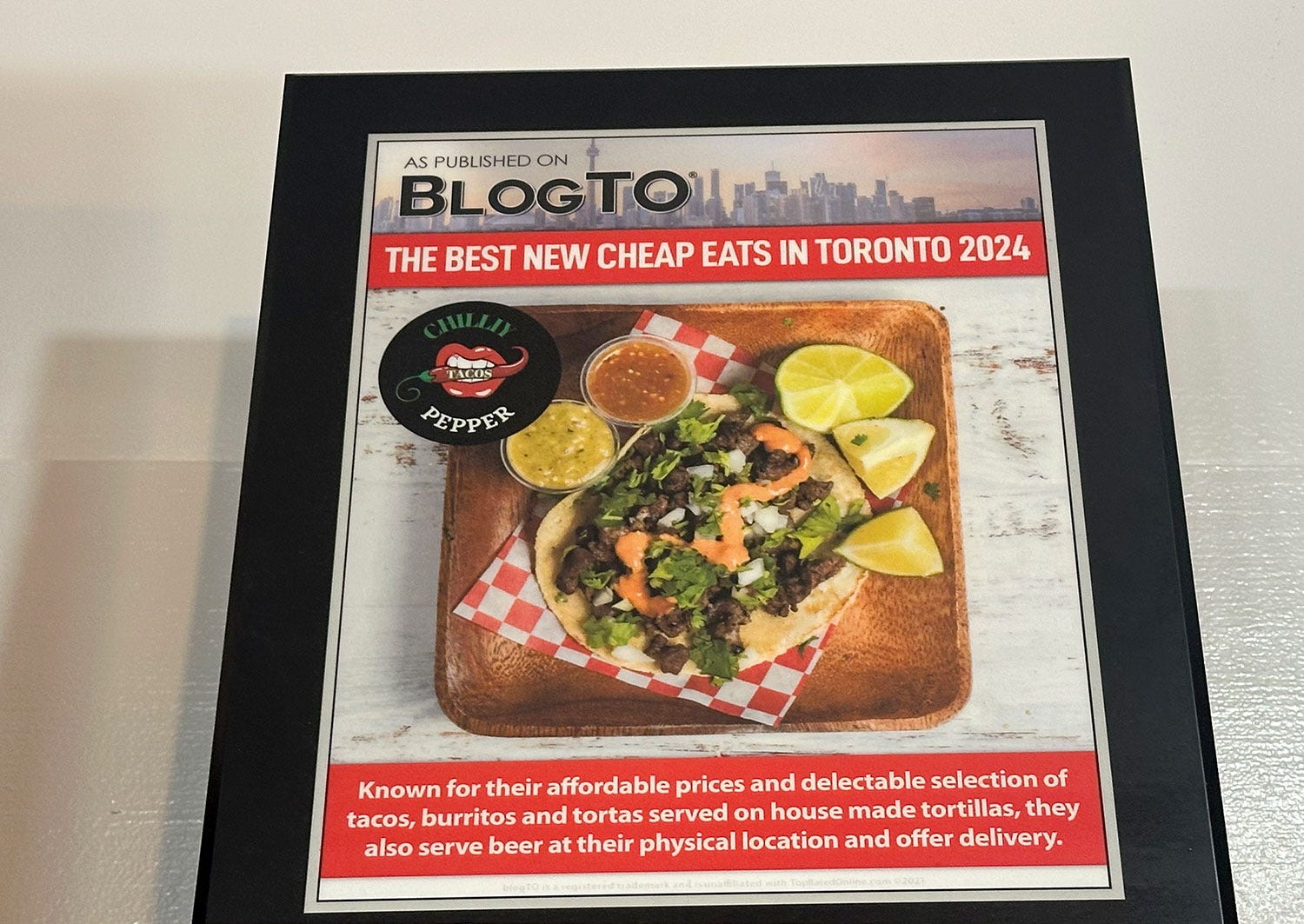
We first got tipped off in 2018, when local businesses started contacting us about the scheme. The owner of Greta Solomon’s, a much-loved but now shuttered restaurant in Leslieville, wrote to say she had received a phone call from a company called Top Rated Online out of Ann Arbor, Michigan, claiming to be affiliated with blogTO. They congratulated her on the restaurant being named one of the best French restaurants in Toronto, and told her that if she wanted a plaque to mark the achievement, she would have to purchase it. She emailed us to ask whether we worked with this company or if it was a scam. I told her it was a scam.
Another business owner wrote to us a few weeks later after receiving a call from “Troy from blogTO” about our best patios list. She wanted to confirm the caller was a real human. I told her nobody named Troy worked for blogTO.
The emails and DMs kept coming, so we posted notices on our social platforms warning local businesses about the scam. Unfortunately, many businesses never saw the warnings and never contacted us after hearing from Top Rated Online. Instead, they bought the plaques, and I would often notice them hanging in restaurants, cafes and other local businesses I visited around the city. Some of these small businesses messaged us after the fact to complain about the poor quality or about the plaque not being what they expected. We pointed them to our social media posts calling out the scam.
After a number of months, it became clear this plaque problem wasn’t going away. So after some sleuthing, I tracked down the person behind Top Rated Online. His name was Sean. At first, I pretended to be an interested customer to hear his sales pitch and pricing details. Then I revealed myself as the founder and publisher of blogTO and told him to cease and desist.
But instead of doing that, he responded with a proposal for a “strategic partnership.” I declined his offer and reaffirmed my request that his company refrain from contacting Toronto businesses about anything related to blogTO. He replied that fair use and trademark law permitted his products and he reserved the right to continue his sales efforts. He even offered to design the plaques so they were “mutually acceptable” and asked me to share my reasoning for not proceeding. I told him plaques were just not a fit for us and asked him to respect the decision.
He didn’t. The reports from local businesses didn’t stop, and a few months later I contacted him again, telling him to cease the activity immediately, that he had no permission to market products using the blogTO name or to create plaques using our logo, photos or article text, and that further reports would leave us no choice but to take legal action.
He just kept selling. I never found the time to pursue more aggressive action against him.
Years later, after blogTO was acquired by ZoomerMedia, I flagged the issue to Omri Tintpulver, ZoomerMedia’s Chief Operating Officer. He said he would consult with the company’s lawyer. I’m not sure what came of that discussion. I still see the plaques around the city today.
Even though much of our focus in 2019 had shifted to video, the blogTO website kept growing. The business was also squarely profitable, so we continued to invest resources in the website, tweaking and enhancing it and adding new features and functionality.
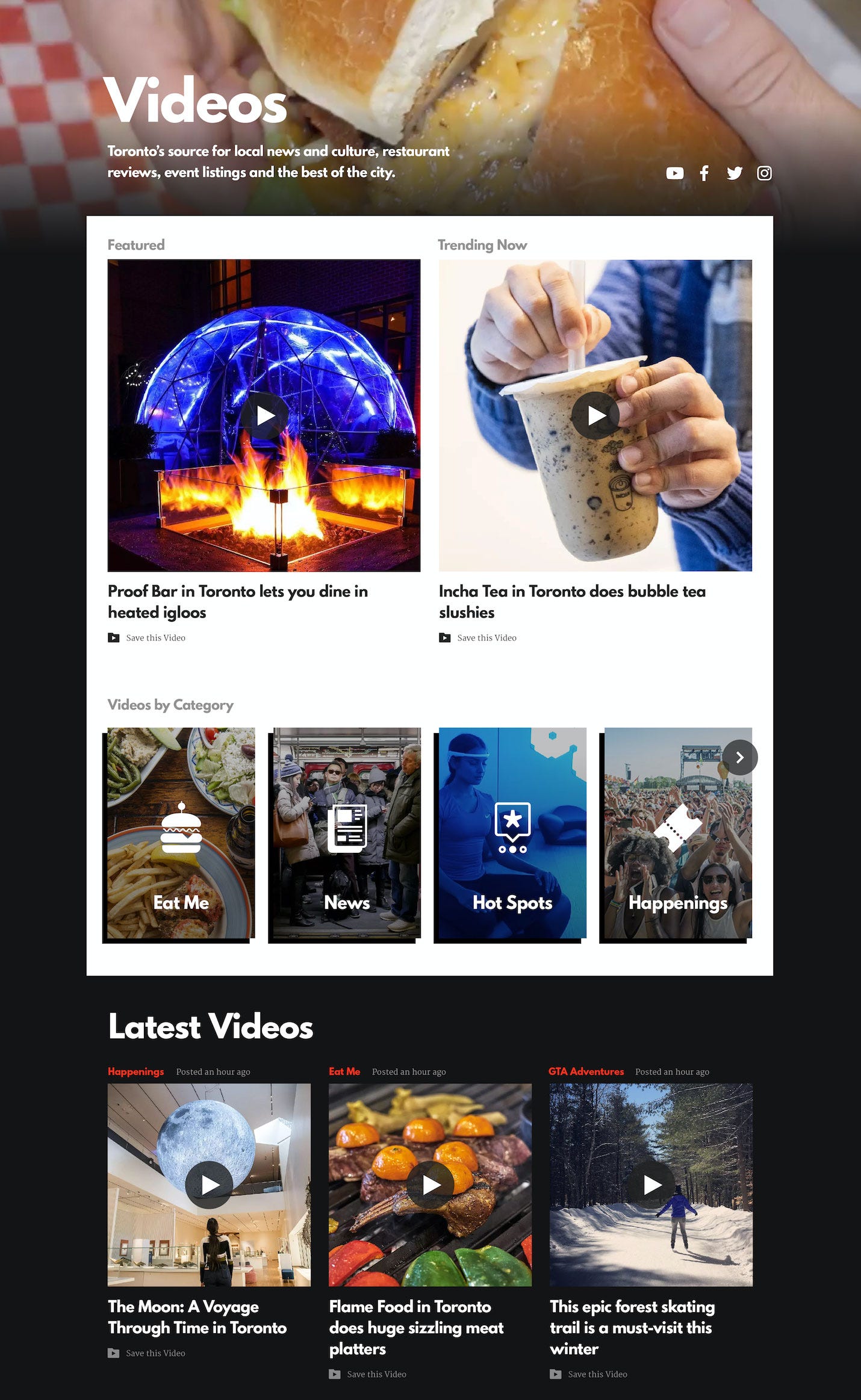
One update we made to the website during this period was to add a dedicated section for our video content and to give video greater prominence on the home page. The update meant the website more fully reflected the scope of our content operations, but we quickly learned that people didn’t come to the website to watch videos. Videos on the website drew a tiny fraction of the views they got on social platforms.
To support the growing volume of content created by our news team, we also increased our use of push notifications, which we had added to both the blogTO app and the website using a tool called OneSignal. Our main use case for them was breaking news alerts. Whenever we sent one, we would watch the traffic to the article immediately skyrocket on Chartbeat as users opened the notification. It was exhilarating, even if the surge was short-lived.
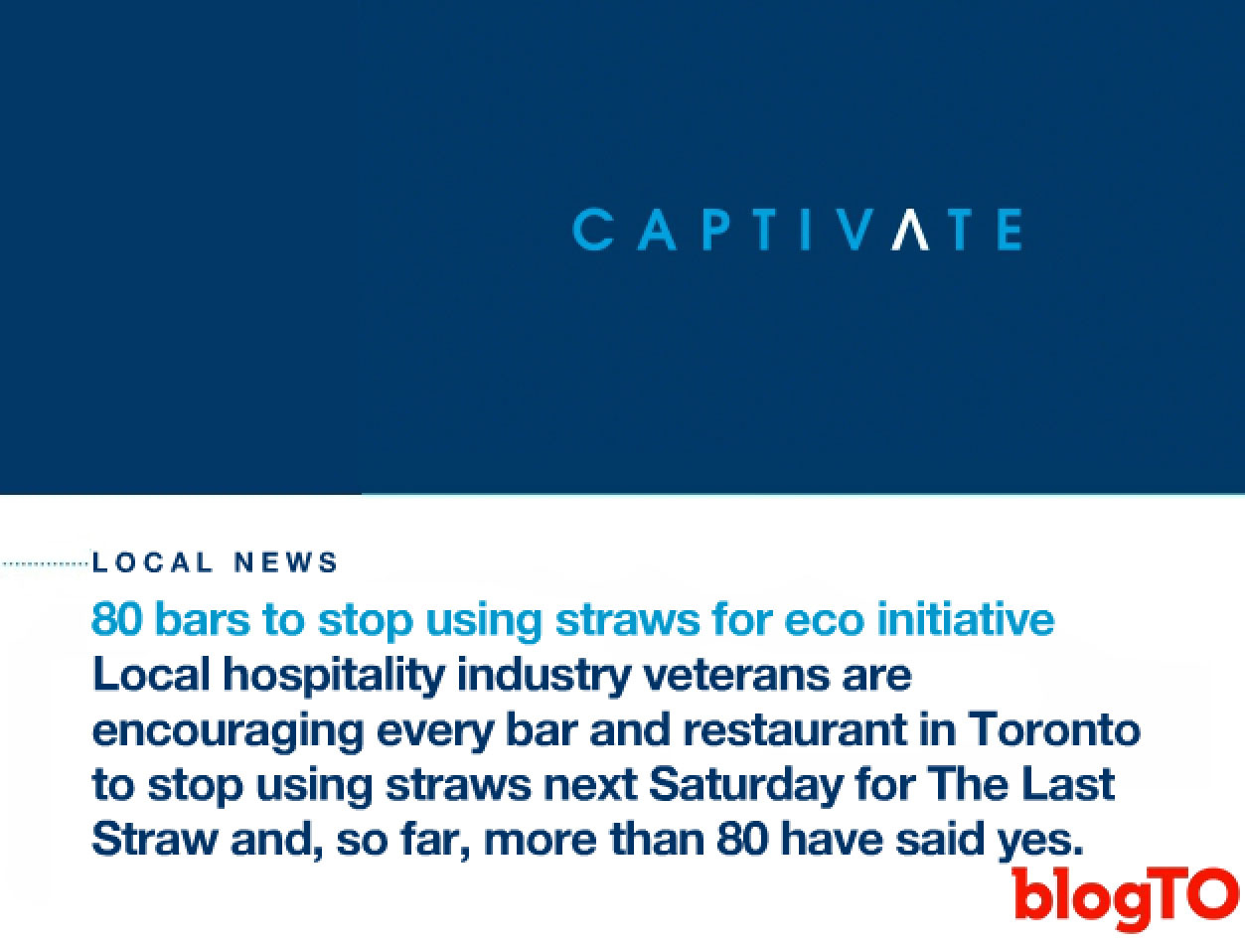
Around this time, we also formed a partnership with Captivate, the company that operates digital screens in office-building elevators across Toronto, primarily in the Financial District. Under the arrangement, blogTO news headlines were displayed in elevators throughout their network. It wasn’t a revenue-generating initiative for us, but it cost us nothing and kept the brand visible to the marketers and advertising professionals who worked in those buildings. It also blocked competitors from taking the space.
One new initiative that did generate some revenue was on the affiliate front. Our relationship with Universe for event ticketing had produced a regular trickle of revenue, so we decided to add Booking.com to the mix. When we mentioned a hotel in a website article, we included an affiliate link and earned a percentage of any bookings made through it.
The biggest investment we made in 2019, though, is one I haven't mentioned yet. I felt it was time to circle back to the vision I had when I launched the company in 2004 under the corporate name Freshdaily Inc. We would recruit a new team and launch a national media brand called Freshdaily. But the launch wouldn't happen without plenty of behind-the-scenes drama and controversy. I'll get into all of that in my next post.