


By the fall of 2011, we needed an office. Not because the business demanded one, but because my home office had become a bedroom. Our second child was born that September, and the room where I had been running blogTO for a few years was now occupied by a crib.
Up until that point, renting office space hadn’t been a priority. The math didn’t work, and even when it started to, the terms didn’t. Commercial landlords expected multi-year commitments, and I wasn’t willing to saddle blogTO with that kind of obligation. But a new category of office space was emerging in Toronto. WeWork was still years away from opening its first location in the city, but a handful of local coworking spaces had begun to appear, including Workplace One, which had just opened near Queen and Bathurst.
I liked the space. It was modern and well-designed. And I saw an opportunity for a trade. Workplace One needed tenants. We had advertising that we could offer them. A barter deal was far more attractive to us than paying cash, so I pitched an arrangement: a small office in exchange for about $10,000 worth of advertising on blogTO. They went for it. We signed a six-month deal and moved in on October 24, 2011.
At that point, the “we” who occupied the office consisted essentially of me, Derek Flack, and Alexandra Grigorescu, who had come on board as an Associate Editor. Derek had joined at the end of 2008, starting out by covering art galleries and bike stores and, more significantly, a wide range of historical content featuring photographs from the Toronto Archives. It was the type of content blogTO became known for over the years. It was so popular that the Toronto Star once interviewed Derek about his work.
Derek had grown up in Toronto and had a deep, wide-ranging knowledge of the city that touched nearly every subject we covered. He hadn’t trained as a journalist, but he was a strong writer and photographer, and his instincts for what made a good story were sharp enough that he was constantly generating ideas, both for his own work and for the team he oversaw. Derek became not just blogTO’s third Managing Editor but also its first full-time employee.
At blogTO, our editors were expected to create content while also managing the team. Derek assigned stories, reviewed pitches and edited submissions, but he also wrote prolifically. The dual role made for long days, but I felt strongly that editors who weren’t also producing work lost touch with what the site needed. I didn’t think we could afford to have anyone in a purely supervisory position, and I also didn’t think it was a good idea.
All of our editorial planning ran through what we called the content schedule, a Google spreadsheet organized by date where we plotted the posts we planned to publish each day, along with notes, related links and status updates. Internal communication happened almost entirely over email. Slack didn’t exist yet, though we would eventually migrate to it years later. We also maintained a wiki where all of our internal documentation lived: style guidelines, best practices, CMS instructions and other resources.
We had an informal work culture. There were no set office hours, nobody was required to work from the office, and we didn’t provide equipment. Everyone supplied their own laptop, phone, camera and software. The office was there if and when our team needed it. What mattered was that the work got done and done well.
What I wanted was for our team to spend their time in the city, not glued to a desk. I wanted them to walk through neighbourhoods, duck into new shops, attend events, and talk to people. The office existed for the moments when we needed to write something up, edit a photo, or meet with colleagues. If I noticed someone spending too many hours in the office, it made me uneasy.
Over the years, readers sometimes asked me how we always seemed to break stories first. There was no secret to it. We were out in the city, talking to people, paying attention. We didn’t wait for press releases or rely too heavily on trawling social media for leads. We found the stories ourselves.
I practiced what I preached. I’d regularly explore parts of Toronto I didn’t know well, seeking out neighbourhoods like Thorncliffe Park or Keelesdale that other publications overlooked. When I went out to eat or drink, I rarely went to the same place twice, so I had more first-hand knowledge to draw on when curating lists or directing coverage.
As the site grew and revenue increased, we had resources to bring on more people and pay them more competitive wages. Our reach and reputation also meant we continued to be flooded with applicants eager to join the team.
My approach to evaluating and hiring new team members was particular.
Knowledge of Toronto was critical. I valued applicants who were actively engaged in some corner of the city’s culture and whose interests went deeper than the mainstream. That sensibility, one we had established in the site's early years, mattered as much as, if not more than, a journalism degree or industry experience.
When I interviewed prospective writers, I’d ask them questions to test their knowledge of Toronto and sensibility. There weren’t necessarily right or wrong answers, but if someone said their favourite coffee shop was Starbucks or that they liked to hang out in Yorkville, it suggested they probably wouldn’t be a good fit.
I’d ask them to name a bar on Dundas West, a cafe in Leslieville, the approximate boundaries of Parkdale or some of Toronto’s notable live music venues. I needed to hear smaller venues like The Dakota Tavern, Lee’s Palace or The Danforth Music Hall, not just the ACC (now Scotiabank Arena) or the Molson Amphitheatre (now the RBC Amphitheatre).
Turning away talented writers who simply hadn’t spent enough time in Toronto was always difficult. We’d often get applicants who had recently moved from Vancouver or another city. It was tough to find suitable roles for them unless the role didn’t rely as much on local knowledge and context. I favoured applicants who had grown up in Toronto or spent considerable time living here.
I also actively sought out writers who wanted to cover parts of the city that other publications overlooked. There was a widespread perception that Toronto media had a downtown-west bias, and I thought that was both true and a real opportunity. If we wanted to grow our readership, we had to cover the neighbourhoods where people actually lived. Former suburbs like Scarborough or North York had massive pockets of underserved readers.
In 2012, the majority of our team had not worked in media before, but Rick McGinnis was a notable exception. He was the most seasoned journalist we had, with years at Now Magazine and Metro under his belt. Rick brought a high level of reporting rigour that added depth to our coverage.
Rick was also the primary byline on our branded page in Tonight Newspaper. Tonight was a free afternoon daily, targeted at Toronto commuters heading home from work. It was a publication we had been working with since its launch in September 2009.
Back then, Tonight’s co-founders, John Cameron and Tom Hyde, asked if blogTO would be a content partner. I was skeptical about the paper’s prospects. The competition among free dailies in Toronto was fierce, with Metro and 24 Hours already well established. Dose had already discontinued its print edition, and it was clear that more people were turning to their phones for news and local information. I wasn’t convinced that a print publication whose key differentiator was an afternoon publishing time had a bright future.
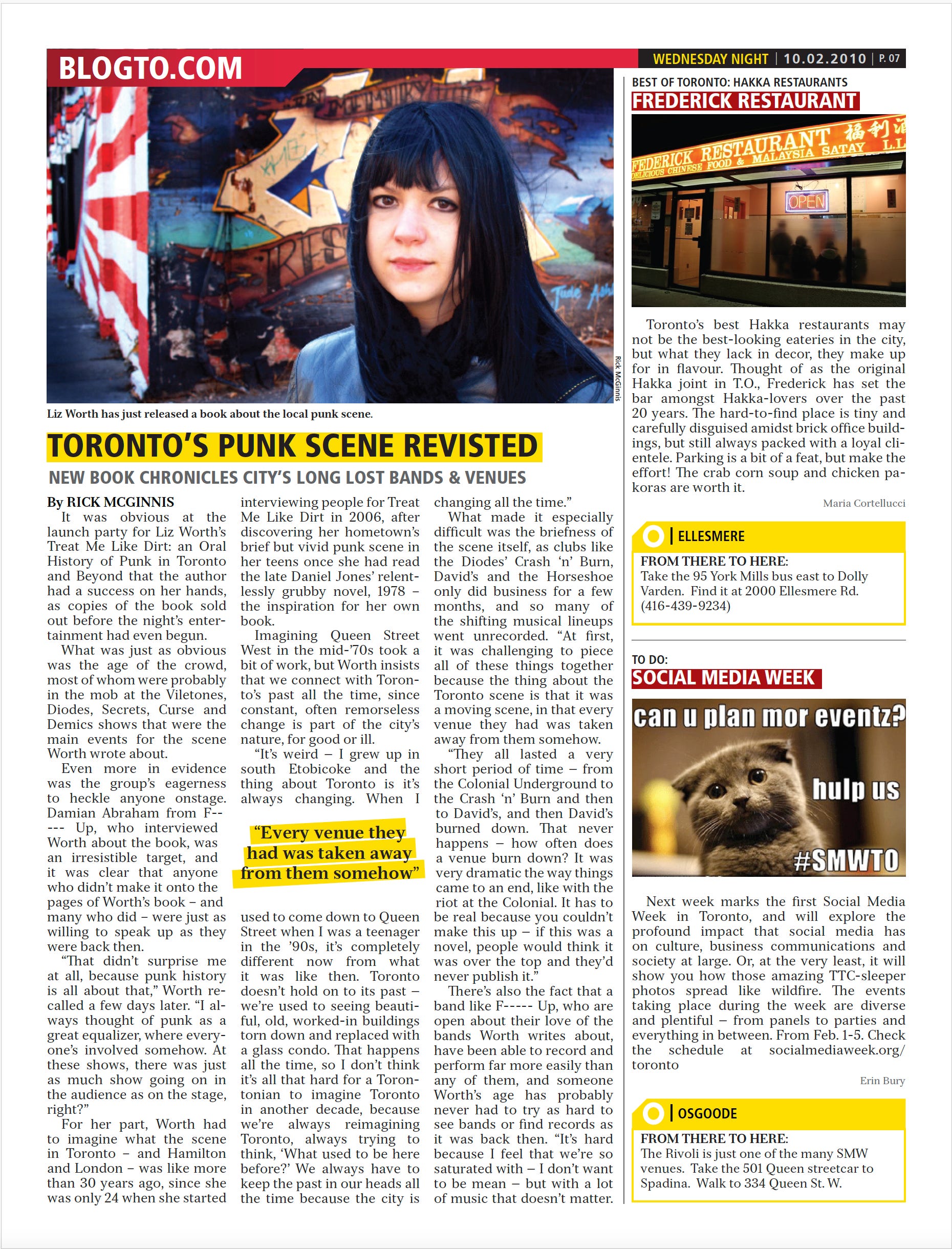
But I said yes to the partnership almost without hesitation. The reasons were straightforward. A blogTO-branded page in a publication with over 100,000 daily circulation represented an enormous amount of free marketing at a time when we still needed cheap, effective ways to build brand awareness. I also knew that if we didn’t partner with Tonight, we’d be leaving the door open for a competitor to take the spot. The costs and downsides for us were minimal since we’d already be producing the content for the blogTO website anyway. I just had one condition. Tonight wasn’t allowed to syndicate our content on their website. It could only run in print.
Each issue of Tonight featured a blogTO-branded page with a feature article, usually written by Rick, alongside two shorter pieces about a local business, neighbourhood or event. The idea was to tie some of the content to a subway stop, since the paper was aimed at transit riders. Tonight would sell advertisements on the page and keep all the money. Revenue sharing wasn’t part of our agreement.
Unfortunately, Tonight didn’t succeed as its founders had envisioned. It was acquired by Annex Business Media in 2013 and folded about a year later.
Another key member of the team during this period was Chris Bateman. Chris had inherited the Morning Brew from Jerrold and created a weekly column called the Sunday Supplement, in which he unpacked a few topical stories in depth. Working under Derek’s direction, he also carved out a niche for himself by writing meticulously researched pieces about Toronto’s history.
While Derek’s history posts tended to be photo-driven, like his popular piece on what Toronto looked like from the 1860s to the 1990s, Chris’ work leaned more toward long-form research and writing, covering subjects ranging from the demolition of Chorley Park to the S.S. Noronic disaster. In 2014, Chris won a Heritage Toronto Award of Excellence for his blogTO article “That Time a Giant Gas Balloon Dazzled Toronto.”
For a few years, Chris was also one of our main news reporters, covering City Hall and the ongoing shenanigans of Rob Ford. I’ll have more to say about his coverage of the infamous crack video scandal in my next post.
Other notable writers on the team at this time included Sabrina Maddeaux, who covered fashion and later became a widely published freelance journalist for the National Post, the Globe and Mail, and the Toronto Star. Libby Roach wrote about food, restaurants and hotels, and later co-founded Auburn Lane, a women-focused Toronto publication. Dayna Winter was writing best-of lists and covering fashion and design before she left to take a content role at Shopify.
Despite all the new additions to the team, we still struggled with turnover. A number of freelancers who had done strong work for the site had since moved on. Erin Bury had pioneered our Toronto tech and startup content before becoming the Managing Editor of BetaKit and later co-founding Willful. Travis Caine had been one of our main music writers. Chandra Menard had written about local film festivals. Meaghan Binstock, Frank Kocis, Joshua Tusin, Emily Thomas and Alyssa Bistonath had all contributed to our food and restaurant sections.
In 2012, I was still working with The Office of Gilbert Li, the studio I had commissioned to design the final version of our neighbourhood maps. As that project wrapped up, we started talking about what to do next. Their specialty was magazine design, and I had always been a voracious magazine reader. I asked them to develop conceptual designs and layouts for a blogTO magazine.
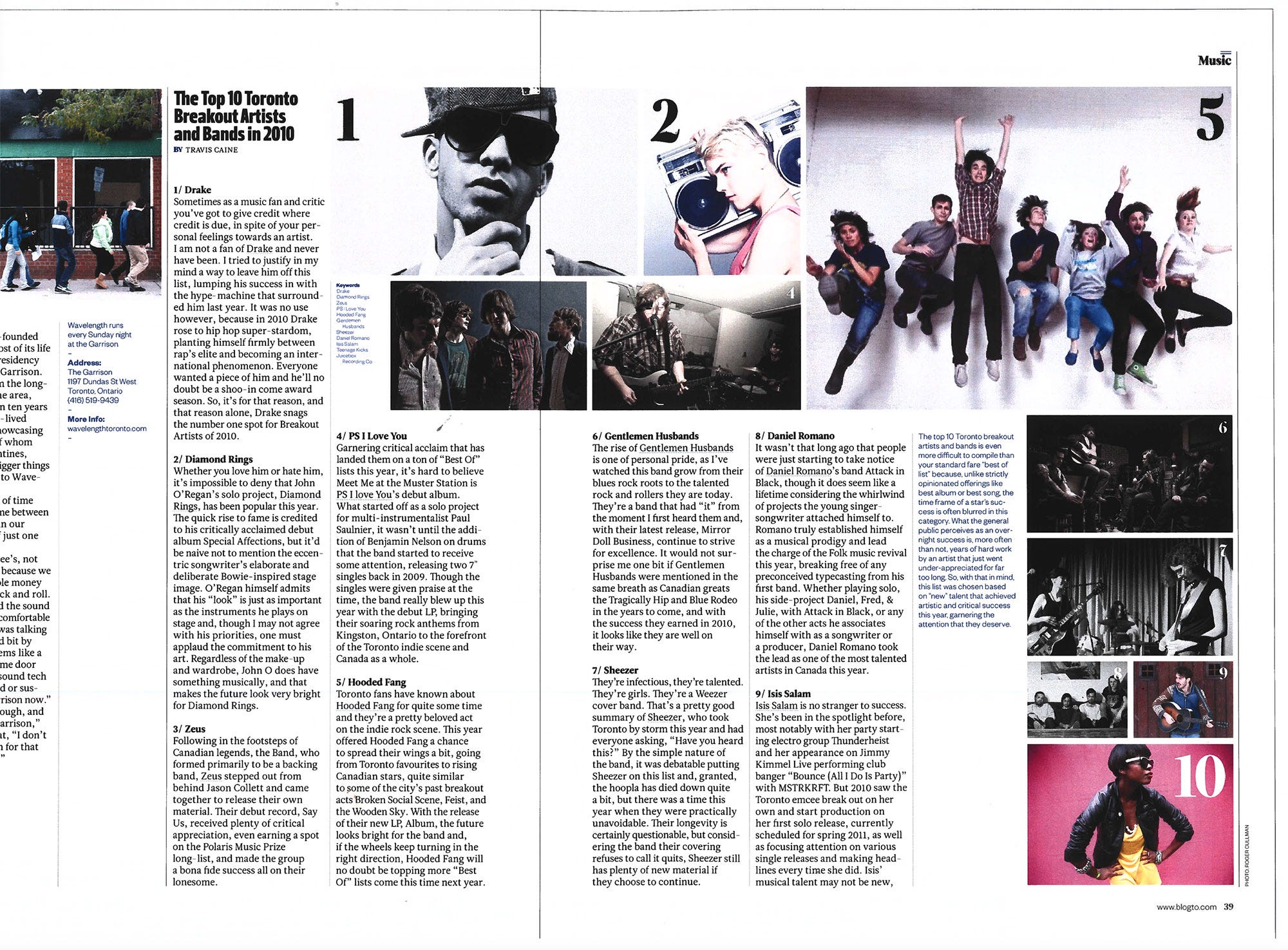
The idea was to distribute it for free, subsidized by advertising, available at coffee shops and local stores, not unlike the model for our maps or the one Vice had used in its early years. The concepts they brought back loosely resembled Monocle’s look, which had already established itself as one of the best-designed magazines in the world.
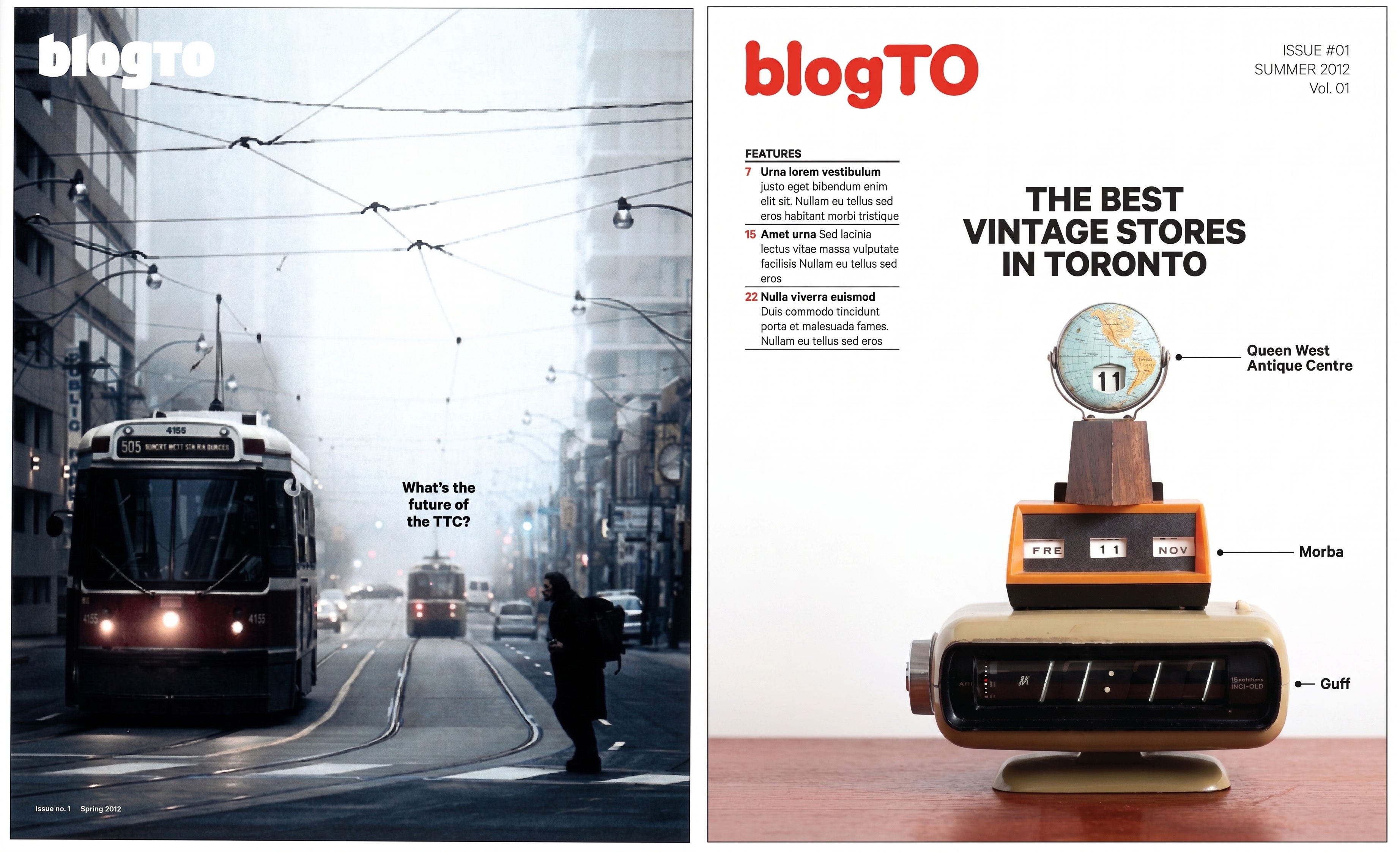
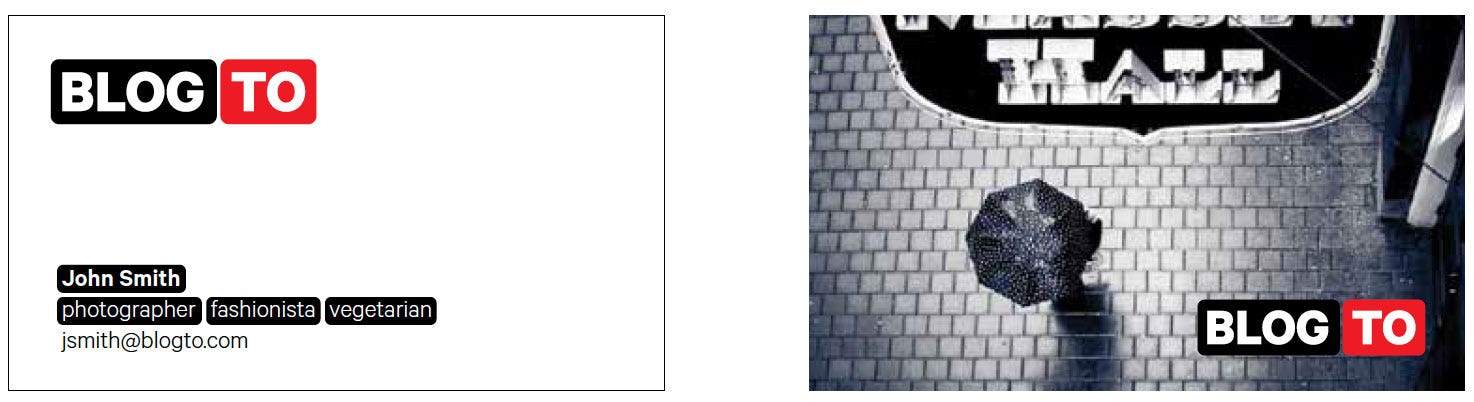
Alongside the magazine concepts, The Office of Gilbert Li also developed new ideas for the blogTO logo and visual identity that could be extended across both digital and print channels, including our branded page in Tonight Newspaper, business cards, and the printed reviews and Best of Toronto decals we distributed to local businesses.
The design work was strong, and I was excited to move forward. But I hadn’t yet fully costed out the viability of publishing a magazine. Plus, the design project’s timelines kept slipping, and as time passed, the business case for me to devote constrained time and resources to a print product grew harder to make.
If blogTO was going to succeed, it wouldn’t be because of a magazine. I knew this was more of a vanity product than something that made strategic sense. We needed to win at digital media. That was the opportunity, and that was where we needed to focus.
One of the things we invested in on the digital side that year was expanding our street-style content. We’d been posting photos showing how people dressed in Toronto for a couple of years by then, and they were getting high engagement. Our readers loved looking at how different people in Toronto dressed and commenting on their outfits. Along with the photos, we would typically include details such as the subject’s first name, occupation, and how they described their style.
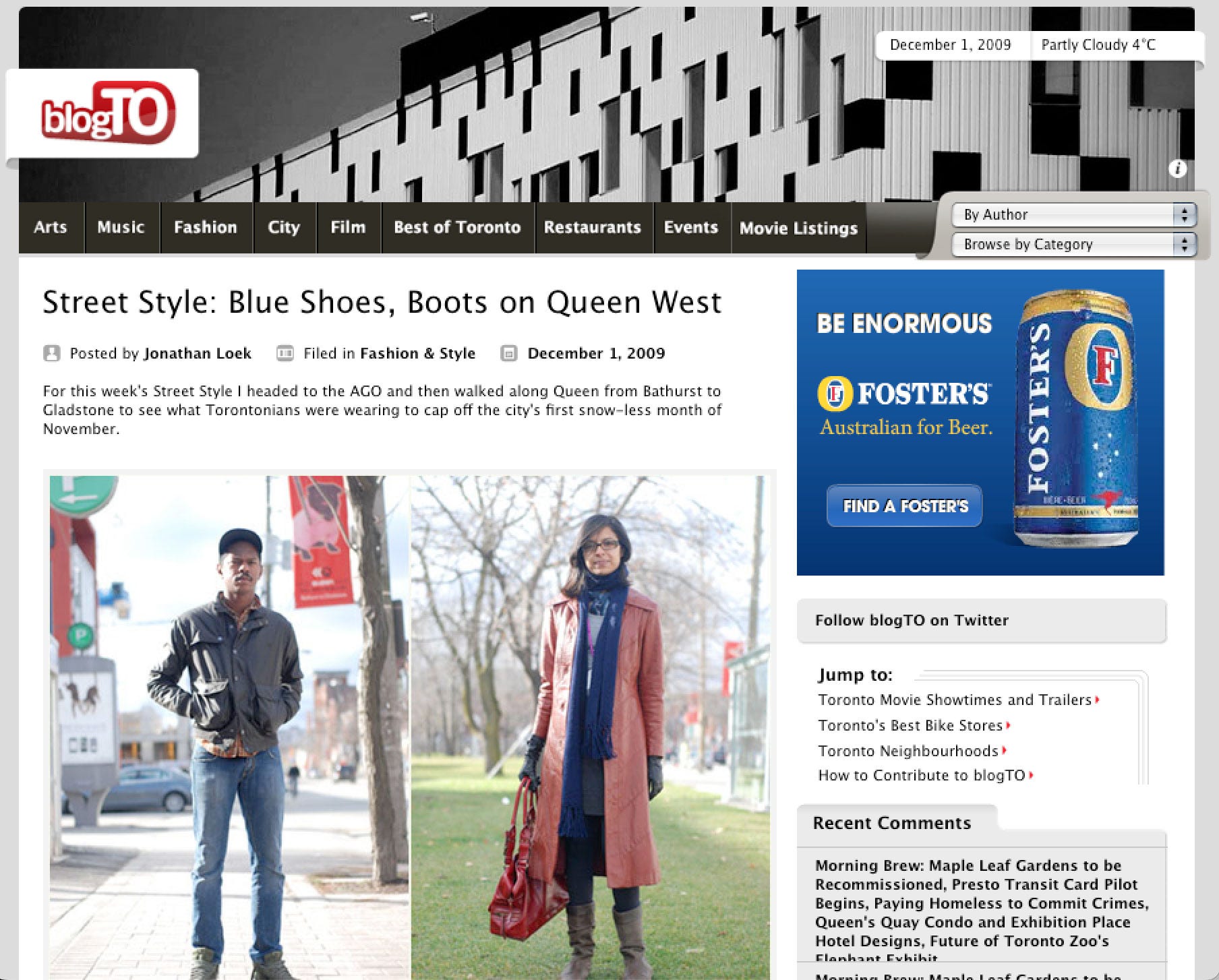
Some of the style was great, and some was questionable or just objectively unique. We decided to stop running the posts as regular articles and instead create an entirely new module or section of the site to house the content. The challenge with the project was that we were still struggling to migrate away from the Movable Type CMS and had built a separate Django system that we decided would serve as the foundational platform for our websites and apps in the future. We also knew we needed a new responsive site design, and I wanted to extend this module to the blogTO apps as well.
To execute the design of the new street-style module, I hired Brian Pullen, who was co-founder of Playground, the agency that designed the award-winning website for The Toronto Standard. Brian would complete the work as a freelance side project, and I was really happy with what he came up with. But, as expected, the module’s look was completely different from the rest of the site. Nevertheless, Abraham and Taylan took his design templates and integrated them into the site without much complication.
In June, the new module went live, and I posted an announcement about the changes. The main thing was that each street-style photo now stood on its own. Rather than engaging in a comment thread about a collection of photos, readers could comment on specific photos and rate outfits as “Hit” or “Miss.” We also made the content more sortable by adding tags like “leather” or “hat” so people could browse by theme.
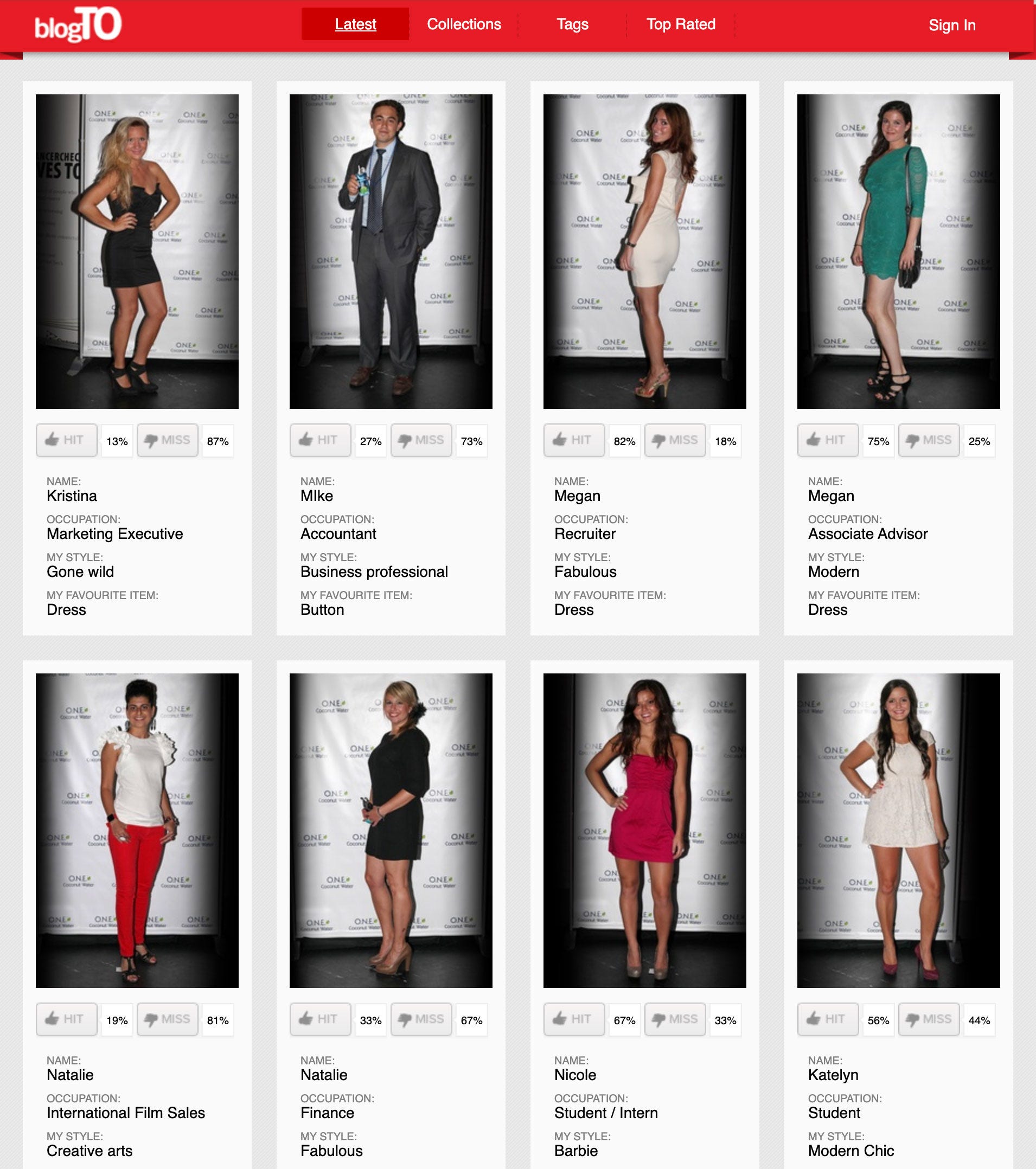
The response to the section was positive, but I later realized that the module wasn’t built for the era of digital media to come, which largely relied on distributing content through Google and Facebook.
Various writers and photographers contributed to the street-style coverage over the years, most notably Jesse Milns, Jonathan Loek, Mona Chammas, Jessica Blaine Smith, Natalia Manzocco and Mauricio Calero.
The project with Brian was such a positive experience that I asked him if Playground would be willing to redesign the entire blogTO website. I was convinced we needed a major overhaul, one that would introduce new functionality to better position us against well-funded U.S. competitors.
Brian sent a quote for the redesign based on the brief and requirements I drafted. There would be an extensive number of templates and a significant amount of new functionality. The cost he quoted was $100,000, significantly more than we had ever spent on any one thing. But we had cash in the bank since blogTO had been growing and generating profits, so I bit the bullet and signed an agreement to move forward with the project.
The website redesign wouldn’t be the last major digital initiative we started that year. We had previously built the blogTO iPhone and iPad apps, which had a growing user base and a five-star rating on the App Store. We needed an Android app, so I found a Toronto-based development shop called Halogen Mobile that I thought would be a good fit for the job.
I wanted to keep the project streamlined. We’d replicate the iPhone app’s look and feel as closely as possible, making changes only when necessary to accommodate Android-specific conventions. Halogen’s rate was $5,000 a month. They wanted a 10-month retainer. They estimated the app would take 2 to 3 months to complete. It was the only time I ever agreed to a project with a monthly rate rather than a fixed fee. It was a mistake I would not make again.
That June, we announced on the site that an Android app was on its way. Readers were excited. We told them to expect it by the end of summer.
Shortly after the Android project started, Halogen came back to me with a proposal: they wanted to build another app, and it wouldn’t cost us a thing. They had secured $15,000 from Questrade to serve as the launch sponsor of an iPhone app about Toronto bars and pubs. The advertising revenue would offset the development costs.
So, in the fall of that year, we started a project for blogTO’s Bars, Pubs and Late Night Eats app. It would include a directory of bars, pubs, and restaurants where you could find something to eat after midnight. It would be available only to iPhone users.
Another digital project worth mentioning was launched that summer. I had observed over the years that Now Magazine seemed to generate substantial advertising revenue from its special Summer Patio Guide issue. This content vertical was a natural fit for blogTO, but I wanted to do more than just publish a series of articles rounding up bar and restaurant patios in the city.
So we created what I believe was the world’s first dedicated Patio Guide microsite for any city, as well as a Patio Guide iPhone app. An Android version would come the following year. Dondy, who also worked with us on the Toronto Food Trucks website and apps, did the design. Abraham and Taylan did the development.
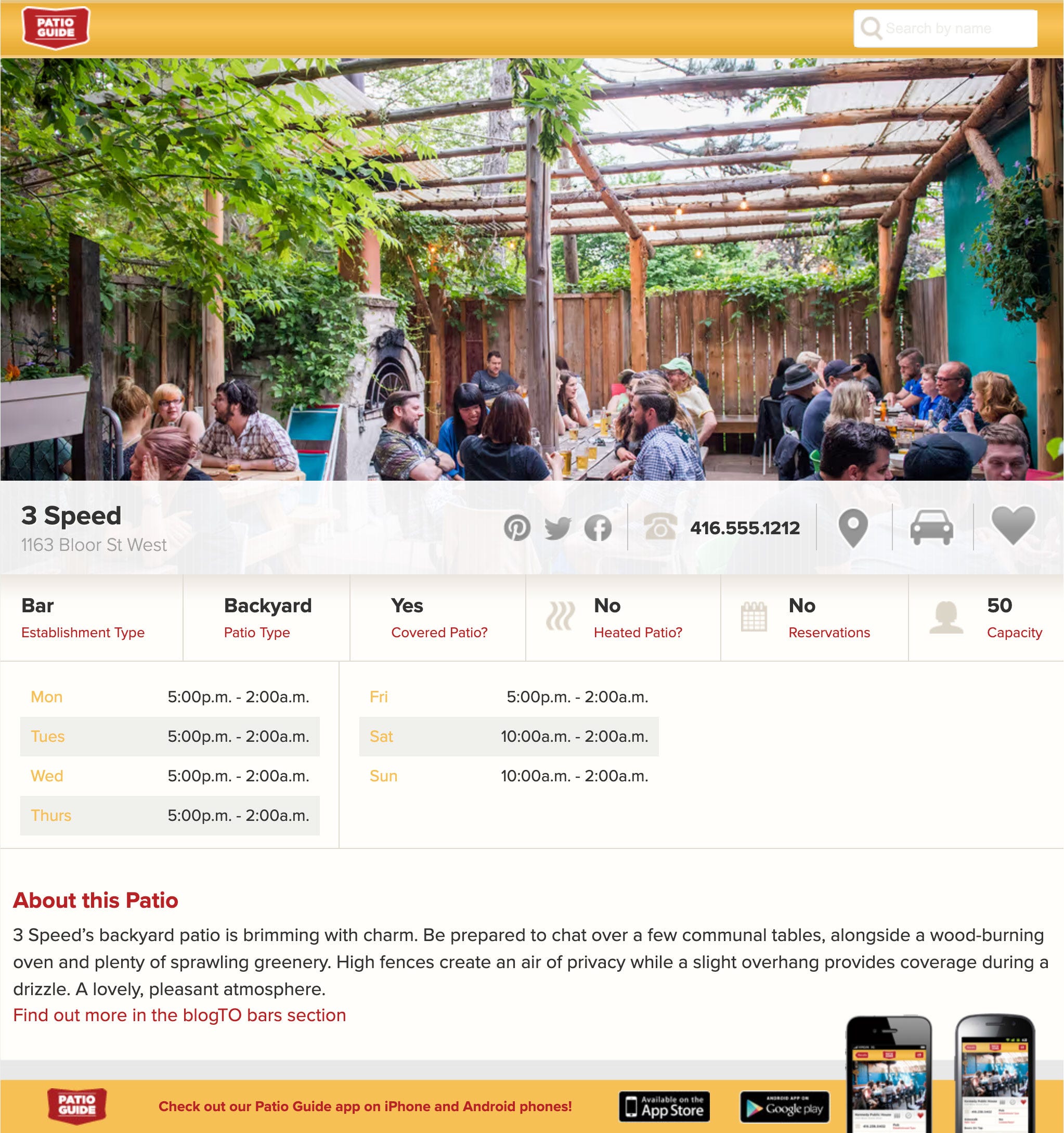
The Patio Guide went live that summer, featuring a curated selection of hundreds of local patios, including photos, descriptions, and useful information such as hours of operation and whether the patio was covered, heated, or took reservations. For a while, we also included details about which beers were on tap, until we realized that gathering and maintaining that information was more trouble than it was worth.
Like the blogTO iPhone app, the Patio Guide was well-received and earned five-star ratings on the App Store. We regularly maintained the database that powered it, sending out writers and photographers to gather the information needed to add patios to the guide and remove patios that no longer existed.
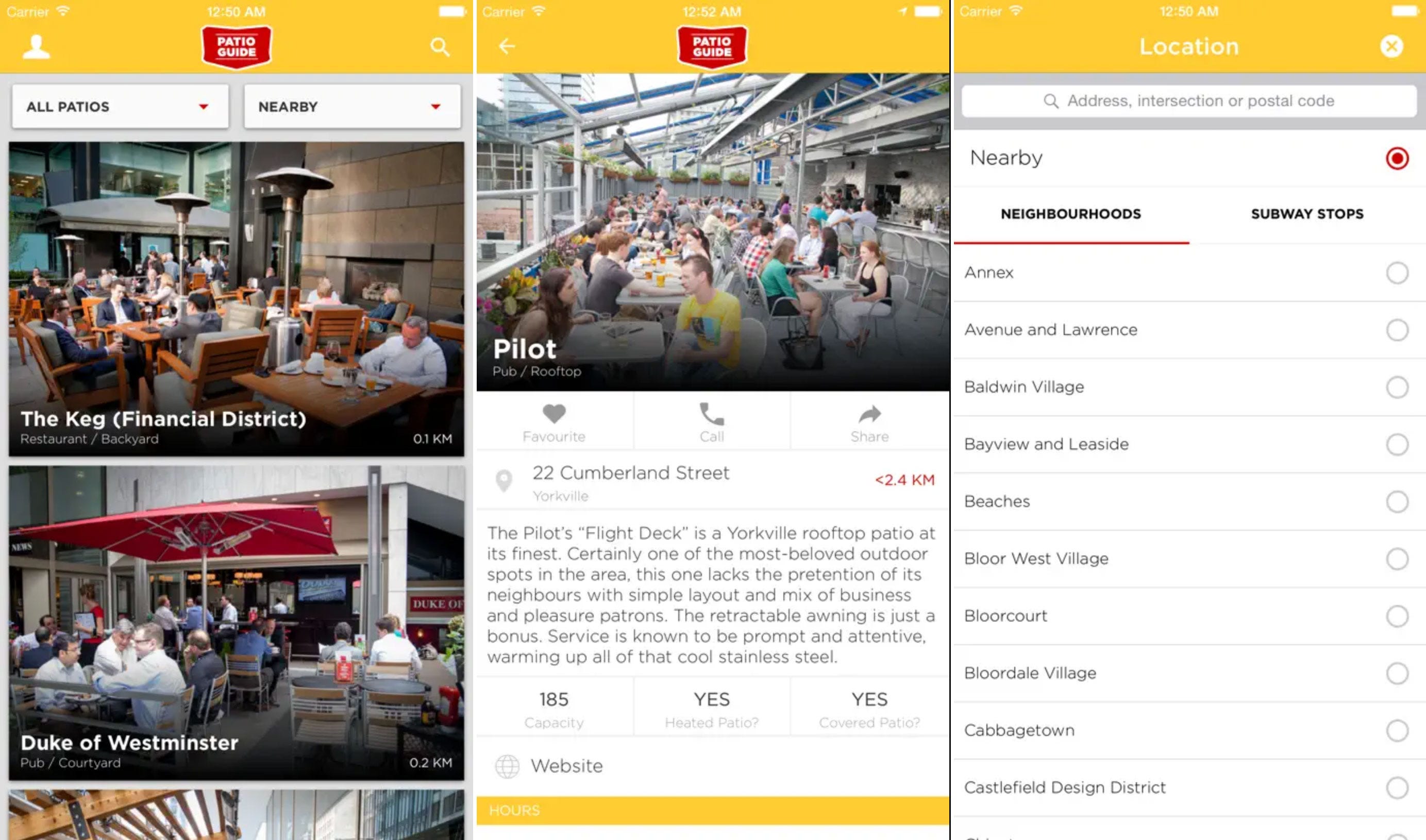
While the Patio Guide still exists today, it no longer appears to be maintained. The microsite is still up, but the link to it from the website’s primary navigation has been broken for a while. The database no longer appears to be actively updated. The iPhone app hasn’t been updated since 2017. The Android version appears to have been removed from Google Play.
While we were busy spending time and money on the website and apps, we weren’t taking our eye off what was happening on social media. The previous year, we had started an Instagram account when few other Canadian media organizations seemed to be paying attention to the platform. We saw immediate traction and high engagement with our posts, which at that time were all photos since Instagram had yet to support video.
The content we posted was mainly photos that mirrored our editorial coverage, regrams of content posted by fellow users, and random shots our team captured while out and about in the city. We weren’t concerned about the platform's lack of monetization or that it drove no traffic to the website. What mattered was that we could see Instagram usage exploding, and that many users in Toronto were following us and engaging with our content.
Twitter and Facebook remained important platforms for us that year, but we also turned our attention to a newer one. Pinterest launched in 2010 and was gaining traction as a place where people could find inspiration and share photos and links to web content. Since we were always looking for ways to extend our audience through emerging platforms, Pinterest seemed worth exploring.
We hired an active Pinterest user, Melanie Dudek, and paid her to see what she could do for us. For several months, she created Pinterest boards on themes we thought people would want to share and pin, including Coffee, Date Night Ideas, and Historical Photos of Toronto. We gained some traction but ultimately concluded that Pinterest wasn’t one of the platforms where it made sense to invest our limited resources. We deprioritized the platform and moved on. Today, blogTO’s Pinterest account sits at just under 50,000 followers, though it hasn’t been active for years.
When our six-month lease at Workplace One expired in April, the arrangement had paid off for both sides. Our advertising helped them fill their Queen and Bathurst location. Their success meant they were opening a second space near King and Parliament. They were no longer willing to give us our rent for free, but offered a deal in which part of the cost would be offset by another advertising trade. We took it and stayed through the end of the year.
As we settled into our second office, blogTO had more shape and momentum than ever. A website redesign was underway that would cost more than any project we’d ever undertaken. We had multiple apps in development. Our brand was in front of thousands of transit commuters every day. And we were building an audience on every major social platform.
In the next post, I’ll get into what happened with these projects we had set in motion, including the ones that didn’t go according to plan, as well as our move into a new office space inside one of Toronto’s most exciting building restoration projects.