


The first year had been about proving the concept. By the start of 2006, we had a website, a team, a growing audience and momentum. Now came the harder part: turning it into something that could last.
We were starting to feel the constraints of our original site design. It was a bit too dark, and we needed new functionality. I hired designer Jay Delmarr to develop a new brand identity and website design. I put together the brief, information architecture, wireframes and functional specs. Jay sent back a few concepts; we refined the one I chose and handed off the final templates to a web developer named Abraham Lopez in Monterrey, Mexico.
It’s fun to look back at some of the logos and design concepts we didn’t choose and wonder what blogTO would look like today if we’d chosen a different direction.
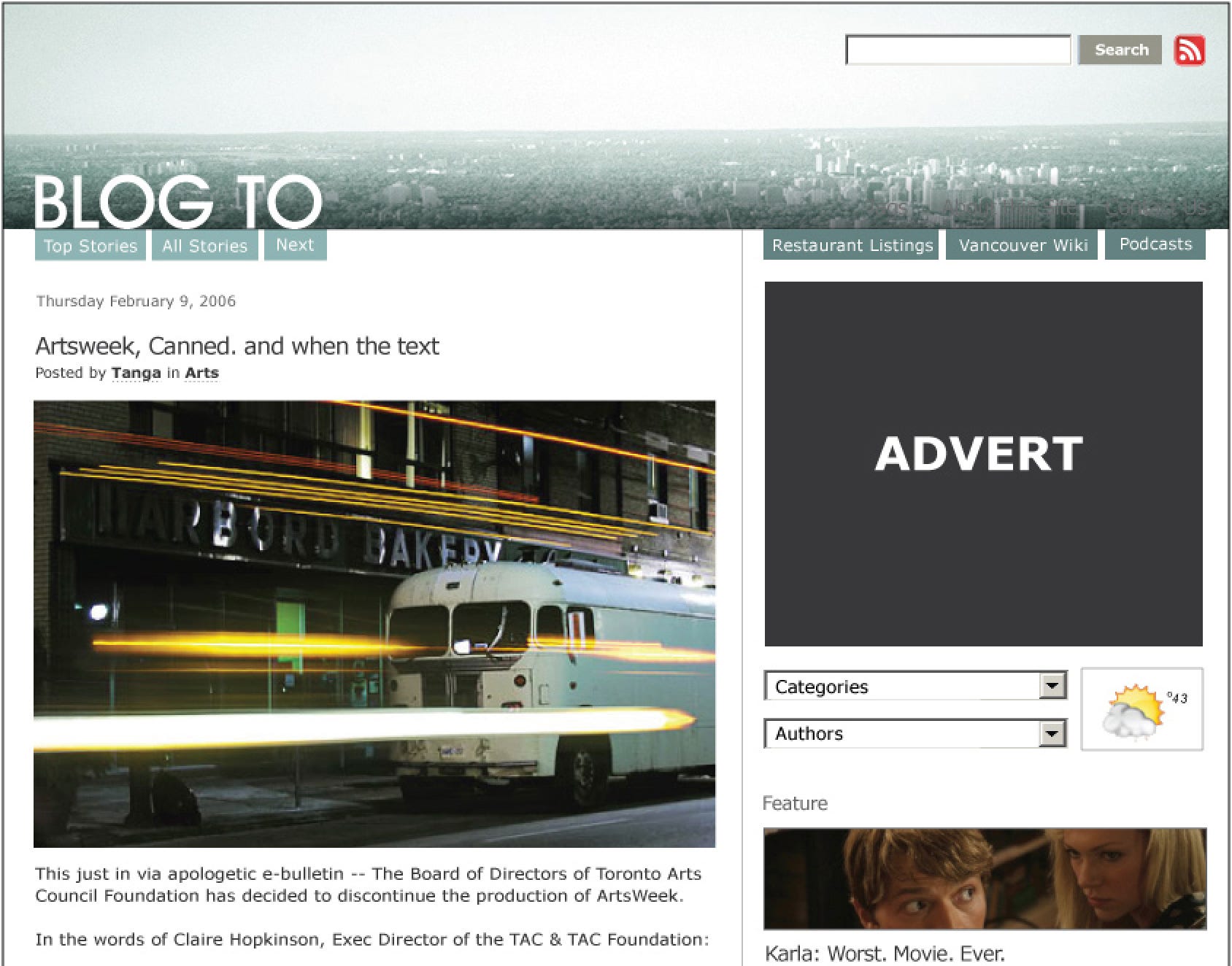
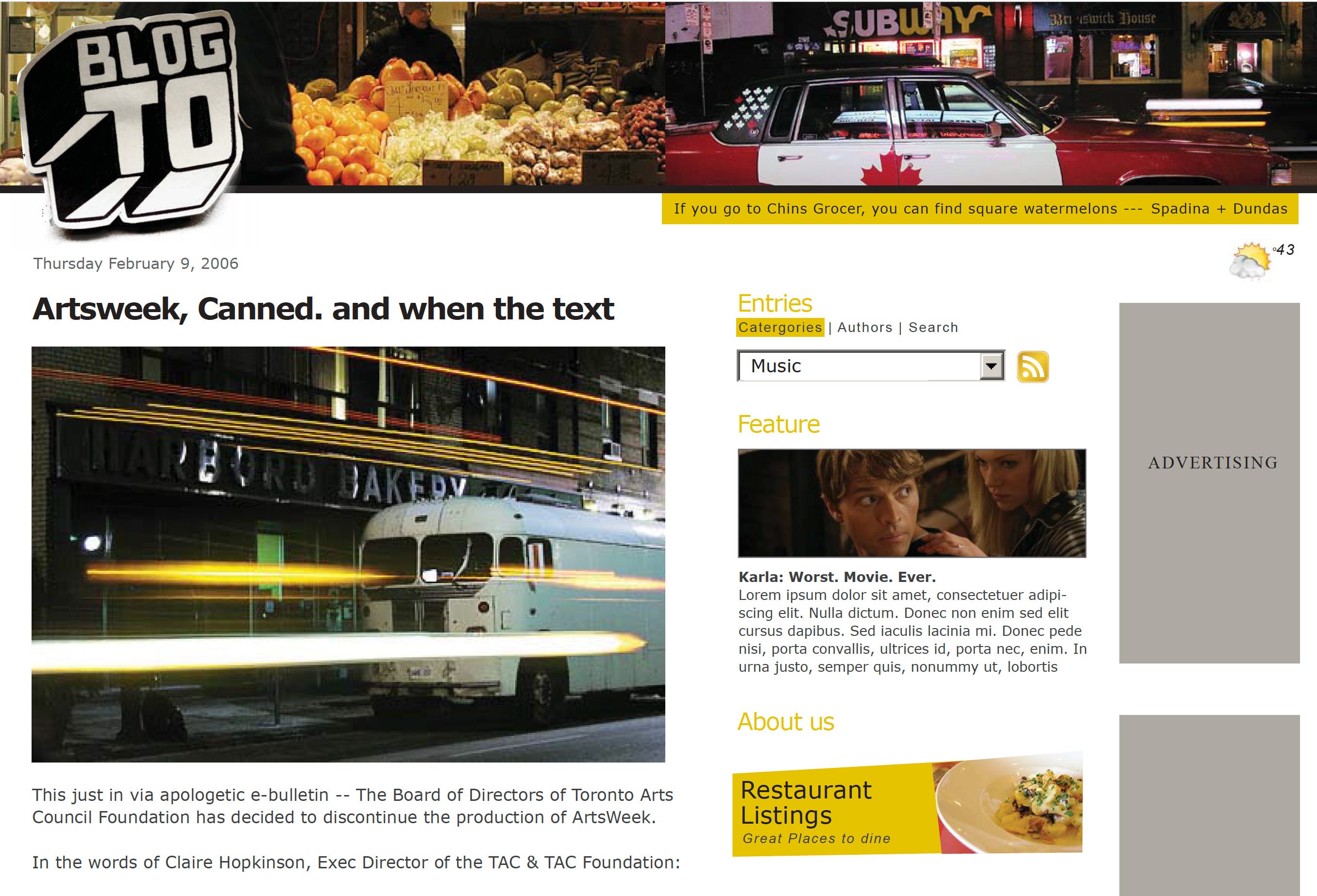
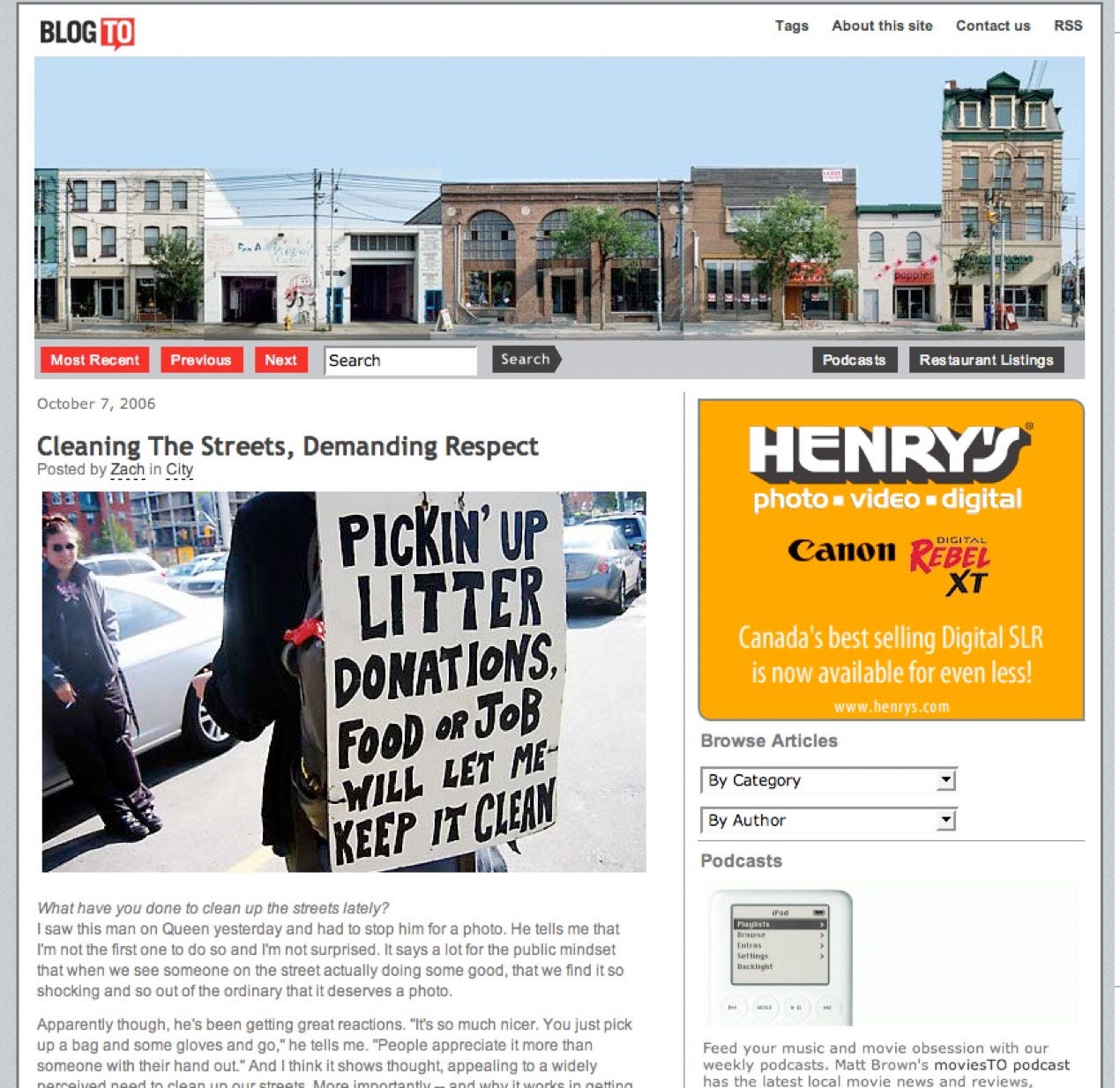
The new design went live in June 2006. It was the first to use the red-and-white colour palette that blogTO would come to be known for. The TO in the logo was shaped like a comment bubble because we wanted to communicate that this was a community site, a place where anyone could show up, read something, and jump into the conversation. This was still a desktop-only experience, years before responsive websites existed. The header featured a rotating selection of photos of the city, enough of them in constant rotation that you’d usually see something new whenever you visited.
The redesign also introduced some features people had been asking for. You could now look up posts by author. You could sort posts by comment count, which made it easy to find whatever was generating the most discussion. And the site now supported slightly larger photos, which mattered as more people got broadband and could actually load a photo-heavy page without waiting thirty seconds.
The new design also introduced visitors to something we’d been building: blogTO was now part of Freshdaily, a national blog network with sister sites in Montreal and Vancouver that we’d launched the previous year.
In the spring of 2006, I left MacLaren McCann for Ogilvy, another advertising agency with a digital division. The work was similar, overseeing digital campaigns, but with a different client: Yahoo! Canada. blogTO was still very much a side project.
Around the same time, I’d moved in with my girlfriend, Bronwyn, into an apartment across from Venezia Bakery on Ossington. Bronwyn was a graphic designer at another ad agency during the day. In her spare time, she helped me with all sorts of miscellaneous design work for blogTO: business cards, buttons, stickers, media kits, whatever we needed on short turnaround and didn’t have the budget to pay someone else to make.
Bronwyn’s help was constant, unglamorous, and essential. blogTO was generating enough work for several full-time people, but it was still years away from hiring even one.
The team of contributors kept evolving. Some of the original members from the first year had moved on. New writers came in and took on key roles. One notable new team member was Jerrold Litwinenko, who would eventually become our second Managing Editor. It’s hard to convey how impactful his contributions were to the site during this period. Jerrold pushed us to think about community building beyond the website itself, which in 2006 and 2007 meant being active on Twitter, Facebook and Flickr. Along with popular and prolific contributor Sameer Vasta, he wrote the Morning Brew, a daily roundup of news from around the web. The format was simple: a curated selection of links and brief summaries of what was happening in the city. Other sites started emulating it. I’ve sometimes wondered whether it even inspired the Morning Brew newsletter, founded in 2015 and later sold for $75 million.
I was a big contributor to the site myself during this period. I was writing posts, taking photos, shooting video, and hosting podcasts. Without any full-time employees and little money to pay anyone, I had to wear many hats and get comfortable doing a little bit of everything. I always knew that as the site grew, I’d need to step back from the editorial side and focus more on running the business, but that was still a way off.
In the fall of 2005, we launched our first Best of Toronto poll with 50 categories. I borrowed the idea from the alt-weeklies but decided to do things differently. When I posted the first poll, I specifically called out Now Magazine for what I thought were questionable selections in their most recent poll, noting my disapproval that The Mandarin had been recognized as the Best Chinese Restaurant and Blockbuster Video had won Best DVD/Video Store.
We would do things our way. We called it “Best of Independent Toronto” to reflect that we wouldn’t recognize chains. It was a controlled poll where we put up nominations for people to vote on, and we also asked readers for their suggestions. That way, only places we thought were worthy of being recognized would be eligible to win. The Mandarin would not be among the nominees for Best Chinese Restaurant. McDonald’s would not win Best Burger. And rather than just recognizing a winner and a runner-up, we’d publish a ranked list of the top nine or ten places in each category.
We ran the polls every year, and the Best of Toronto articles became some of our most popular content. In 2009, we eventually dropped “Independent” from the name, not because we changed the focus, but because “Best of Toronto” was simpler and better for search engine optimization (SEO).
The range of what our contributors were producing kept expanding. Matt Brown was doing great work with the moviesTO podcast, our most listened-to show, where he’d talk about upcoming Toronto film events and festivals and review recently released movies. Beth Hamill, Garry Tsaconas, Mike Rotenberg, Gary Peter and others were writing concert reviews and interviewing local musicians. Megan Mooney was covering the live theatre scene. Anita Clarke was our window into local fashion. Lily Dustbin was interviewing other bloggers as part of a recurring series called The Blogerati Files. Panthea Lee connected with well-known Toronto personalities like Susur Lee in a series called Toronto Through the Eyes Of. Jay Moonah and then Rajiv Thavanathan hosted the Toronto Independent Music Podcast, a show that introduced listeners to songs from local bands. Elle Cooper and Amil Niazi teamed up on the Arts Now Podcast, where they’d interview local artists and talk about upcoming shows. Zach Slootsky, who later opened the popular Toronto restaurants The Federal and Gold Standard, was taking photos for us at concerts and parties.
The podcasts were getting up to 1,500 listens per episode. People liked the content, but we couldn’t grow the podcast audience as quickly as we were growing everything else, and there wasn’t enough podcast-specific revenue to support it. It was one area of the operation that never quite took off the way we hoped.
Then there were the sex columns. We had two contributors writing regular pieces about sex and dating, including future bartender Japhet Bower, whose posts included a guide to where to have public sex in the city and a straight man’s account of visiting a bathhouse for the first time. The articles were so popular, and we were running so many of them that we created a dedicated category called TnO to house them. We published them on Saturdays because we deemed them not safe for work.
One of our earliest viral articles was written by Ryan Couldrey, now an award-winning filmmaker. It was a first-person account of an incident at Toronto Pride where the performer Jeffree Star punched an audience member after being pelted with objects on stage, leading to Star being banned by Pride officials. Perez Hilton linked to it, sending a wave of traffic our way. The post got about 35,000 page views, which at the time felt enormous.
I’m not naming everyone who contributed during this period; there were many more than I can mention here. The team was large and growing, and I’m grateful to every person who gave their time and energy to blogTO in those early years.
Compensation for contributors was transparent but modest. I implemented a new compensation model inspired by something I’d read about Nick Denton paying Gawker Media writers based on traffic performance. Eighty percent of the site’s revenue would be paid out to contributors. The remaining twenty percent, plus whatever I was putting in from my Ogilvy paycheque, covered overhead and other costs.
We developed a point system in which each post earned a base of 3 to 5 points, with bonus points awarded based on page views. At the end of each month, total revenue was divided by total eligible points to determine a point value. One month, the site brought in $632.92 across 544 eligible points. A writer who collected 50 points that month earned $58.17.
It wasn’t much. But it was transparent, tied to performance, and ensured that everyone who contributed received something in return. The truth is, compensation was never the main reason people wrote for blogTO. The real perks were elsewhere. Contributors got media passes to concerts, film screenings and other events around the city. They got to be part of a growing community of people who genuinely cared about Toronto. They had a platform where their work was being read and discussed. And sometimes the opportunities were ones nobody saw coming.
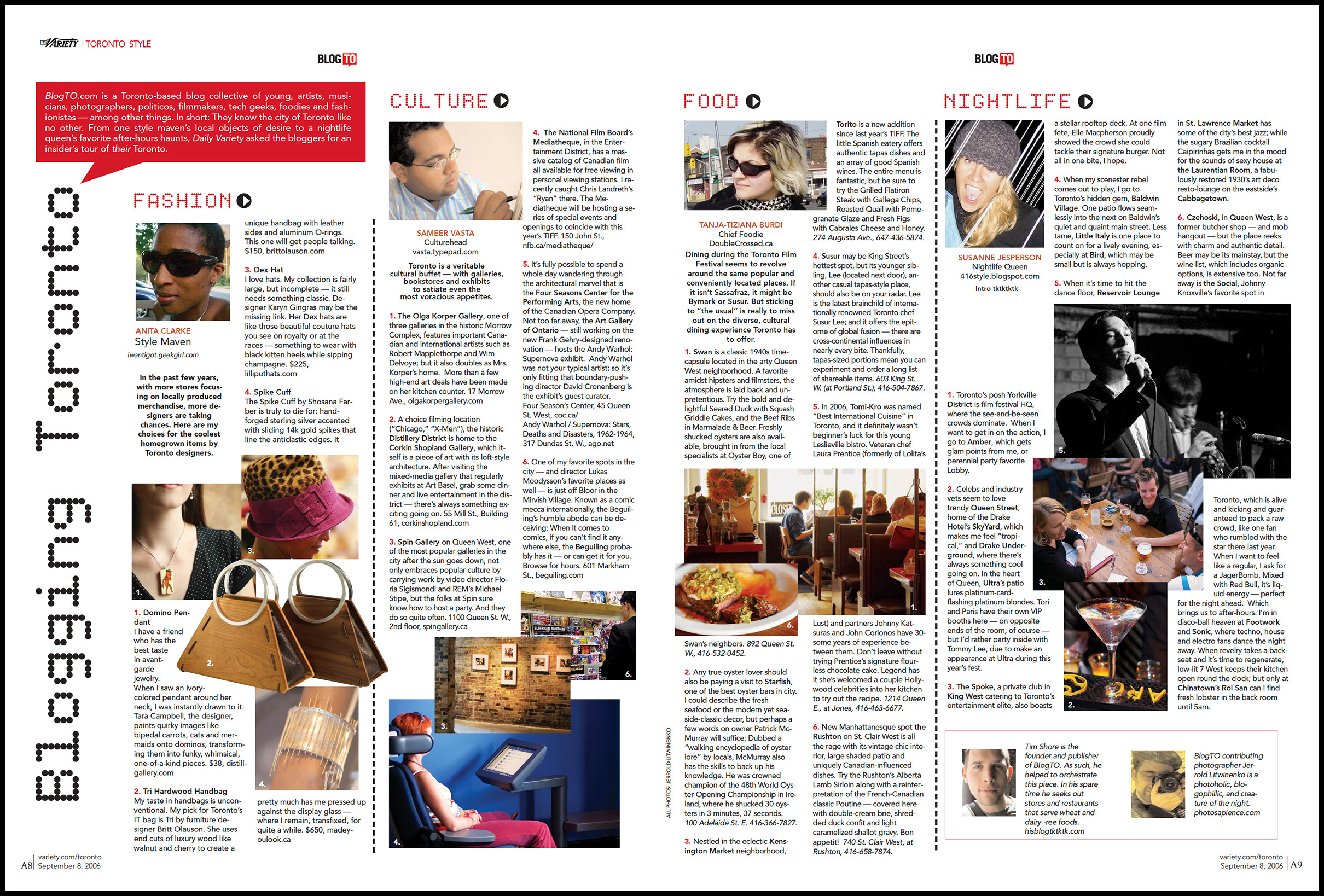
Prior to the 2006 Toronto International Film Festival, Variety reached out to ask whether our contributors could put together a spread in their special TIFF issue highlighting favourite spots in the city for shopping, food, culture, and nightlife. I still remember some of the writers being amazed to see their photos and names appear in Variety. It was the kind of thing they were proud to show their parents, and something none of them could have imagined blogTO would have provided the opportunity to do.
Our traffic had doubled from the previous year. By the end of 2006, we had reached 50,000 unique visitors and 110,000 page views per month. But the numbers only told part of the story. I started hearing from people I’d never met at parties and events who told me blogTO was their favourite site. That they’d made it the homepage on their browser, the first thing they checked in the morning and the last thing they looked at before bed. People were tweeting that blogTO was the best thing to happen to Toronto media in years. We’d get emails from readers telling us how much they loved what we were doing.
This kind of feedback meant more to me than the traffic stats. The stats told me the audience was growing. The feedback told me we were building something people actually cared about.
By 2007, we were more organized behind the scenes. We finally had a proper set of editorial guidelines, two pages of formatting rules, and something resembling a content schedule. Film reviews went up on Tuesdays and Fridays. Concert reviews on Mondays and Thursdays.
The editorial guidelines tried to establish some standards without killing the energy that made the site work. Contributors still edited and published their own posts. The Managing Editor had the right to pull something back to draft status or modify a post, but that was generally reserved for things that violated the guidelines, duplicated something already published, or contained obvious errors.
We were clear about what we didn’t want: press releases repackaged as posts, content ripped from other sites without attribution, self-promotional hype, anything obscene or defamatory. We encouraged hyperlinking to other sites and publications. Every post needed a photo or image, original photography preferred. We asked contributors to acknowledge their sources.
We also asked writers to keep posts to around 250 words. Our logic was that shorter posts were easier to read on the web and faster to write, which meant more posts overall. We allowed exceptions for longer pieces, but brevity was the default.
My most important rule had nothing to do with word count. Everything in the city is local. Don’t write in a way that makes it sound like you had to travel somewhere to cover it. For example, never write that you “trekked” to an event on the Danforth, because you’ll lose credibility with the readers who actually live there. As far as the audience was concerned, the writer lived everywhere in the city. You only wrote about “travelling” somewhere when you were heading out of town.
We reviewed web stats regularly and identified the top-performing posts for each day of the week. About 40% of our traffic came from site referrals. Another 40% came from search engines. We paid close attention to the keywords that were driving traffic.
We had regular team meetings down the street from my apartment on Ossington, in the basement of a gallery called Interaccess that we got to use for free because I was a member. I’d get pizza from Magic Oven and beer from Amsterdam Brewery.
These meetings had become important. The team was growing fast, sometimes adding more than 10 new contributors between meetings. We needed a way to keep everyone aligned and make people feel like they were part of something, not just publishing into a void.
At each meeting, we’d introduce new team members. We’d review the latest traffic stats, and every time we met, there was a new record to report. We’d go over formatting reminders, discuss strategy, and hand out swag like t-shirts, buttons, stickers, and personalized business cards. Sometimes we’d run workshops on topics like SEO to ensure everyone understood how to write to rank higher in organic search results.
At some point we came up with a list of the types of content that we felt created value for the site: posts that sparked conversation and got linked to from other sites; regular columns that provided editorial consistency; timely news that kept the community informed; business, event listings and reviews that functioned as a long-term resource and drove search traffic; posts that built community; and contests.
Revenue was growing, slowly but steadily. We now had advertisers such as the Canadian Film Centre, Harbourfront, Arts & Crafts, the ROM, and Sony BMG, each spending between $300 and $800 on small campaigns. The National Post spent $1,000. Zipcar and Virgin Mobile each spent $2,000. The City of Toronto became a recurring advertiser. Some advertisers, like The Drake Hotel, would only do deals on a barter basis, offering us credit for food and drinks instead of paying cash. I used the credit for lunches and drinks with team members or for taking Bronwyn out to dinner.
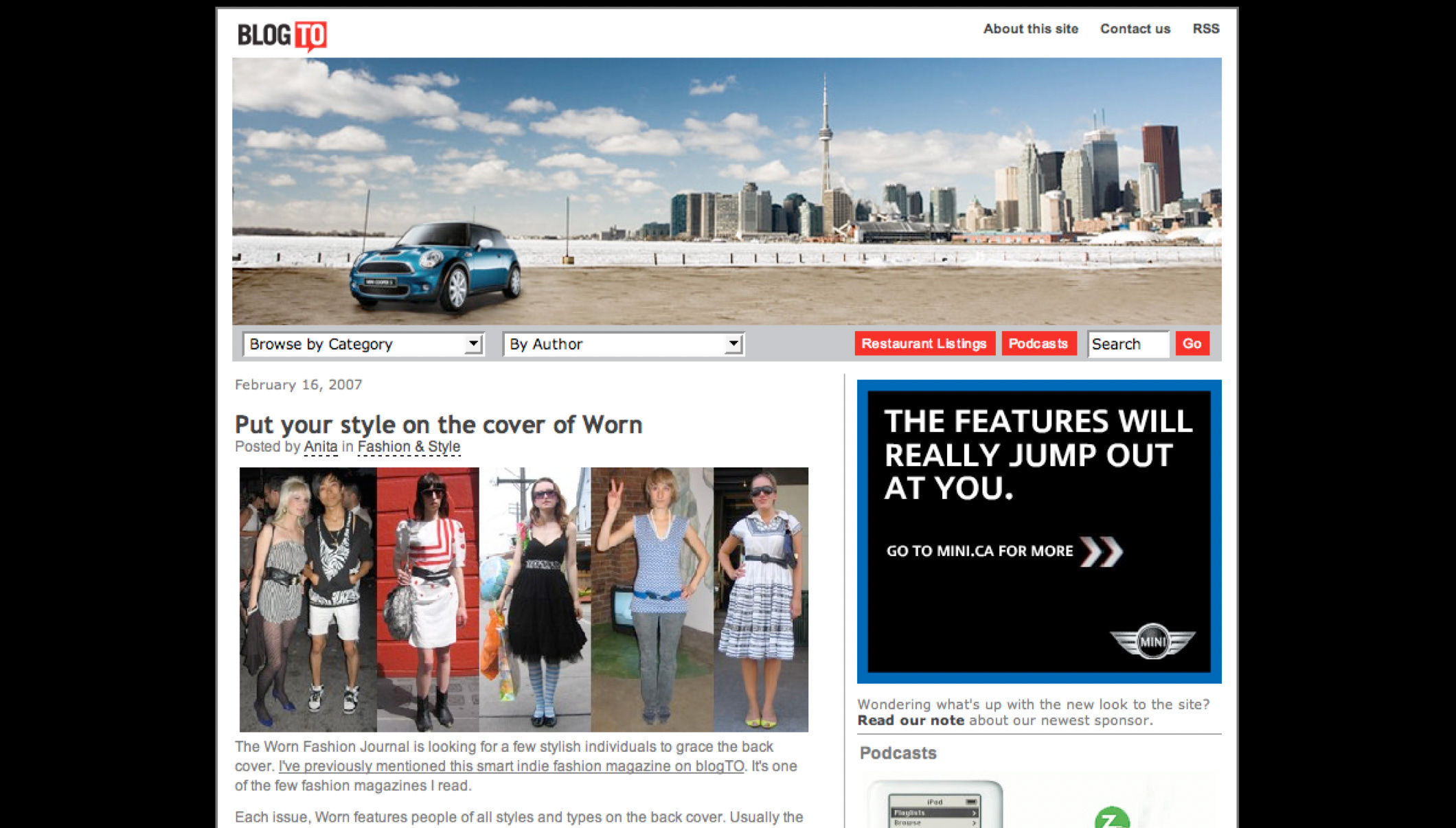
Then we had our biggest ad buy to date: $4,500 across all three Freshdaily sites for the Mini R56 launch campaign.
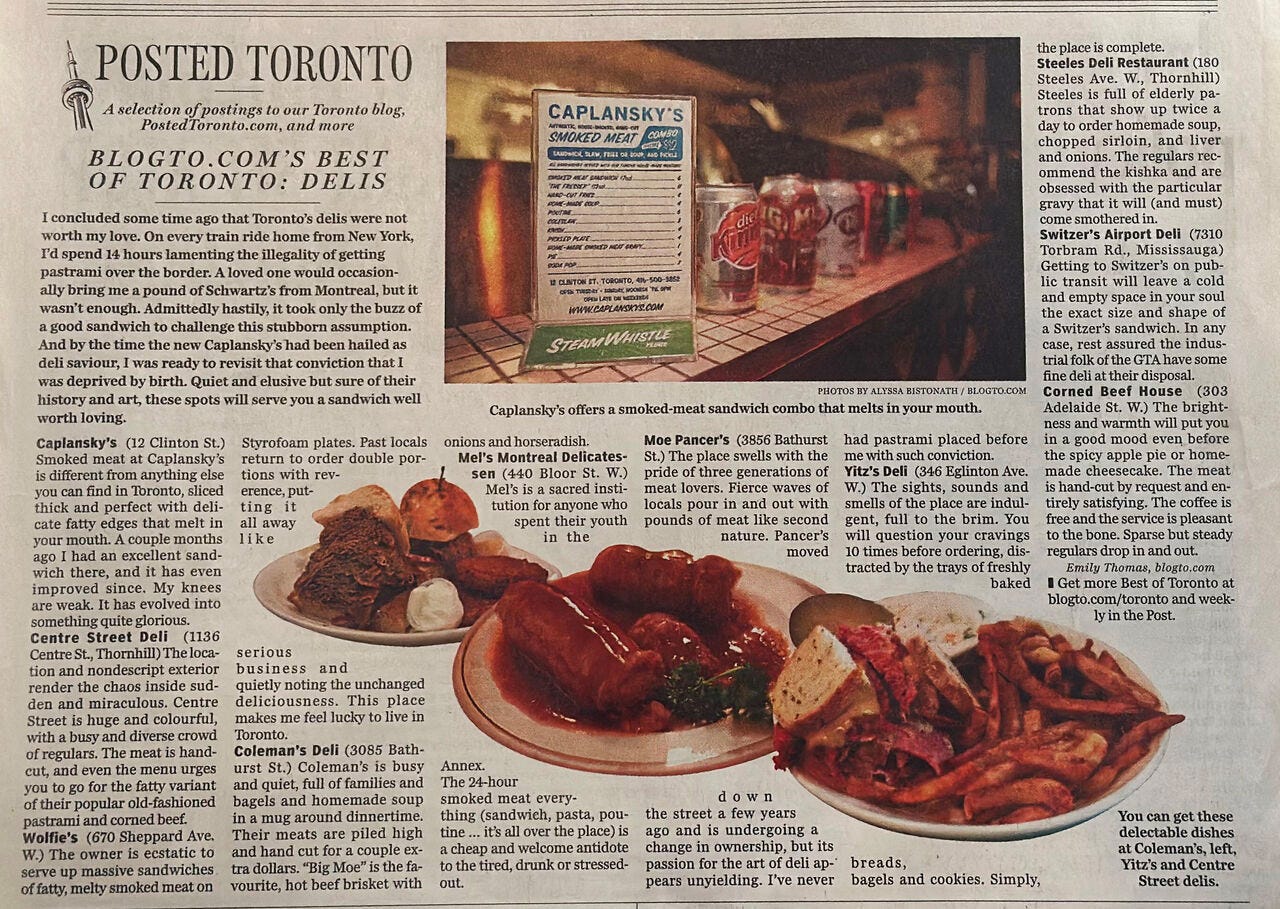
In 2007, we also began a partnership with the National Post that lasted a few years. They ran blogTO content in their print edition, including Best of Toronto features, restaurant reviews and a weekly news roundup that Jerrold would write, similar to the Morning Brew. For the National Post, it was free content. For us, it was free marketing with prominent callouts to the website, introducing blogTO to a wider Toronto audience. The amount of space our content occupied in the newspaper would have cost a fortune if we’d had to pay for it as advertising.
By the end of 2007, total annual revenue across the three Freshdaily sites was just over $65,000. It had taken three years to get there. blogTO was real and growing, but it was still a long way from sustaining itself.
In the summer of 2007, we launched our printed neighbourhood maps. The idea came from similar guides I’d encountered while travelling in Buenos Aires and Mexico City. Ours initially covered four areas: West Queen West and Liberty Village, Parkdale and Roncesvalles, Leslieville and Riverside, and Little Italy and Dundas West.
The maps were highly curated guides to each neighbourhood, printed on recycled paper. We distributed them for free at local cafes, restaurants and shops. We didn’t charge businesses to be included, but we offered them the opportunity to pay for more prominence. Hotels put them in guest rooms. Realtors requested copies for open houses. For a modest shipping fee, people could order a complete set online. We got orders from across Canada, the U.S., Mexico and overseas from people planning trips to Toronto.
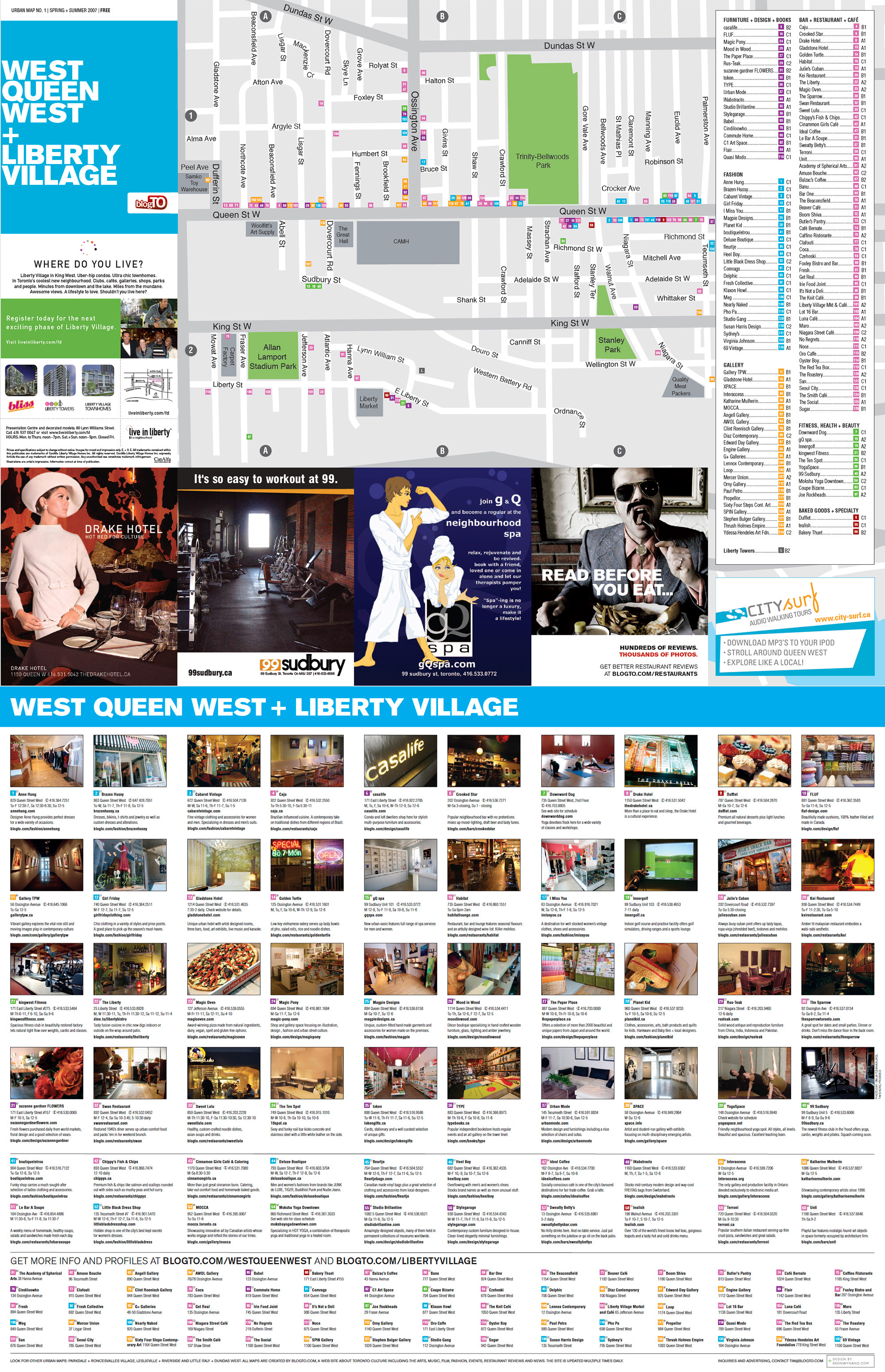
This was the same summer that the first iPhone was released. Google Maps was still a few years away from being something everyone used on their phone. A well-designed printed map of a neighbourhood, with curated recommendations from a trusted site, was genuinely useful.
Creating, distributing and replenishing the maps was hard work. I did all the door-to-door sales and distribution myself. Bronwyn put up with the extra boxes we kept in our apartment so I could do second and third waves of distribution when cafes and shops ran out. The maps were mostly a breakeven proposition, with modest profits in good years. But their real value was as a marketing tool. They built brand awareness, connected us with local businesses, and reinforced blogTO as a brand that helped people discover new places and get to know their city better.
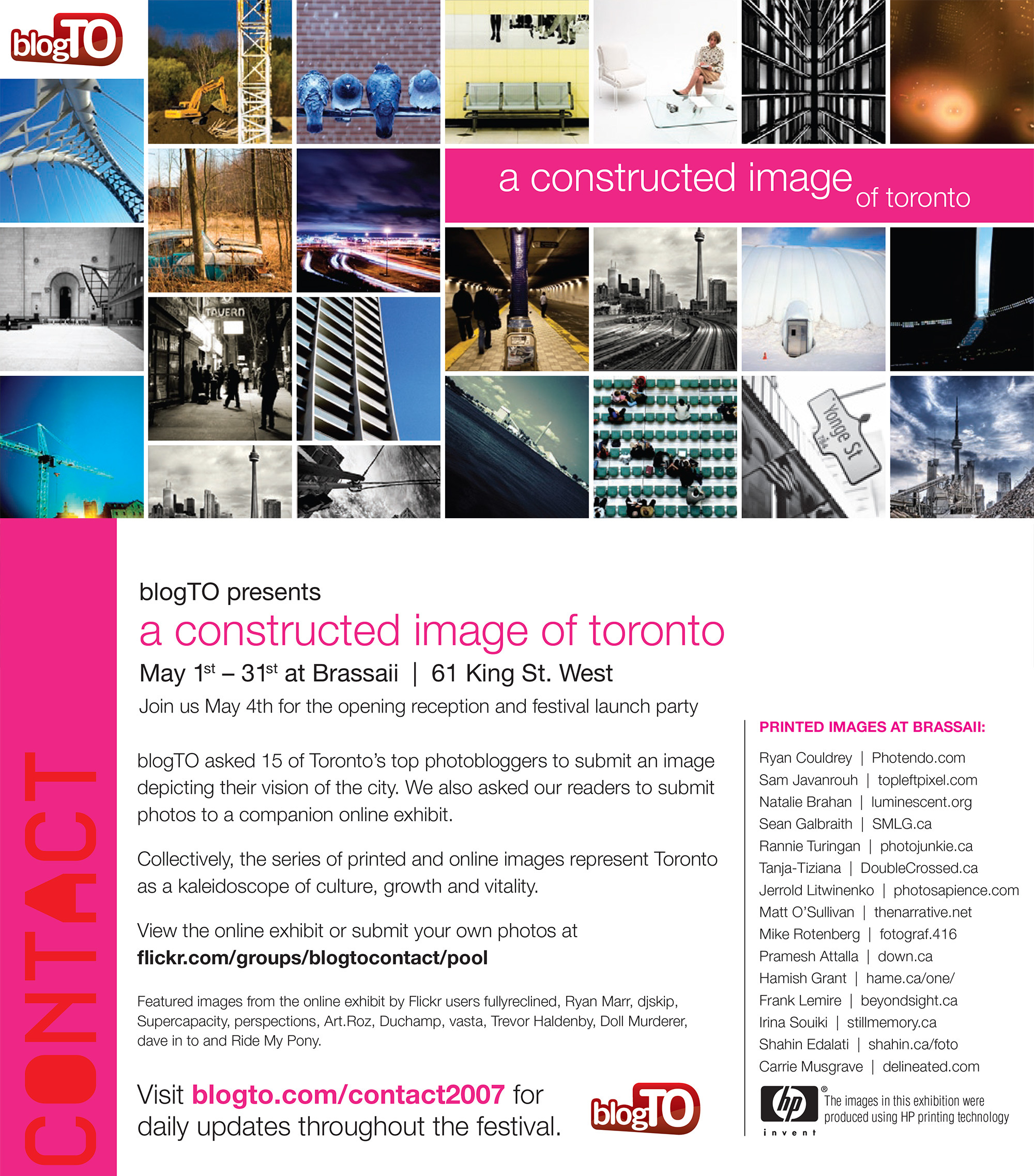
In 2007, we held our first IRL event during the Contact Photography Festival. For the Constructed Image, we partnered with Toronto photobloggers and asked 15 of them to submit one image depicting their vision of the city. We printed them out and held an opening party at Brassaii on King West. We were also sponsoring other local events to get our brand in front of people in the real world.
Around the same time, we were getting recognition. Backbone Magazine named blogTO one of the “Top 20 Web 2.0 Pioneers in Canada.” Forbes included us in their Best of the Web list.
Before the end of 2007, we embarked on our third logo and website redesign in three years. This one was done by Mark Holden, a colleague of mine from Ogilvy. We removed the comment bubble from the logo and leaned into the Web 2.0 design aesthetic that was popular at the time. The site got a more detailed directory section for places like bars and restaurants, making it easier for users to search by category, cuisine and neighbourhood, with Google Maps integration. The event listings section became more robust, with a date picker.
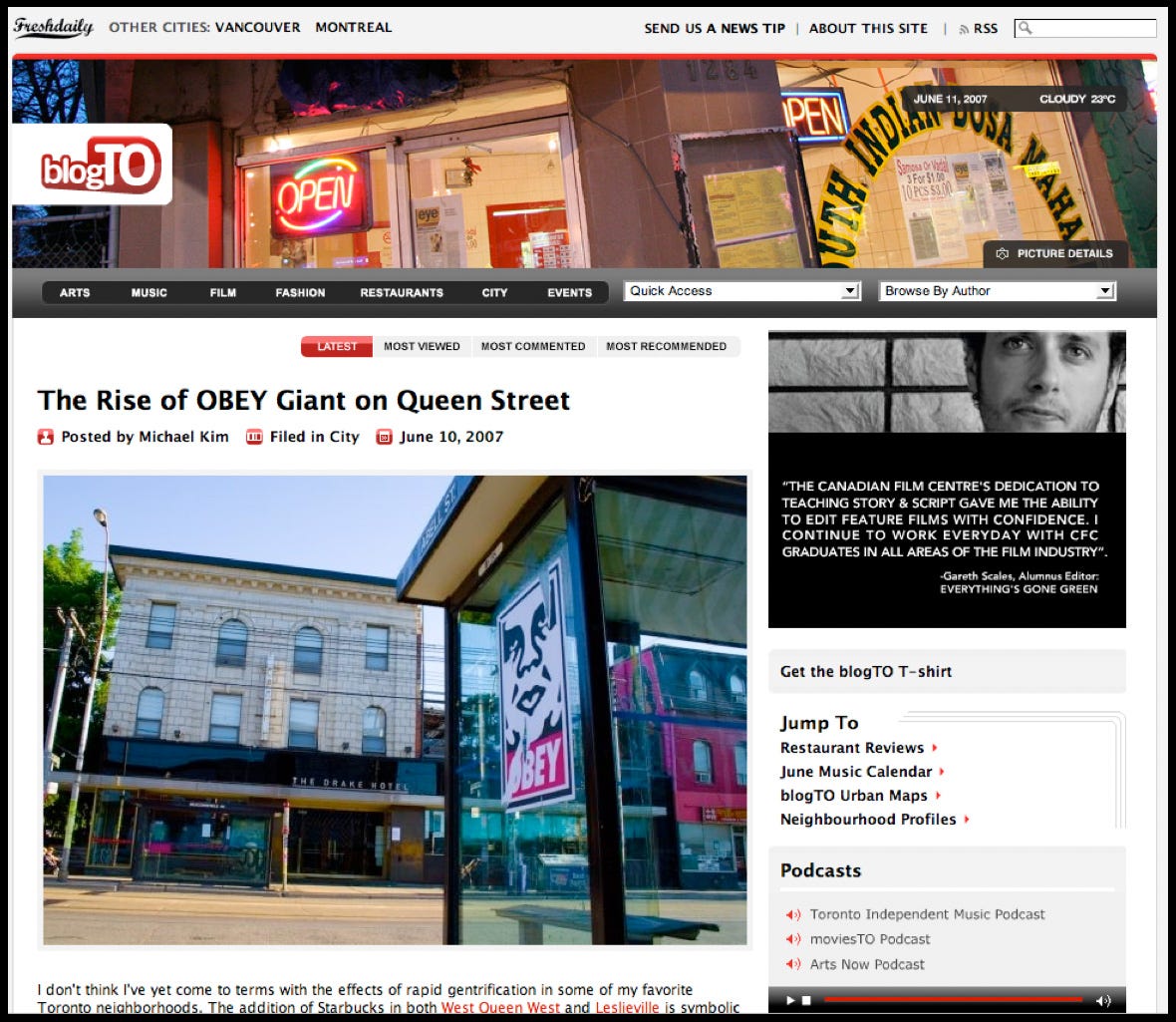
In June 2007, I presented at Casecamp, part of a wave of “unconferences” that were taking place across Toronto’s tech community, alongside events like DemoCamp, PodCamp and TransitCamp. I introduced the audience to the Freshdaily Network, describing it as “hyper-local arts, music, film, fashion, food and news, in Vancouver, Toronto and Montreal.” I talked about what we’d built: over 18,000 podcast downloads a month, 23,000 reader comments and more than 1,000 Flickr group members.
I presented a theory that was getting traction at the time: that we were entering a “blog 2.0” era defined by more sophisticated websites that would make the first generation of blogs look dated. We’d just completed our third redesign and introduced features not typically associated with blogs: a restaurant directory and robust event listings. blogTO had started as a blog, and the name said as much. But it was becoming something else. Something closer to what I’d imagined when I’d worried the name might be too limiting.
And then Ogilvy let me go. My boss had changed, business was slow, and I suspected they knew I was distracted by blogTO. It turned out to be the best thing that could have happened. blogTO was consuming more and more of my time, and I reached a point where it was unsustainable to keep working full-time at an agency while also doing what I needed to keep growing the site. I got one month’s severance. That night, Bronwyn and I went out for drinks at The Embassy in Kensington Market to celebrate.
The next morning, for the first time in three years, blogTO wasn't a side project. It was the whole thing.
It wasn’t glamorous. But every month the numbers went up. Every month, the team got bigger. Every month, there were more advertisers, more readers, more comments, more evidence that this thing was turning into something the city actually needed.
The next chapter of the story is about what happened when we tried to replicate it in Montreal and Vancouver. That’s for the next post.