


On the evening of May 16, 2013, Derek Flack, blogTO’s Managing Editor, was helping a friend move when an alert lit up his phone. Gawker had just published a story alleging that Toronto’s mayor, Rob Ford, had been caught on video smoking crack cocaine.
Derek read the article and immediately messaged Chris Bateman. “Chris, please be able to write this right now,” he thought. Chris was available. Within the hour, an article was live on blogTO under the headline “Gawker says it’s seen video of Rob Ford smoking crack.”
The comments came fast. “Somehow, the madness that has been the Rob Ford saga has all felt like it was boiling down to this moment,” one reader wrote. Within a couple of hours, another noticed something striking: “It’s interesting to note who is NOT yet carrying the story: City, CP24, CTV, and National Post... Oh...and CBC.” A few minutes later, someone else posted simply: “Twitter is on fire.”
The Toronto Star, whose own reporters had viewed the same video weeks earlier, didn’t publish its own story until close to midnight. By that point, our post had been live for more than two hours. That night, thousands of people in Toronto heard the news from us first.
Chris updated the post throughout the night and into the next morning, tracking Ford’s movements, the emergence of Gawker’s “Crackstarter” crowdfunding campaign and the mounting calls for the mayor to resign. The article quickly accumulated nearly 100 comments, with readers debating, speculating, trolling and, in a few memorable exchanges, trying to explain to each other the difference between a crack pipe and a marijuana pipe.
The crack video story was the biggest of 2013, and our coverage of the ongoing Ford saga remained one of the site’s most significant drivers of traffic and engagement for the rest of his tenure. Over the months that followed, the story kept escalating. There were photos of Ford with the Hells Angels, and a video of him drunk and rambling in Jamaican Patois. There were allegations from former staffers about his behaviour at City Hall. Chris covered it all, often updating stories in real time as developments unfolded. Ford wouldn’t admit to smoking crack until November, when he told reporters it had probably happened “in one of my drunken stupors.” A second video would surface the following year.
But that Thursday night in May established something important: blogTO could compete with legacy media on breaking news. Not by producing original investigative reporting, which we didn’t have the resources for, but by being fast, being first to reach our audience, and leveraging the social media following we had built over the years to distribute the story further and faster than outlets with far more people and far bigger budgets.
It became a complement to the original reporting and service journalism that remained the foundation of what we did. When a major story broke, and we felt it was relevant to our audience, we made sure they heard about it from us.
But let me rewind. The year had actually started with a move to a new office.
I had been keeping my eye on the restoration of the Dineen Building at Yonge and Temperance, one of the most interesting building projects in the city. The heritage building, which had originally been home to a hatmaker in the late 1800s, was being brought back to life with a mix of tenants that felt perfectly suited to the Toronto we covered. The ground floor would house the first Dineen Coffee Co. A rooftop seafood restaurant called The Chase was on the way. And the building’s main tenant would be IQ Offices, which was about to open its first coworking space.
I had never expected to have an office in the Financial District, but the opportunity was there, and I took the same approach that had worked at Workplace One. I pitched a barter deal: advertising on blogTO in exchange for office space. IQ Offices agreed. On January 1, 2013, we picked up the key cards to our new home.
The team had grown considerably. By 2013, we had the largest roster of writers, photographers and editors in blogTO’s history.
Our core group of staff was anchored by Derek, Chris, our Culture and Events Editor, Aubrey Jax, staff writers Erinn Beth Langille, Jen Hunter, Liora Ipsum, Rick McGinnis and Natalia Manzocco, Staff Photographer Jesse Milns and Style Photographer Mauricio Calero.
Around them was a deep bench of freelancers covering nearly every corner of the city’s culture.
Ben Johnson was chronicling the local beer scene at a time when new breweries were opening across the city, and Toronto’s craft beer culture was beginning to come into its own. Darren Susilo was writing about restaurants in Scarborough, Markham, and Richmond Hill, covering these dining destinations well before other publications recognized them as places worth paying attention to. His piece on the hidden gems at New Kennedy Square, an unremarkable-looking mall that happened to house some outstanding food, was exactly the kind of story that set blogTO apart. Nobody else was writing about it.
Erin Scholtz pulled double duty as both a food and music writer, discovering new places to eat in one post and curating monthly concert guides in the next, from her pick for the best bowl of soon tofu in Koreatown to a rundown of every show worth seeing that month. Anders Whist, Josh Wise, Laura Adams, Tara MacInnis and Amanda Cupido rounded out the food team, covering restaurant openings and closings, writing up new spots as soon as they appeared, and producing our recurring DineSafe round-ups that readers loved and restaurant owners dreaded.
The music team was one of our largest verticals. Ryan Bolton, Adam Kamin, Eric Boshart, Jesse Ship, Julia Stead, Markit and Lori Steuart covered the local scene with genuine enthusiasm. The size of the team and their willingness to go to shows most nights of the week allowed us to provide extensive live music coverage that shone a light on Toronto’s vibrant music community, particularly up-and-coming artists and bands at smaller venues like Handlebar, The Garrison, Double Double Land, Wrongbar and Sneaky Dee’s.
Our photography team was nearly as large as the writing team. Alejandro Santiago, Brian Morton, Matt Forsythe, Hannah Jor, Matt Kozovski, and Irina No focused primarily on concerts and festivals, filling the site and our social feeds with photos from shows every week. Morris Lum, Jimmy Lu, Christian Bobak, Denise McMullin, Emily Baillie and Andrew Williamson shot everything else: the arts scene, local businesses, food, people, news and events. Together, they documented parts of the city that mainstream media rarely covered, from a Star Wars fan fiction comedy night to a shop that combined handmade art with salvaged industrial materials.
Blake Williams was our film writer. In a world before streaming services, he wrote a recurring feature called This Week in Film, picking what was worth seeing in cinemas that week and covering local festivals like Hot Docs and TIFF. Kate Fane was our window into the local arts scene, writing about everything from the city’s artist collectives to the ongoing displacement of galleries as rising rents pushed creative spaces to new parts of the city. Keith Bennie covered the theatre community, including festivals like SummerWorks, in a recurring column called This Week in Theatre. Michael Jagdeo highlighted the comedy scene in a weekly column called This Week in Comedy.
Ana Starats and Jonathon Muzychka profiled local tech startups. Erica Berman covered fitness, writing about gyms, yoga studios and new ways to work out in the city. Dylan Giuliano tracked new real estate developments.
The breadth of the team meant that when we published something about film, theatre, comedy, the arts, live music, food, beer, fashion, technology, or any of the other subjects we covered, the work came from writers who were genuinely immersed in those worlds. They knew the scenes they wrote about because they participated in them.
2013 felt like the year we were hitting our stride. The content mix was strong: breaking news sat alongside food coverage, lifestyle writing and deep cultural reporting. We had unique, originally reported stories that readers encountered on blogTO first, often days before another publication wrote their own version. We had recurring weekly, monthly and seasonal content that kept people informed about what was happening in Toronto. And we had a team with the knowledge and curiosity to make it all credible.
The Rob Ford coverage had demonstrated that we could compete on speed when something broke. But the foundation of what made blogTO work was still the daily grind: the restaurant openings, the neighbourhood profiles, the live music and arts coverage, the DineSafe round-ups, the lists that people loved to argue about in the comments. It was service journalism and cultural coverage, produced by people who cared about the city, and it was what kept readers coming back day after day.
I had more ideas for where to take the brand than we had resources to pursue. I briefly considered launching a blogTO Kids brand extension to produce content aimed at parents. With two young children of my own, the concept was appealing, but it would have been a significant departure from our existing audience and editorial focus. With multiple projects already in progress, some of which were struggling, I had to be disciplined about what to prioritize. I shelved the kids’ idea. We were never short on ideas for how to grow and expand. The constraint was always our ability to fund and execute them.
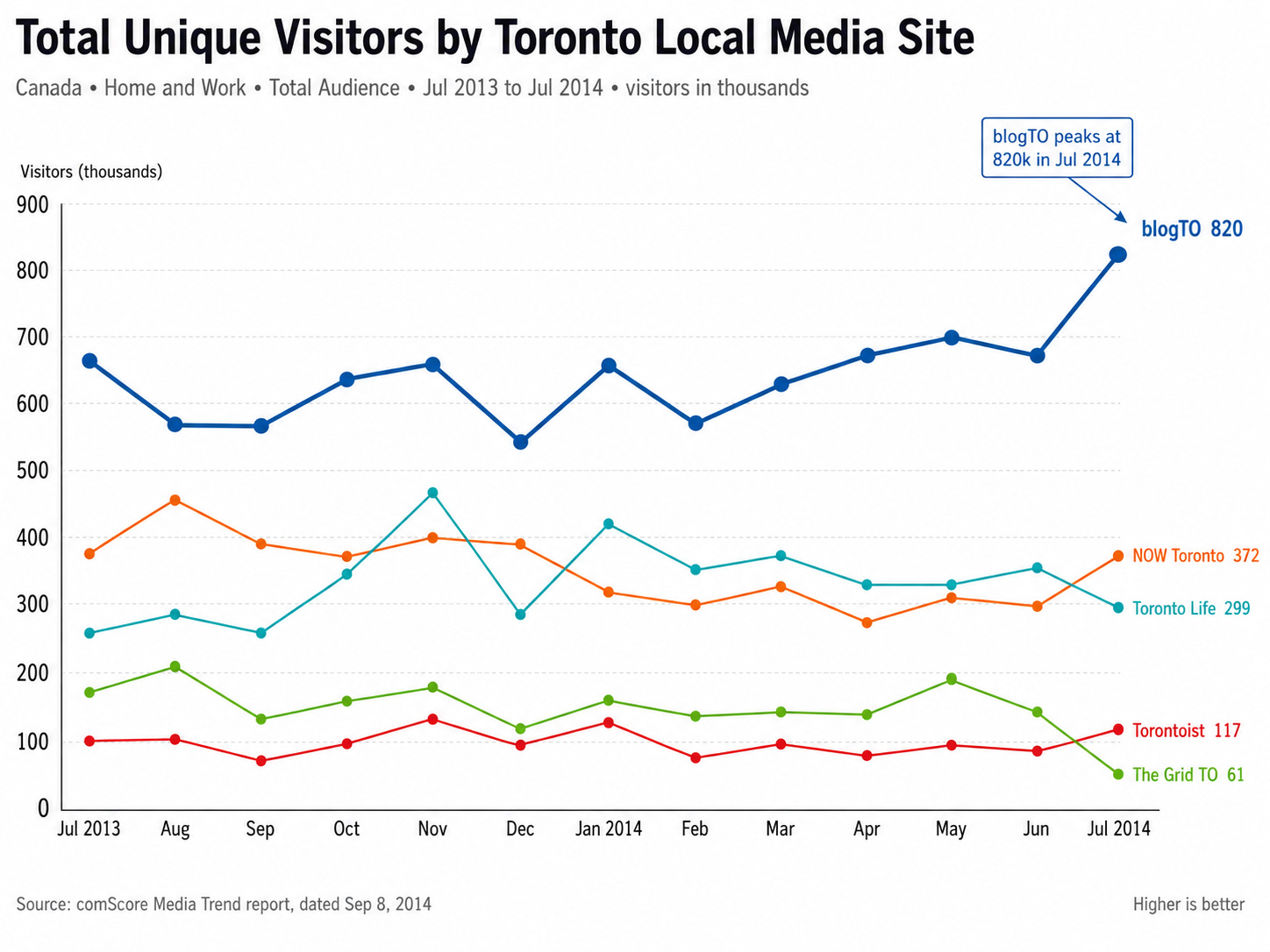
On the competition front, 2013 brought a couple of American entrants to the Toronto market.
Eater, the food blog that had started in New York in 2005 and expanded nationally four years later, launched in Toronto on October 2. I had always figured it was only a matter of time before they came north. I had been studying their content strategy for years and made sure there were no gaps in our food coverage that would give them an opening. A few days before their Toronto launch, their newly hired local editor emailed us to ask if blogTO would like to do an exclusive interview with Eater’s owner, Lockhart Steele, about the expansion. They offered early access to the Eater Toronto website before it went live. We laughed. We weren’t about to introduce our readers to a competitor. We had our sights set on doing whatever we could to prevent Eater from gaining a foothold in Toronto. Sure enough, they didn’t. They didn’t have anything to offer the city that blogTO wasn’t already doing. Eater shut down its Toronto operation less than a year later.
Thrillist, which covered food, travel and events, also started publishing Toronto content that year. Their local output consisted mostly of event round-ups and restaurant listicles, none of which added any value to what we were already doing. Several of their articles also featured photos taken by our photography team without permission. I emailed them repeatedly asking them to stop. Their editor eventually apologized and removed the images. Thrillist never gained meaningful momentum in Toronto and appears to have published its last local article in 2018.
I was also keeping an eye on Shopcastr, a Toronto-born startup that had been around since 2011. Founded by Matt O’Leary and backed by Mantella Venture Partners, the company had raised $1 million and built a local e-commerce platform that connected shoppers with independent retailers. Matt had reached out the previous year about a cross-promotion, but as the much larger brand, the trade didn’t make sense to me.
If I were being honest, I admired what they had built and wished we had the technology to complement our editorial coverage of local shops and retail. We didn’t have the capacity to do what they were doing, so I watched them cautiously. You could never predict how a startup might evolve, and it wasn’t out of the question that they could expand beyond their initial offering and start competing on our turf. By 2013, they had a new CEO and were gaining momentum, but they never expanded in the direction I feared. Shopcastr was acquired by Symbility Solutions before the end of the year.
As if the competitive landscape wasn’t enough to manage, Google added to the pressure.
On July 10, I got a call from Google’s enterprise team informing me that we would now need to pay for Google Maps. Since the site’s early days, every map element on blogTO had been powered by Google: restaurant pages and other business listings, events, and listicles. We were generating roughly 65,000 map loads per day, nearly 24 million a year, well beyond the limits of Google’s free tier. The annual cost to continue: approximately $100,000.
I flagged the situation to Abraham and Taylan immediately. Taylan had seen this happen to two other clients. In both cases, Google had doubled the price within six months. His recommendation was clear: switch to Mapbox, which Foursquare had already migrated to earlier that year, at a fraction of the cost.
The decision was easy. The execution required some deception. If Google realized we were planning to leave, they might cut our access before the migration was complete, breaking every map on the site. So I wrote back and told them we were looking into things, buying time while Abraham and Taylan worked on the switch behind the scenes. I kept stalling. By mid-August, Google told me that if I didn’t agree to the new terms by September 20, our domain would be blacklisted, we’d receive a terms-of-service violation letter from their legal team, and maps would stop loading across the site.
With days to spare before the deadline, the team finished the Mapbox migration. I wrote to Google and let them know we wouldn’t be continuing with their product.
Meanwhile, two of the major projects we had initiated the previous year were not going according to plan.
The redesign of the blogTO website by Playground was months behind schedule. By the time we moved into our new office, the bulk of the work was still incomplete. I’d show up for creative review meetings at their office near King and Spadina, only to find that the templates I was expecting weren’t ready or didn’t meet the requirements I had provided.
Playground was also now asking for more money, arguing the project was more complicated than they had anticipated. I pushed back. They hadn’t followed their own processes, and the work felt uninspired, not the calibre I expected from the agency behind The Toronto Standard’s award-winning website.
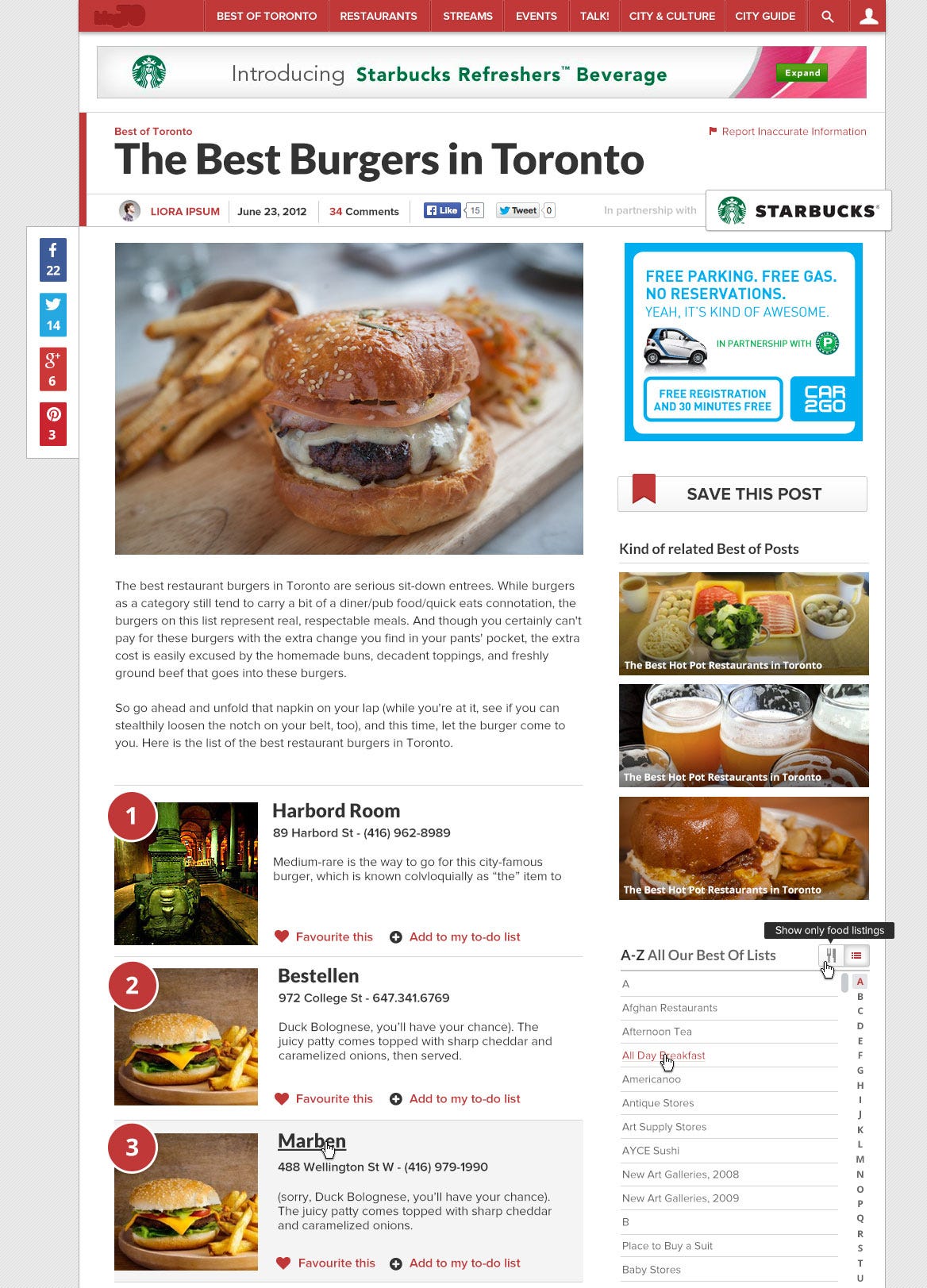
In hindsight, I had been overly ambitious with the scope. Beyond a visual overhaul, I had layered in features meant to compete with much larger, better-funded platforms: a user profile system with the ability to save articles, rate businesses, and check-in to places; a photo-sharing module where users could upload and organize images by theme; an enhanced events section; and the ability for readers to create and share their own versions of our listicles.
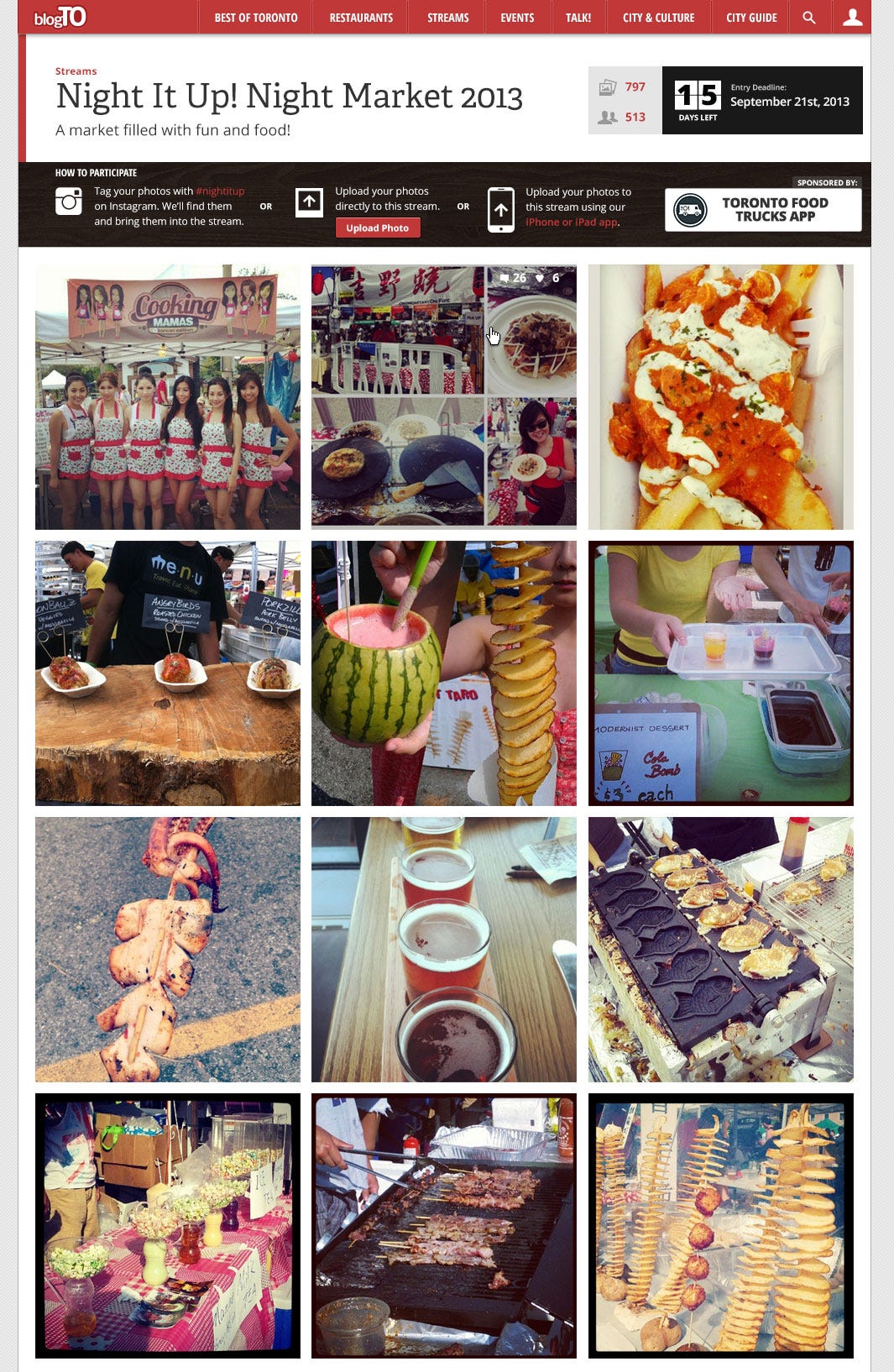
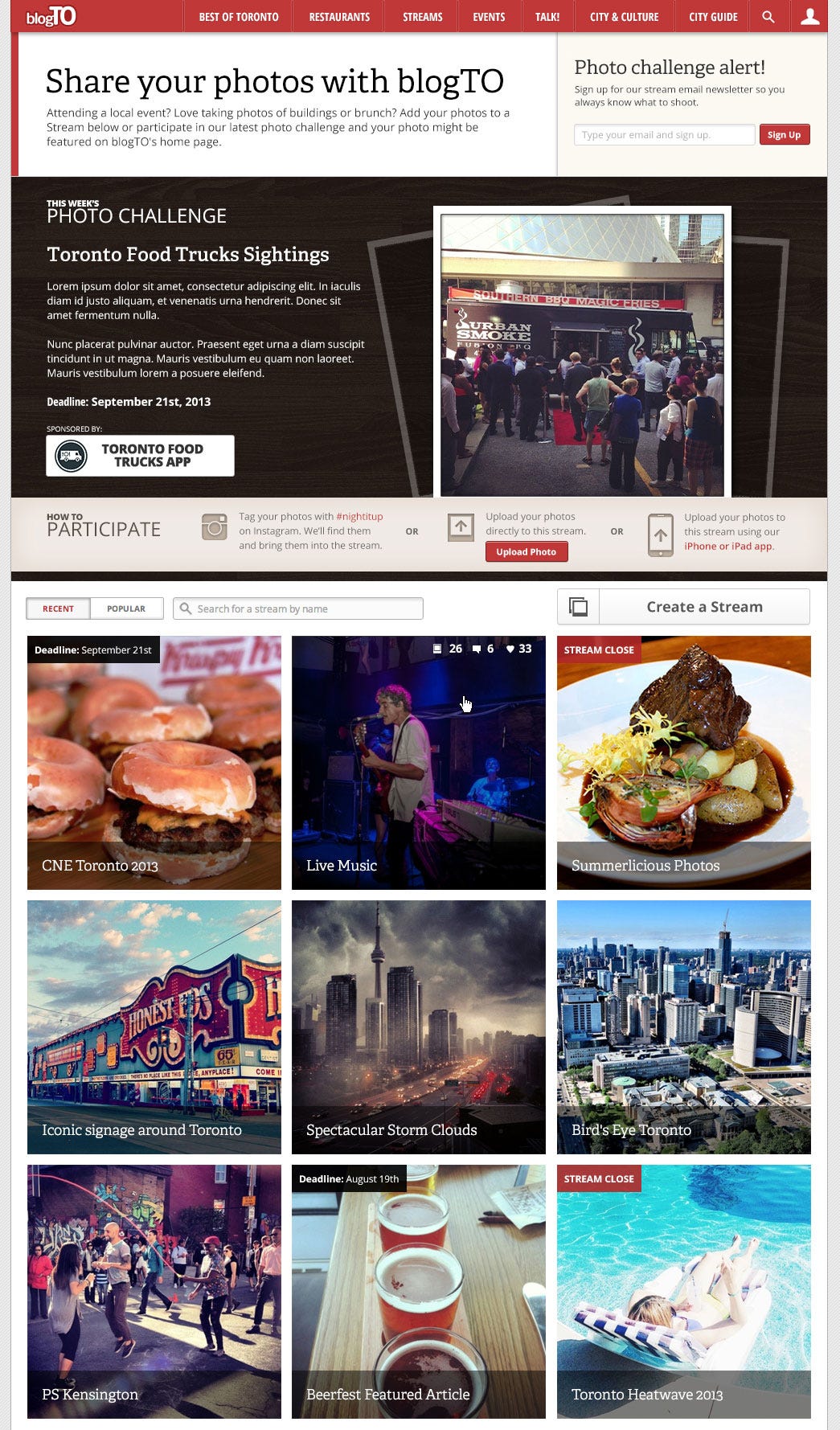
Around the time the Rob Ford crack video broke, Playground finally completed its scope of work, but the deliverables had issues. The few templates we did implement created a disjointed experience for readers. The street-style module from the previous year had one visual language, the new contests section had another, and the mobile version of the site looked different again. The blogTO website had no coherent identity. And by that point, the approach to web design had continued to evolve, making it clear we should have been building a responsive site rather than separate desktop and mobile templates.
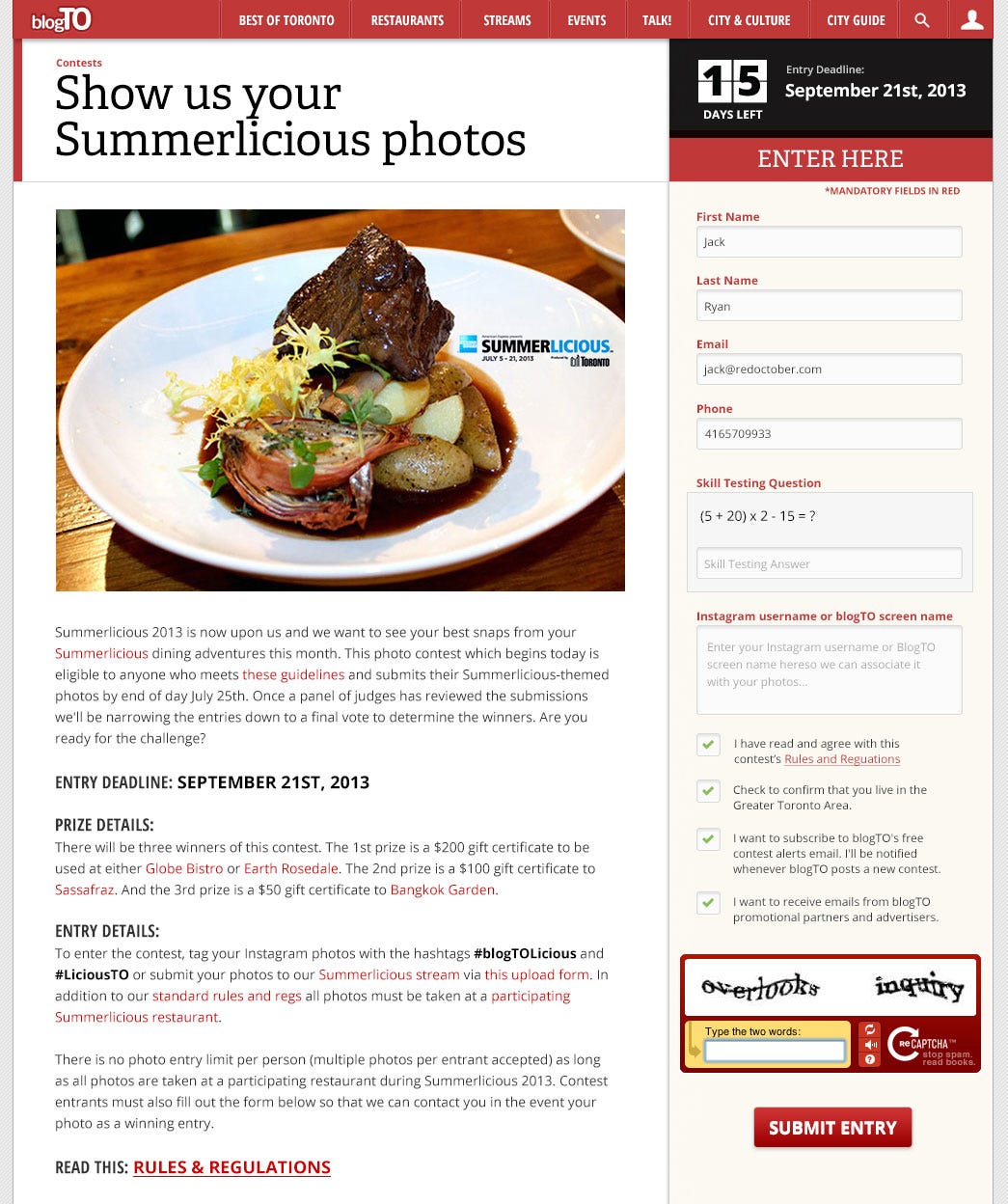
I decided to salvage what we could and move on. I asked Dondy, who had done strong work on the Patio Guide and Toronto Food Trucks, to revise some of Playground’s designs into a usable state. We managed to implement a handful of templates, including the events, streams and contests sections. But we scrapped the rest. The majority of the site still looked the same as it had before the project began.
It was one of the most expensive mistakes I made while running blogTO.
The Android app was its own saga.
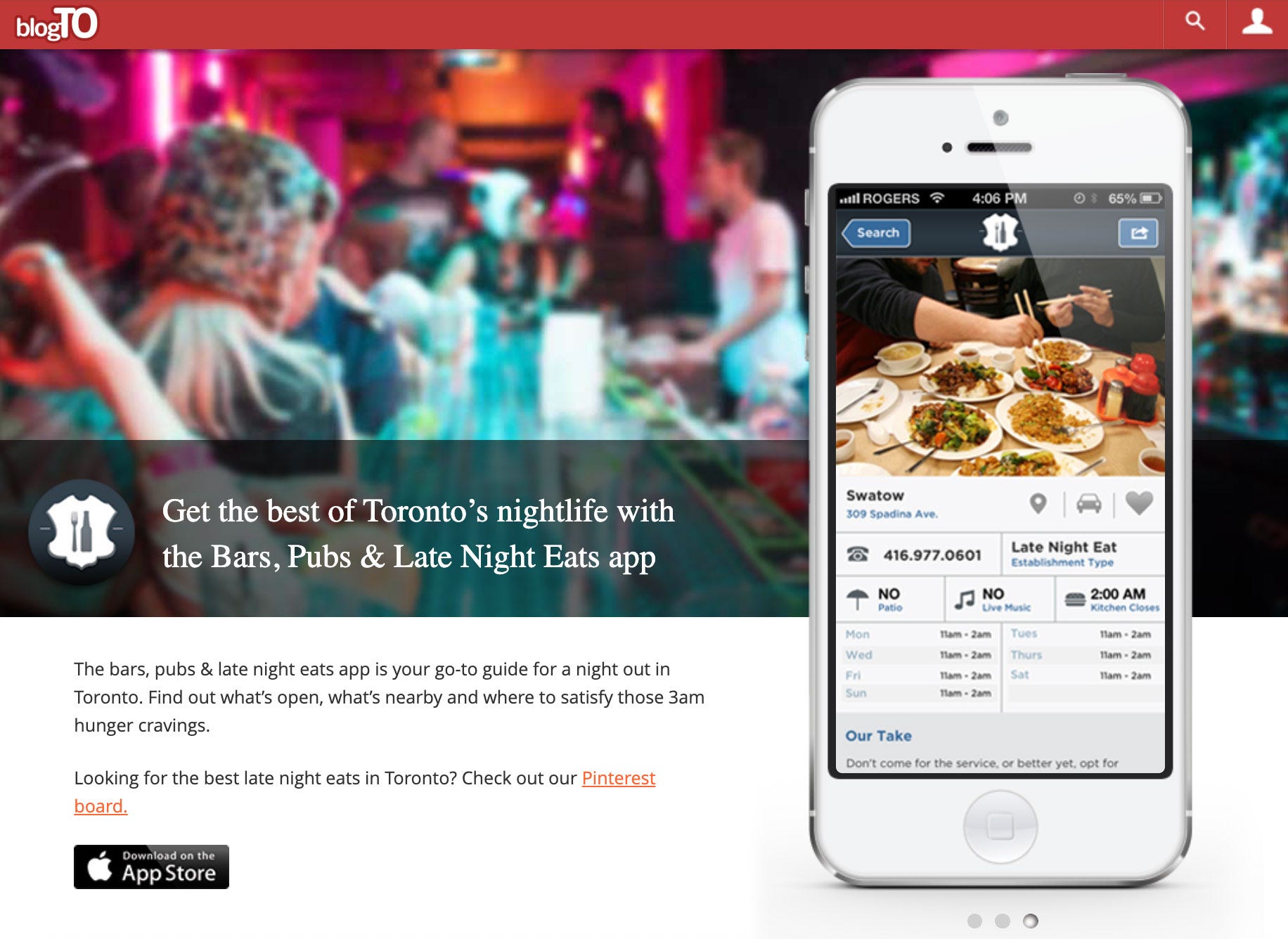
The smaller apps shipped first. Bars, Pubs and Late Night Eats launched in February 2013 and was designed to help people find places to drink and eat late at night. You could search by neighbourhood or subway stop, browse photos and details for each spot, and filter for places that were still open, a feature that came in handy after last call.
My favourite touch was a feature that let you shake your phone to get a random suggestion. Couldn’t decide where to go? Just shake again.
The trade publication Media in Canada covered the launch. To support the app, we ramped up our editorial coverage of late-night dining.
The Patio Guide for Android followed in May, timed perfectly to the start of patio season. Nothing marks the shift to warmer weather in Toronto quite like patio openings, and interest in patio content is always highest at the beginning of summer. Suite 66 had sold advertising to a beer sponsor across all our patio content and apps, so there was revenue at stake with the deadline. We made it.
But the main blogTO Android app remained stuck. We had gone through multiple builds and rounds of revisions, yet the app remained buggy and lacked key features. Halogen Mobile had tried to replicate the iPhone app’s design but had made changes to accommodate Android-specific conventions that I wasn’t happy with. I wasn’t willing to release anything until the Android version matched the iPhone app in both functionality and design quality.
Meanwhile, readers kept emailing to ask when the Android app would be available. Some of them had been waiting since the previous summer, when we had announced it was on the way. I responded to as many as I could, apologizing and promising we were still working on it.
By summer, we had exhausted the project’s budget. Halogen asked for more money to finish. I started looking for someone else.
My search led me to Sleeklabs, a small app development shop run by Satraj Bambra and his wife Megha. They had built the apps at Wave Financial and were fans of blogTO. When I asked them to audit the existing code, their assessment was blunt: the code base wasn’t worth building on. They recommended starting over.
There would be no blogTO Android app before the end of the year. All those readers who had been emailing us would have to keep waiting.
2013 was busy. Our audience was growing. Some of the projects we had set in motion were working. Some were not. But blogTO was on a roll.
In the next post, I'll write about what happened when the Facebook algorithm started becoming more powerful, and the difficult decisions we made to adapt to it.
The Rob Ford scandal seems almost innocent now. Incredible to review this timeline, work, competition and decisions, Tim.
Too bad you don’t still work at Yonge and Temperance!