


By 2008, the local digital media landscape in Toronto was getting crowded, and the competition was coming from directions I hadn’t originally anticipated.
blogTO had grown into a site that did a lot of different things. We published local news and culture coverage, which put us up against established local media and newer digital rivals like Torontoist. We had restaurant reviews and business directories, which meant we were now competing in a space alongside platforms built specifically for that purpose. We had event listings, which increasingly meant competing with Facebook itself. My view of who we were up against had become very broad.
So who were the new competitors?
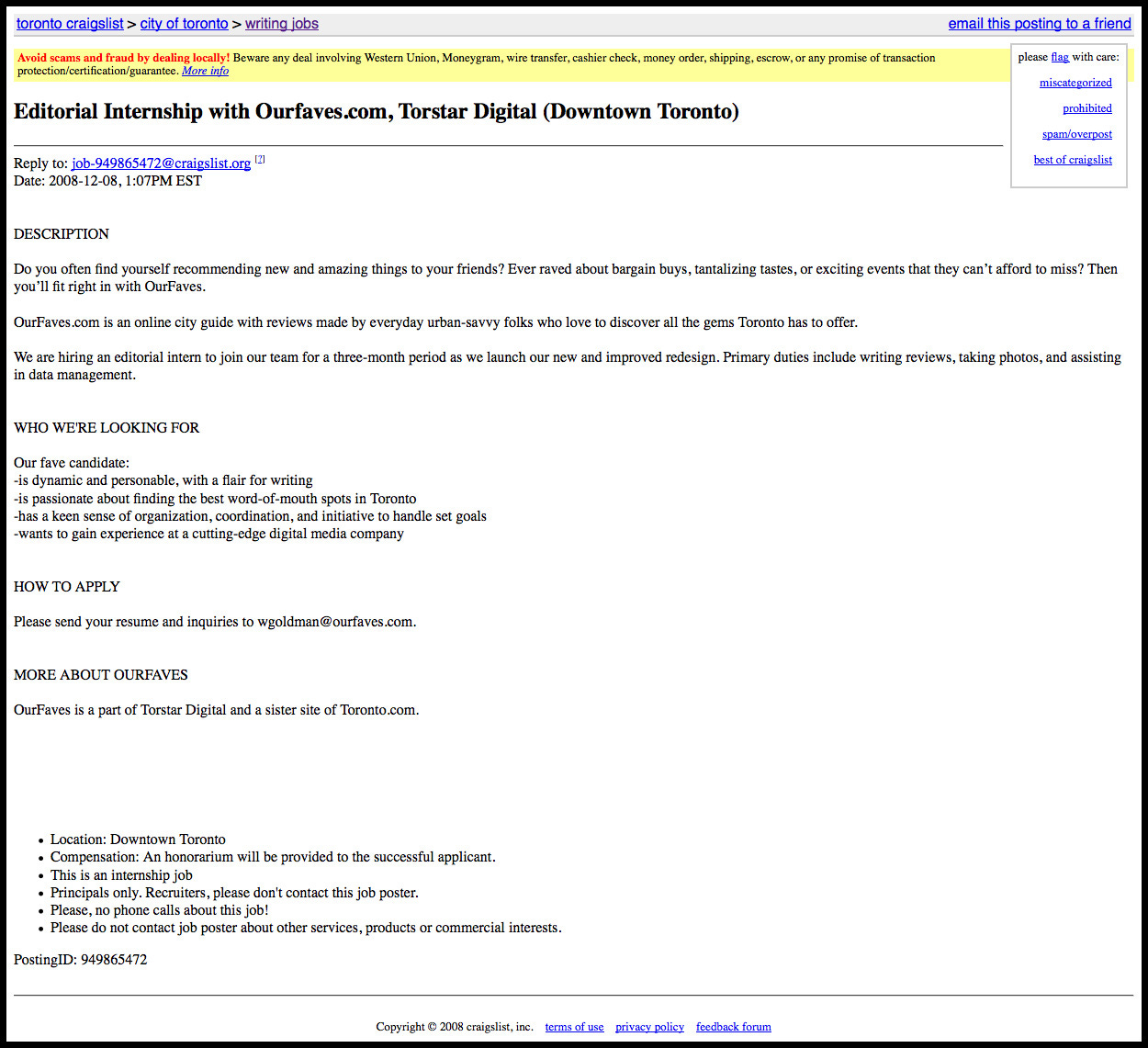
Torstar Digital had launched OurFaves the previous year, an online city guide built on user-generated reviews and staffed largely by unpaid interns.
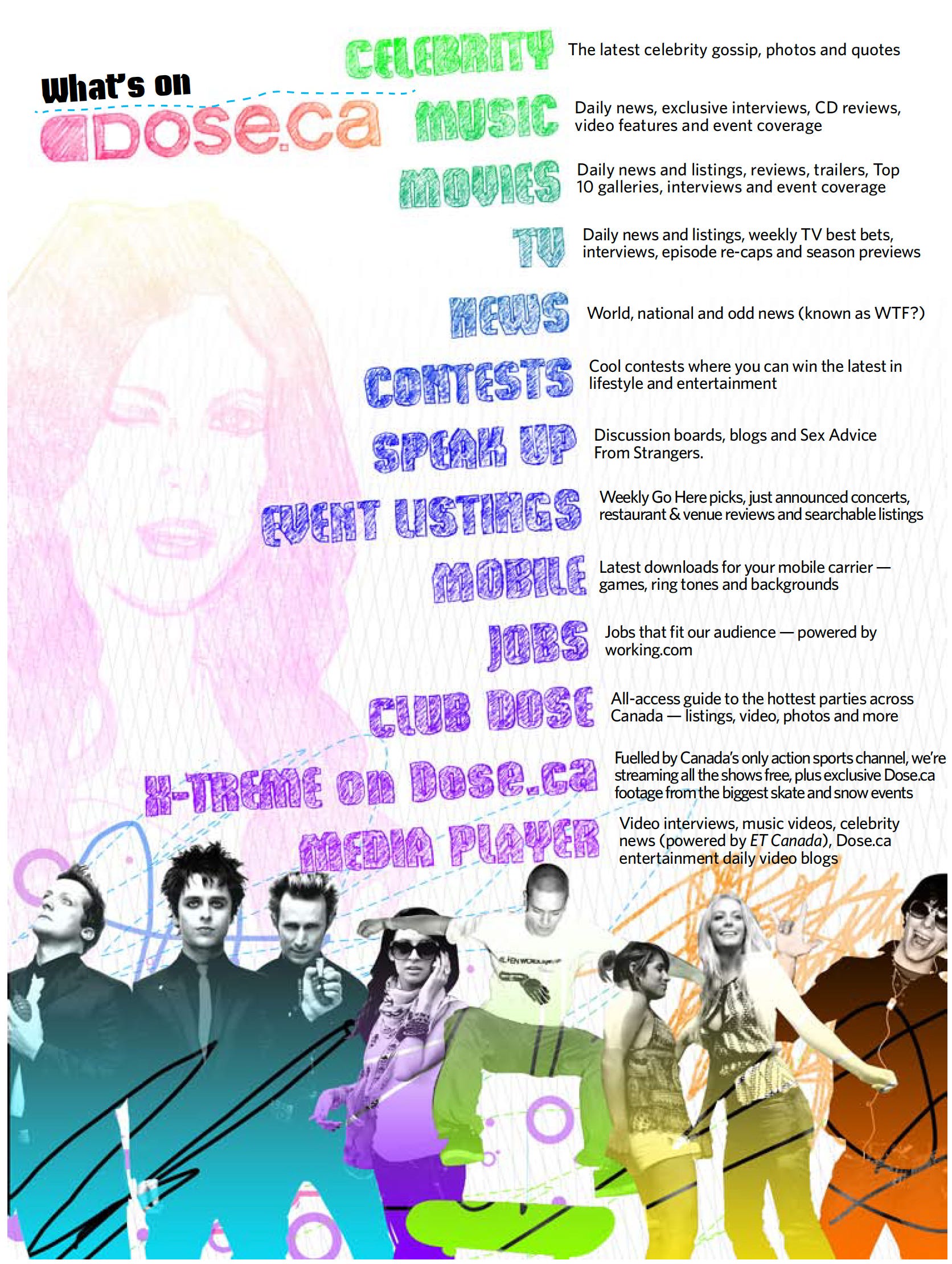
Dose, the Canwest Media publication that had launched as a free daily newspaper in 2005, had dropped its print edition and gone entirely digital. It had more writers and resources than we did, and its website looked good. Dose was more entertainment and celebrity-focused and didn’t go nearly as deep into the city-centric reporting blogTO had become known for, but it was close enough to our space that I paid attention.
She Does the City was launched the previous year by Jen McNeely. It had started to build a small but loyal following. Its coverage deliberately skewed female and tended to revolve around the downtown west scene. I didn’t view it as a direct competitor, but it was another publication going after a piece of the Toronto audience.
Vice Media had opened a Toronto office. They were still primarily a print magazine at the time, but they were beginning to invest in digital, and there was some concern that they’d start stepping on our turf. One of their editors even got in touch with us to propose sharing content between the two sites. I wasn’t interested.
Then there were the well-funded American platforms expanding into Canada. Yelp launched in Toronto in 2008, one of its first international markets outside the United States. Urbanspoon, another major player, was also competing in the restaurant review and discovery space. I felt we needed a strong competitive offering in place to defend our position before these platforms gained too much traction in the Canadian market.
The answer, as far as I could see, was to keep doing what we were doing but do more of it, faster, and with better tools.
blogTO had always been a community-driven site. By 2008, we’d created a wide range of ways for people to participate beyond just reading and commenting. You could submit different types of content, such as articles, reviews or event listings, send us news tips, or even submit photos that we would rotate next to the logo at the top of the site. In a pre-Instagram world, our Flickr group was a popular place to share photos, and we regularly featured Flickr submissions in our articles.
Jerrold kept our Twitter account active and interesting. He was always coming up with fun ways to engage followers. And when someone in Toronto joined Twitter, blogTO was often among the first accounts they were recommended to follow, which helped our following grow quickly.
Early that year, I gave a presentation called “Website Marketing in Facebook” at a Toronto unconference called Facebook Camp. Facebook had launched its developer platform the year before, and we were among the first Canadian media companies to build something on it. Our Facebook application was called Toronto Faves, and it let users create a list of their favourite Toronto restaurants, bars and other places and display it on their Facebook profile.
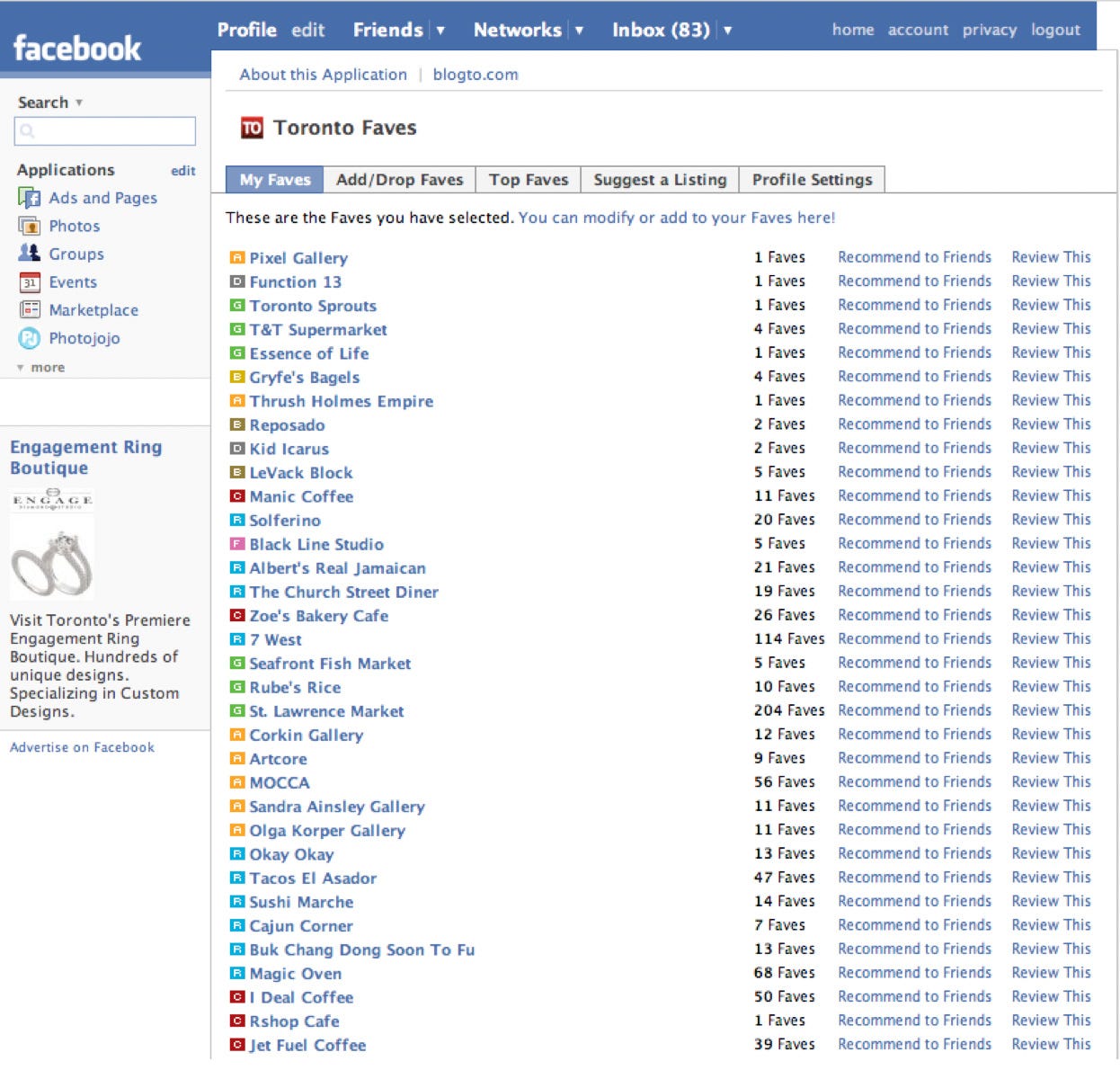
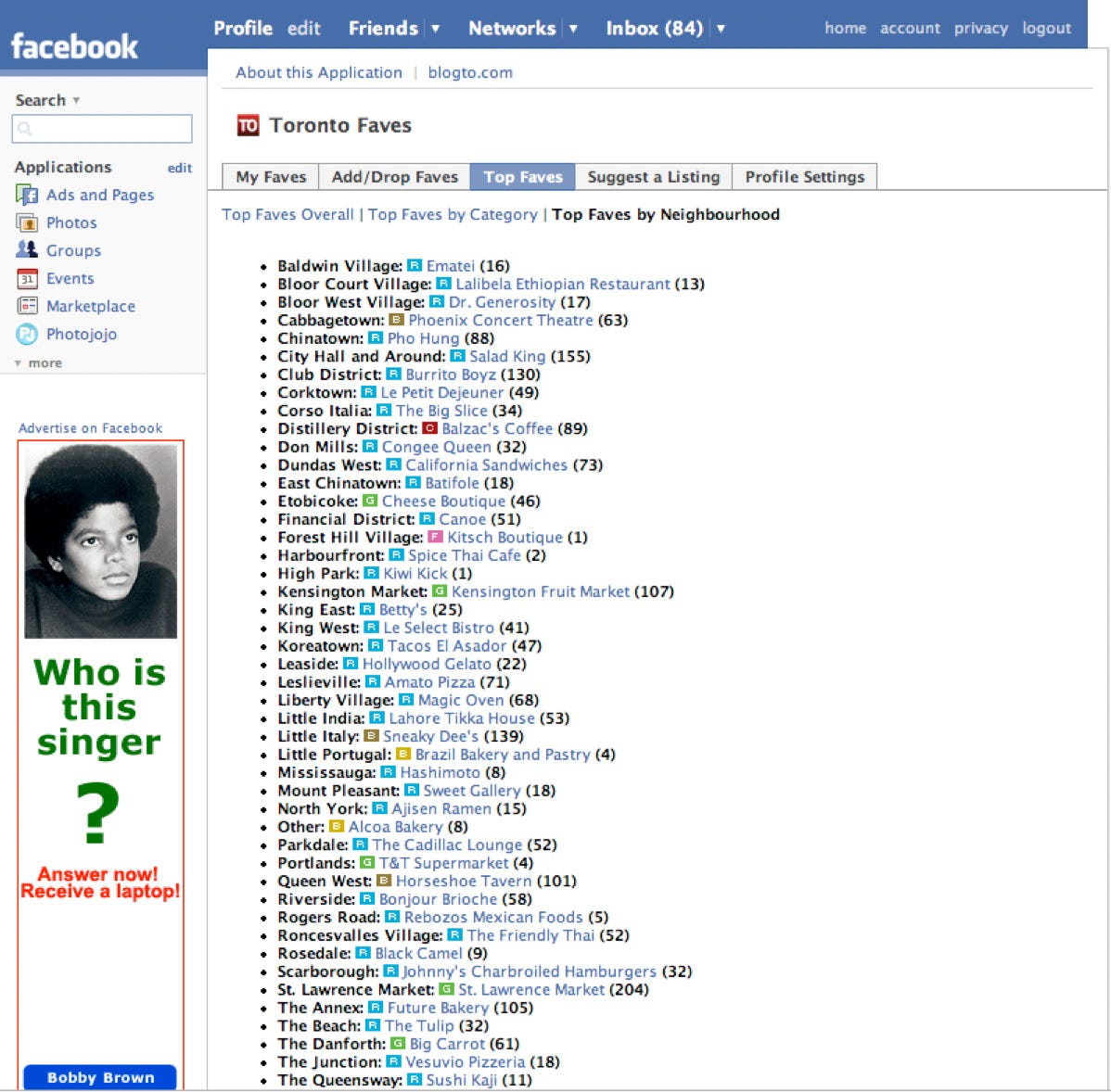
On the blogTO website, we added an “Add to Faves” button next to some of our content. We built a leaderboard so you could view the most popular faves by category or neighbourhood. Within months of its launch, we had nearly 1,000 users, and Facebook had become our second-largest source of traffic after Google.
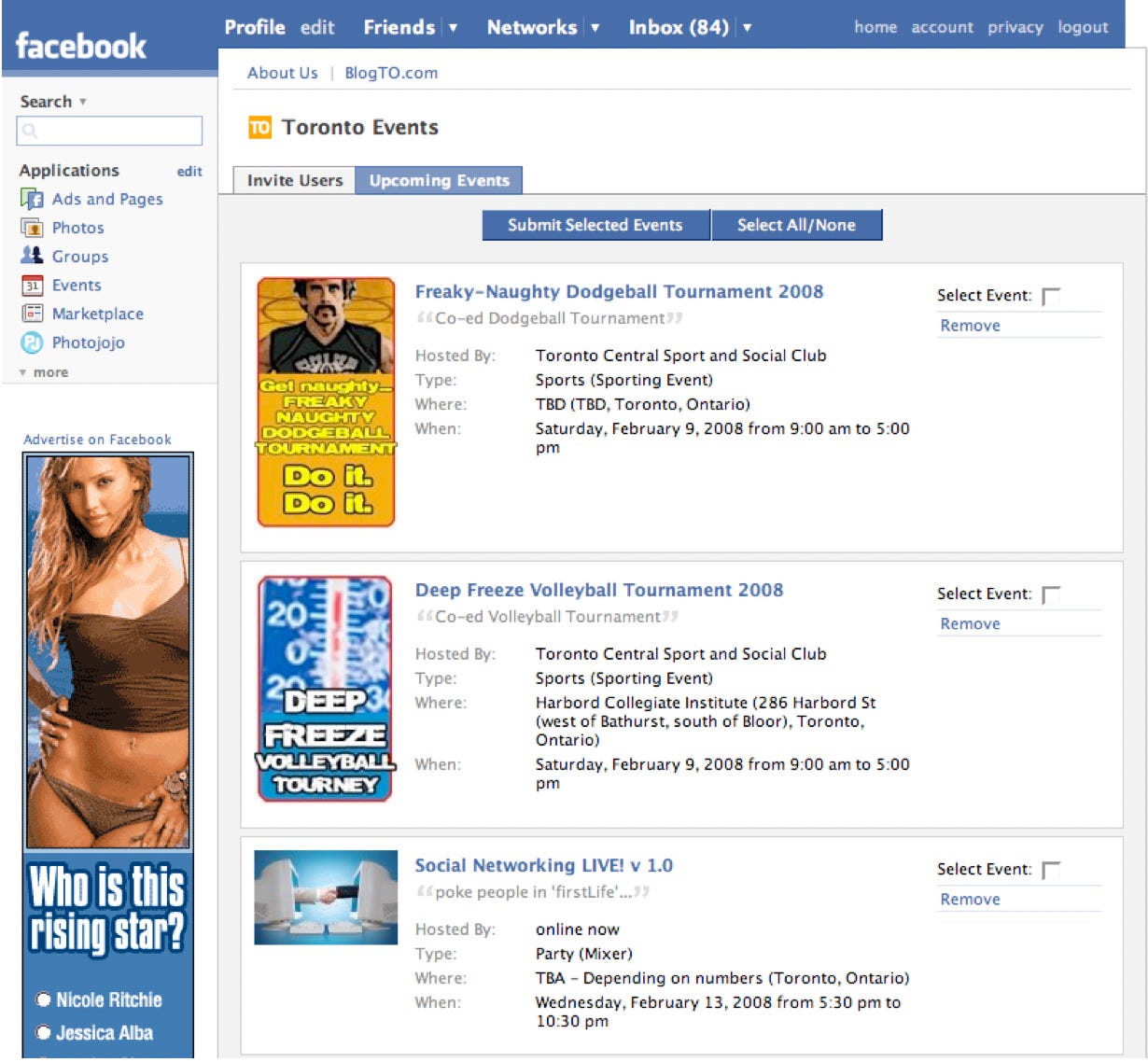
We followed it with a second app for events. By this time, most people in Toronto had started using Facebook to promote their events. Our app let them push those events directly into blogTO’s event listings with a couple of clicks. We also built an internal tool for our team to do the same. What had been a tedious process of manually adding events one by one suddenly became something we could do at scale. Hundreds of events could be added with a few clicks.
Apple launched the App Store that summer. We’d already built a basic mobile site from our RSS feed, but it wasn’t a great experience and using it on your phone likely meant watching your data bill go up.
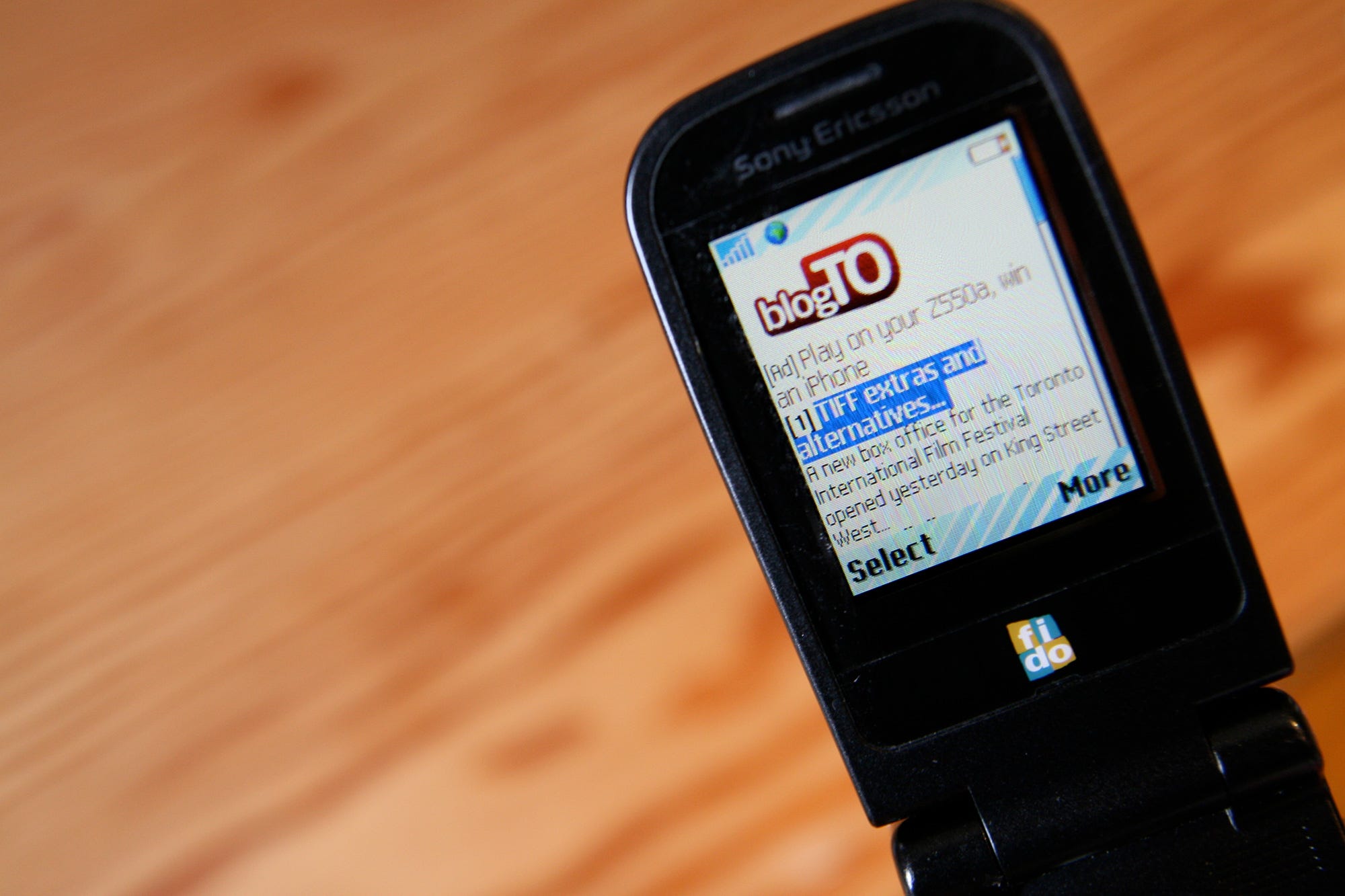
The App Store changed things. We immediately started working on an iPhone app that would feature our latest articles, a Best of Toronto section, the ability to look up restaurants and other businesses, and our event listings.
The content on the site kept getting better, and page views were going up. Many of the team members from the early years had moved on, but a new crop of writers had joined with fresh ideas and perspectives.
Robin Sharp was writing a popular series called Toronto Portraits that profiled up-and-coming creatives in the city. His subjects included people like Anthony Furey, who would years later run for mayor of Toronto.
Jonathan Castellino had a regular column called Toronto’s Forgotten Landmarks, in which he’d photograph and write about buildings the city had abandoned, or people had stopped noticing, such as the Canada Malting Company plant on the waterfront.
Chris Reynolds was exploring the fringes of Toronto in a series called GTA Tripping, turning up places most of us had no idea existed, like a gun range in Stouffville where anyone could walk in off the street and fire a shotgun.
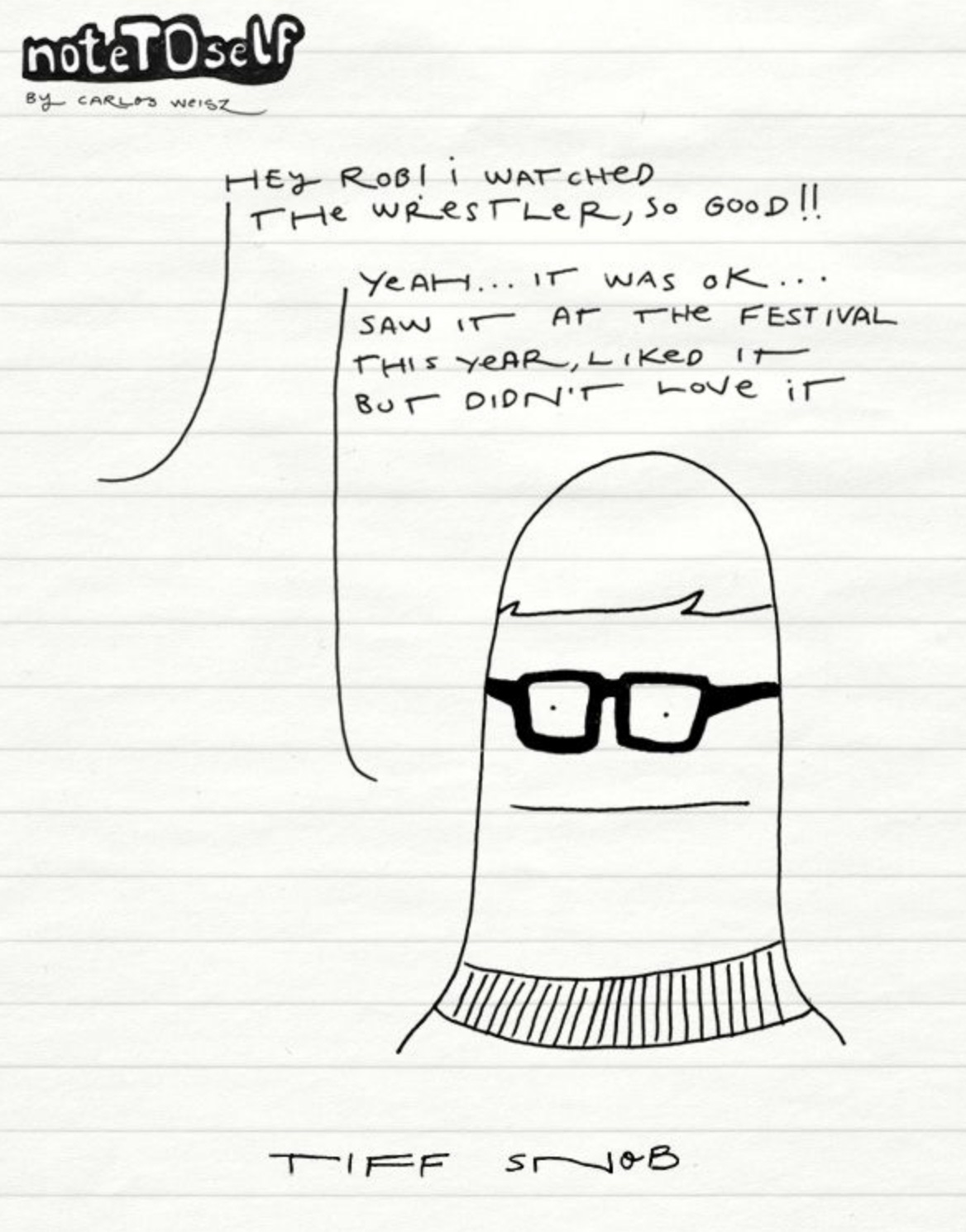
Carlos Weisz posted weekly sketches with a Toronto theme under the name noteTOself.
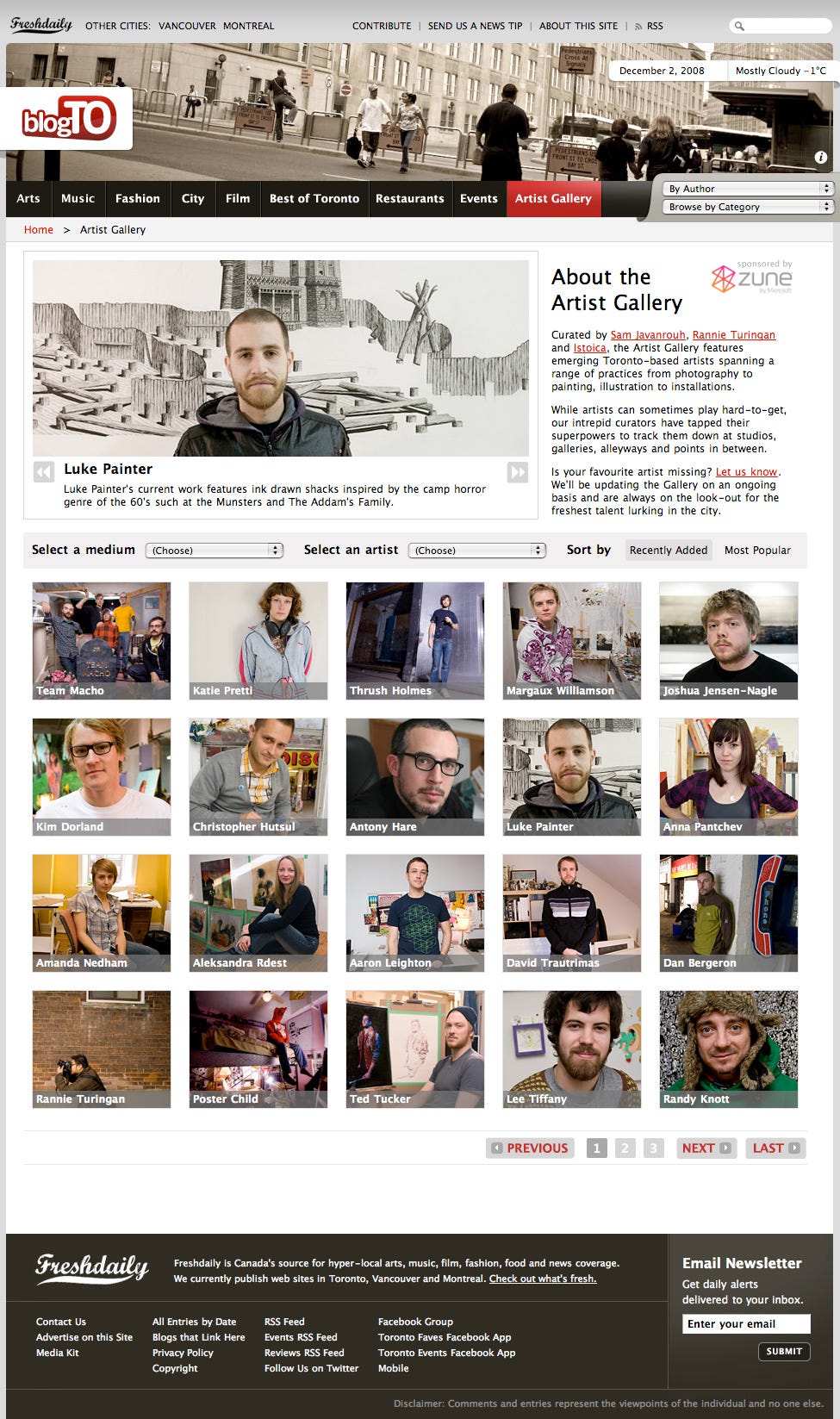
We also launched a new section on the site, the Artist Gallery, and had Microsoft Zune pay for it. The Zune advertising dollars allowed us to hire a team of popular photobloggers (Sam Javanrouh, Rannie Turingan and Istoica, the collaborative team of Chris Altorf and Jessica Hayes), to curate the section and take photos of all the artists. The deal mattered beyond the immediate revenue because it gave us proof of concept for something we could sell to other advertisers.
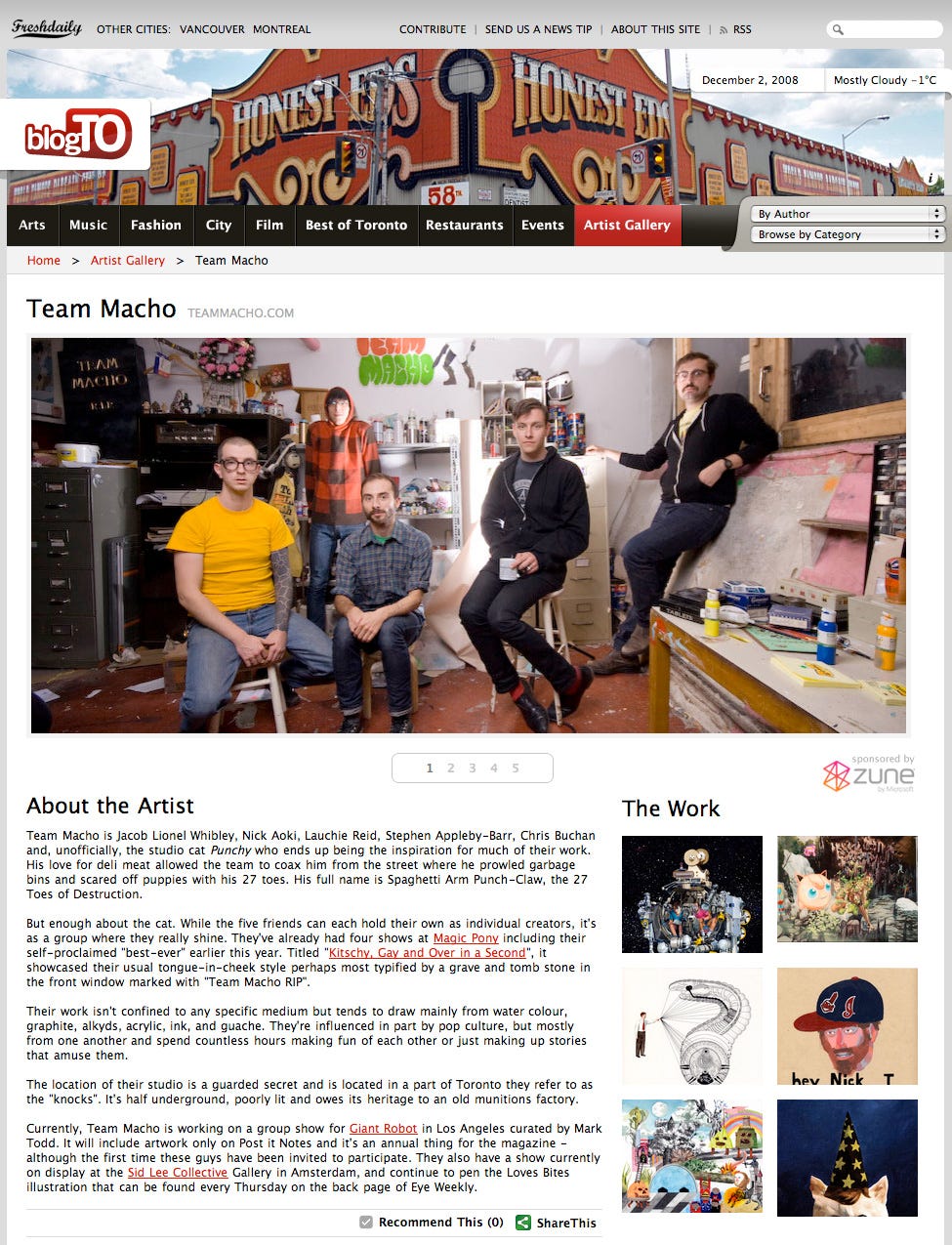
We partnered with the Contact Photography Festival again, this time staging an exhibit called 50 Artists 50 Photos at Barbershop Gallery in Parkdale. It was an extension of the Artist Gallery, featuring the same photographs of the 50 emerging Toronto artists taken by the photobloggers. Opening night was packed. We served custom blogTO cupcakes and handed out swag.
We launched a new podcast called DiverCity, produced and hosted by Nana Aba Duncan, who has since had a distinguished career as an award-winning journalist at the CBC and is an Associate Professor at Carleton University’s School of Journalism.
We also leaned harder into bar and nightlife coverage, launching a redesigned bar section and an ongoing series that counted down the 50 most essential bars in the city. We hired freelance photographer Eugen Sakhnenko to take the bar photos. Jessica McCann did most of the writing.
We focused a lot on arts and culture coverage during this period. I wanted to amplify what the city’s creative community was doing and shine a spotlight on emerging artists because I felt no other local media was doing so. But the analytics were clear. A thoughtful gallery profile or artist interview got a fraction of the traffic that news about a rat infestation at a local restaurant generated.
Traffic was growing regardless. We’d been the first site in the city to aggressively optimize content for search engines, and Best of Toronto posts had become our most reliable growth engine. If you searched for “best brunch in Toronto” or “best bike stores in Toronto,” there was a good chance you’d end up on blogTO. We started handing out window decals to Best of Toronto poll winners, a tactic I’d borrowed from Now Magazine and Eye Weekly.

That summer, we hit 663,000 page views in a single month. It was a new record. By December, we’d reach one million monthly page views. It was a cause for celebration, even if hitting this target was a year behind schedule.
But the editorial operation was straining. Our target was six to ten posts a day, and we were regularly falling short, particularly on weekends. The team was large on paper, but many writers were only posting once or twice a month. Revenue and traffic were both climbing, but the editorial model needed rethinking.
I was handling all of the advertising sales myself. Banner rates ranged from $5 to $10 CPM, with a special rate for local businesses starting at $50 a month. All sales were based on inbound leads. I wasn’t cold-calling or proactively selling to anyone. We were selling out most of our inventory, which meant the real constraint was traffic: we needed more of it to generate more impressions to sell. I didn’t want to create more inventory by adding more ad units to the site. I knew that would piss off readers.
My sales approach was borrowed from my years on the agency side: be easy to work with, deliver on your promises, and throw in bonus impressions when you can. I’d watched publishers lose repeat business by under-delivering, and I wasn’t going to make that mistake.
That fall, Bronwyn and I had our first child. We’d moved from our apartment at Ossington and Argyle to a semi in Leslieville to make room. The night before he was born, we ordered Indian takeout from Bombay Palace because someone had told us spicy food might help induce labour. Bronwyn still reminds me that while she was having contractions later that evening, I was writing up a review of the meal.
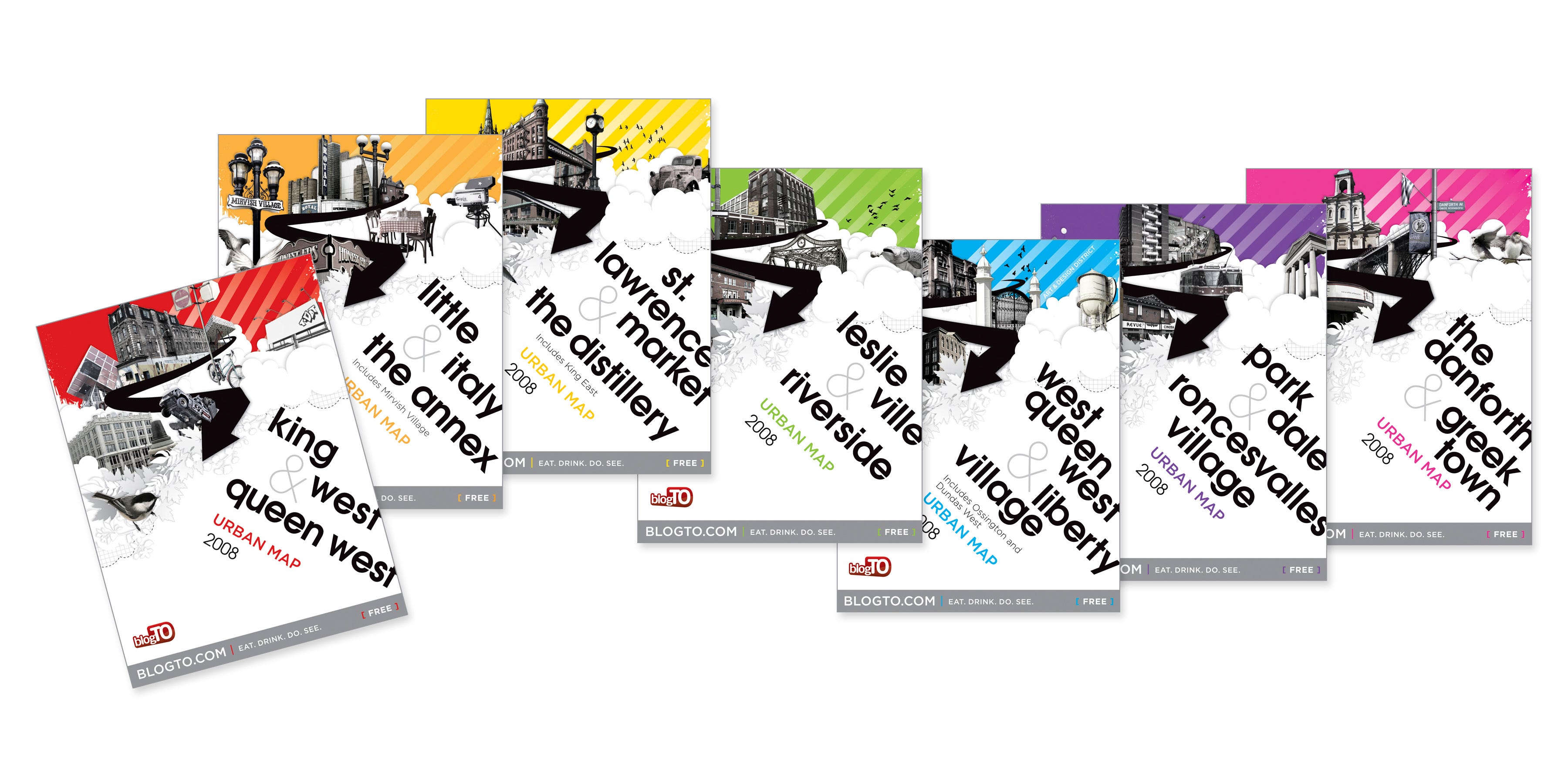
We expanded our printed neighbourhood maps to new areas and produced a custom edition of our King West and Queen West map for the EF International Language School, which helped us reach international students in the city.
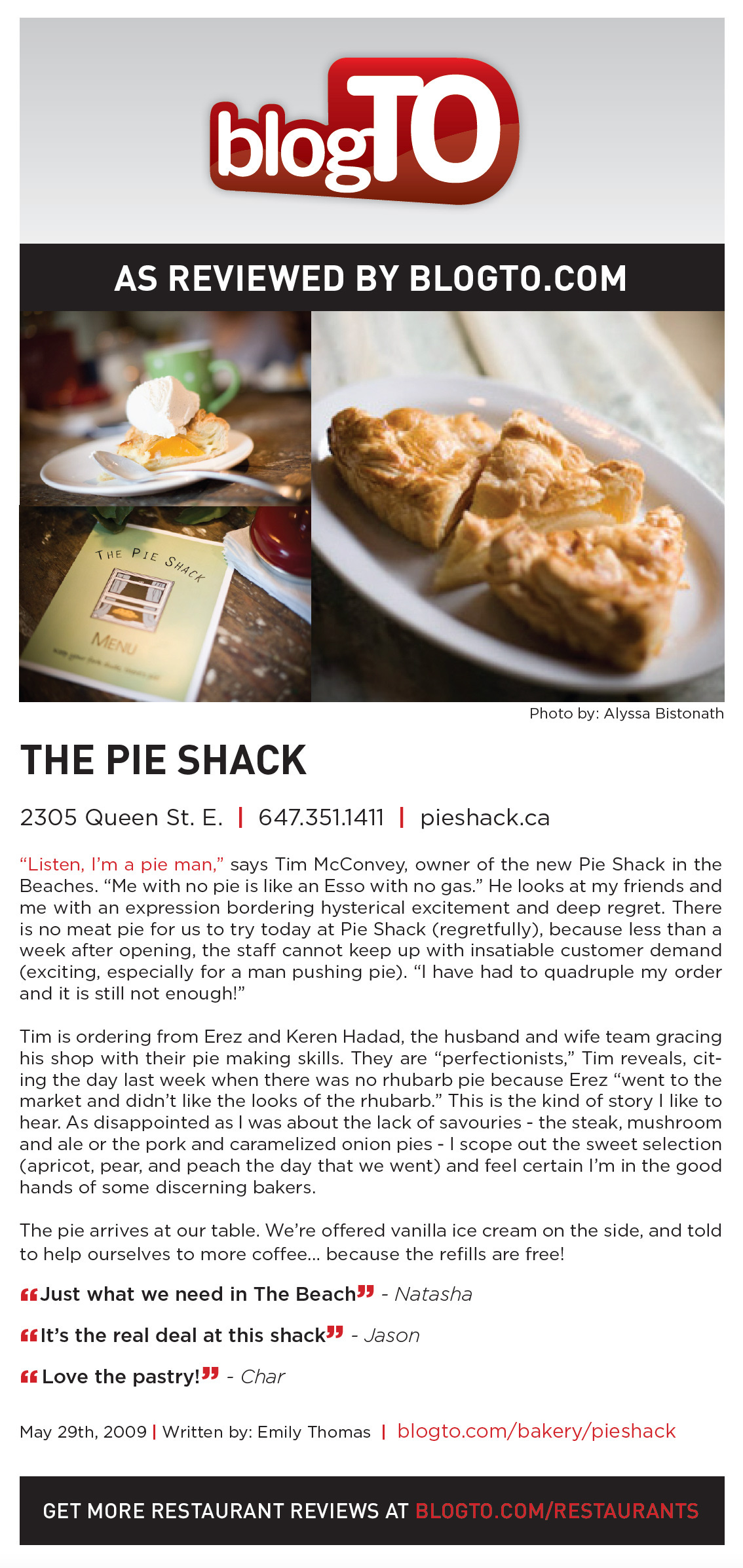
We also started printing copies of our restaurant reviews and giving them to local businesses to post on their walls, another low-cost, highly contextual way to get our brand in front of people in Toronto.
On December 12, 2008, Torontoist editor David Topping posted an announcement that seemed to catch everyone off guard. The site was shutting down. Gothamist, its New York-based parent company, had decided to close Torontoist and redirect resources to its more profitable American properties. Topping told the press that the site couldn’t be sustained under its current structure and that the worsening economy made its future even more uncertain. Of all the sites in the Gothamist network, Torontoist was the only one losing money.
I wasn’t surprised. I don’t think Gothamist fully appreciated, when they launched Torontoist, that the Canadian advertising market was a completely separate ecosystem from the one that funded their American sites. They would have needed to build relationships with Canadian agencies and brands from scratch. They also likely hadn’t anticipated the level of competition they’d face from blogTO.
After the closure was announced, several parties entered discussions with Gothamist about acquiring the brand. The financials weren’t encouraging. Total revenue for 2008 was just under $14,000. The site had no liabilities and no writers under contract, so an acquisition would have been straightforward. The one complication was that Gothamist initially wanted to license the brand rather than sell it outright, with an annual fee plus a percentage of future revenue.
In April 2009, Torontoist was sold to Ink Truck Media. The site would continue under the new ownership.
The competitive pressure continued to mount in 2009. Foursquare launched in early spring and expanded to Toronto within months. It leveraged the same Facebook developer platform as our Toronto Faves app but was far more sophisticated, changing how users interacted with local businesses in real time.
Between Foursquare, Yelp and Urbanspoon, the restaurant review and discovery space was now filled with well-funded American platforms. We couldn’t compete with their engineering, capital, or scale, but I felt we needed to be in the game and to defend our position in Toronto and the other cities where Freshdaily operated. Significantly increasing our investment in technology became one of my top priorities.
One notable misstep that year was my decision to add movie listings and trailers to the site. It required us to sign our first content licensing agreement to get showtime data from all the Toronto cinemas. We spent money to license the data. We spent money on redesigning the site to accommodate it. But it never gained much traction, and we dropped it a couple of years later. People came to blogTO for original content. Years later, when people suggested adding crosswords and other features readily available elsewhere to the site, I would think back to this experience.
The single biggest headache around this timeframe was comment moderation.
Comments had always been one of blogTO’s most popular features. People would often tell me they visited the site just to read the comments. They could be harsh, funny and surprisingly informative. But the system allowed anyone to post anonymously without logging in, and as the site grew, the volume became impossible to manage. We were getting hundreds of comments a day and didn’t have the people or the tools to keep up.
The problems went beyond article threads. Across our site, on pages for restaurants, bars, gyms and clothing stores, people had started leaving reviews, similar to what you’d see on Google today. Some were fair and useful. Many were not. Commenters accused business owners of being dishonest or complained about rude staff. If you can picture the worst Google reviews you’ve ever read, that’s essentially what we were dealing with, except we were the ones getting the angry emails from the business owners.
It was almost a daily occurrence. A business owner would contact us to demand that the comments be removed. We’d take them down if they could show us a clear violation of our comment policy. People who’d posted something impulsive would email us days later asking us to delete what they’d written. The Toronto Police would sometimes reach out requesting any identifying information we had about commenters who had threatened violence. Lawyers sent emails on behalf of businesses. And more than once, a commenter wrote to let us know they were being sued by a business over something they’d posted on our site.
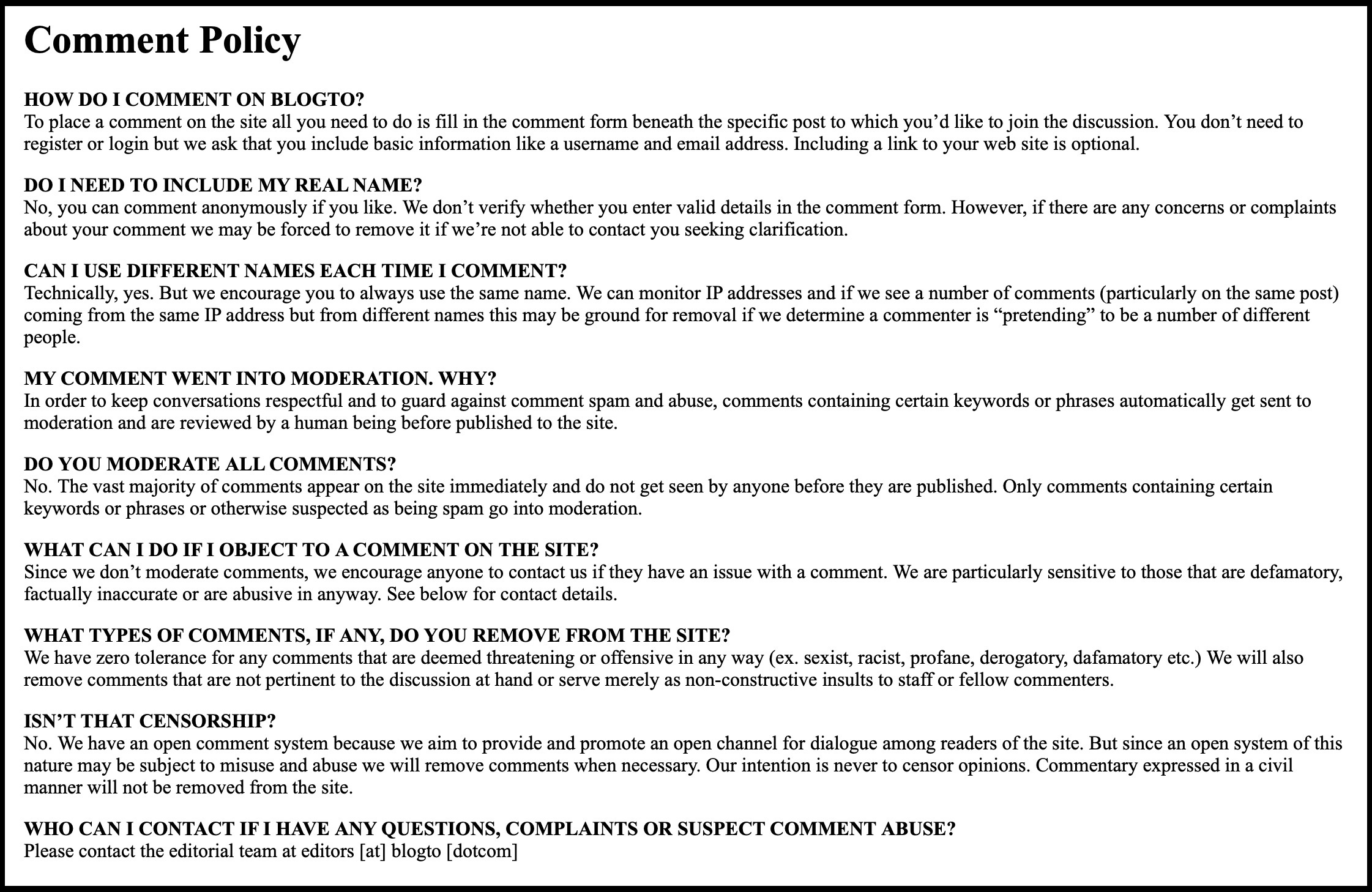
That year, we received our first formal legal threat. A lawyer representing a local hair salon demanded we pay $100,000 in damages. The salon’s owner had gotten into a back-and-forth with people who had left negative comments on a page that reviewed her salon, and it hadn’t gone well. She was blaming us. I believed we’d done nothing wrong and decided to fight it. I looked up the lawyer who represented The Globe & Mail, a media law specialist named Peter Jacobsen, and hired him. It cost us money I hadn’t planned on spending, but he got the matter dismissed.
We tried to address the moderation problem by adding Facebook Connect, a login system Facebook had recently rolled out, which gave users the option to sign in with their Facebook account before commenting. Some people used it, but anonymous commenting remained far more popular, and the underlying problem didn’t go away. There was no immediate technical fix available to us while we were running on what had become an outdated and increasingly problematic Movable Type CMS. On the worst threads, we’d just shut comments down entirely. It was a blunt solution, but sometimes it was the only one we had.
Despite the headaches, by the end of 2009, blogTO was in the strongest position it had ever been. Traffic was growing. Revenue was climbing. The brand had become a fixture of daily life in Toronto. I had no idea that in less than a year, someone would offer to buy it.