


In June 2023, a few days after the Online News Act became law, I sat at my desk in the blogTO office at the ZoomerPlex and joined a video call with Meta.
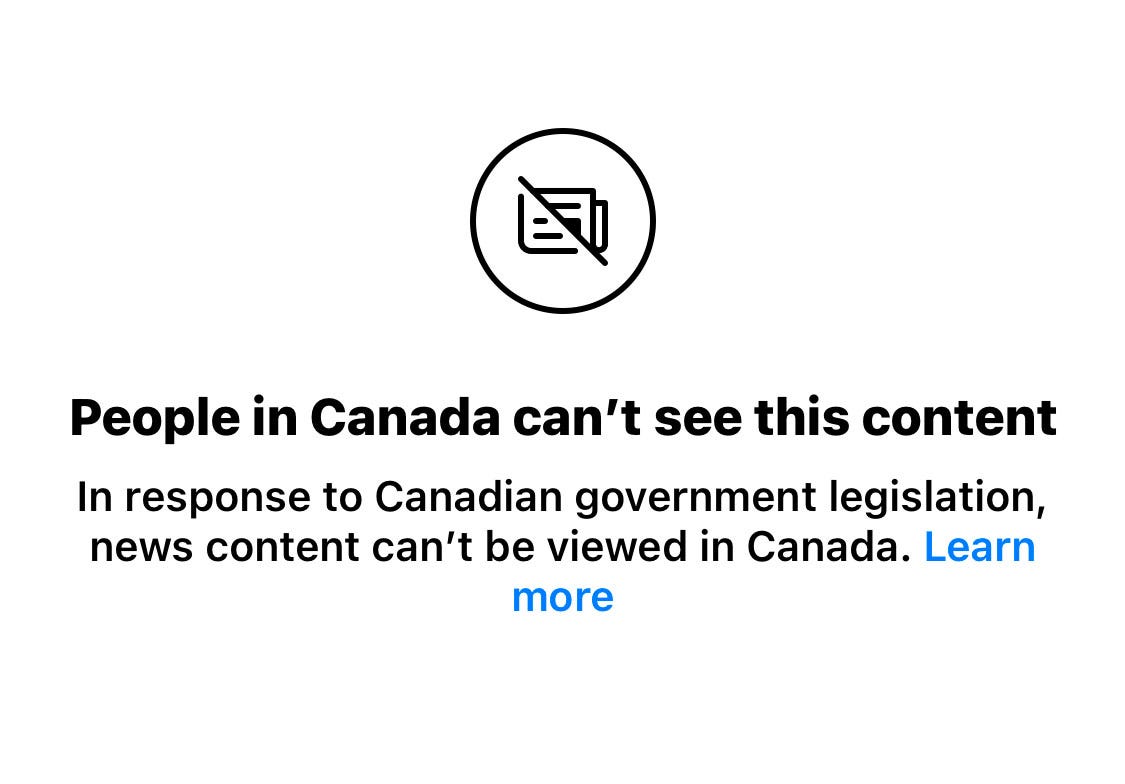
They had something to show me. On the screen were mock-ups of the blogTO Instagram account and Facebook page as they would look once Meta stopped making news available in Canada. Our photos and videos were gone. In their place was a notice very similar to the one Canadians still see today when they visit a news publisher’s account: “People in Canada can’t see this content.”
I couldn’t believe what I was looking at. Meta had been threatening for months to pull news from its platforms if the bill passed, but I didn’t think it would happen. I assumed the government and Meta would reach a compromise before the block took effect. I was wrong.
More than three years later, Canadian news publishers are still blocked on Instagram and Facebook, and the Online News Act is still law.
I’ve already written about the 2016 roundtable where the few digital media leaders present argued against government intervention in the media industry. Our arguments carried little weight in a room full of newspaper and broadcast executives. The Online News Act is what that day ultimately led to.
The bill was introduced in April 2022. It targeted only Meta and Google. Its premise was that the two companies had captured the advertising revenue that once sustained Canadian news media, and should pay publishers as a result. I saw it as a government bailout for the flailing newspaper industry that had lobbied for it.
News Media Canada, the trade association for newspaper publishers, lobbied the government for years. Law professor Michael Geist counted 52 meetings between the association and the government while the legislation was being developed. He called it “an astonishing level of access” and suggested it might explain why the bill left out the concerns of independent media like blogTO.
In May 2022, a coalition representing more than 100 outlets published an open letter warning that the bill would disproportionately benefit large news organizations over digital startups. The letter didn’t oppose the bill. “We support the goals behind Bill C-18,” it said, but it asked for several significant amendments.
I didn’t sign it. I didn’t think the bill needed fixing. I thought it should be scrapped. Instagram and other social platforms were key distribution channels for our content, especially our videos, and by the time I sold blogTO, they generated considerable revenue and profit. If any payments were needed, I would have thought it reasonable for us to pay Google and Meta to maintain access, not the other way around.
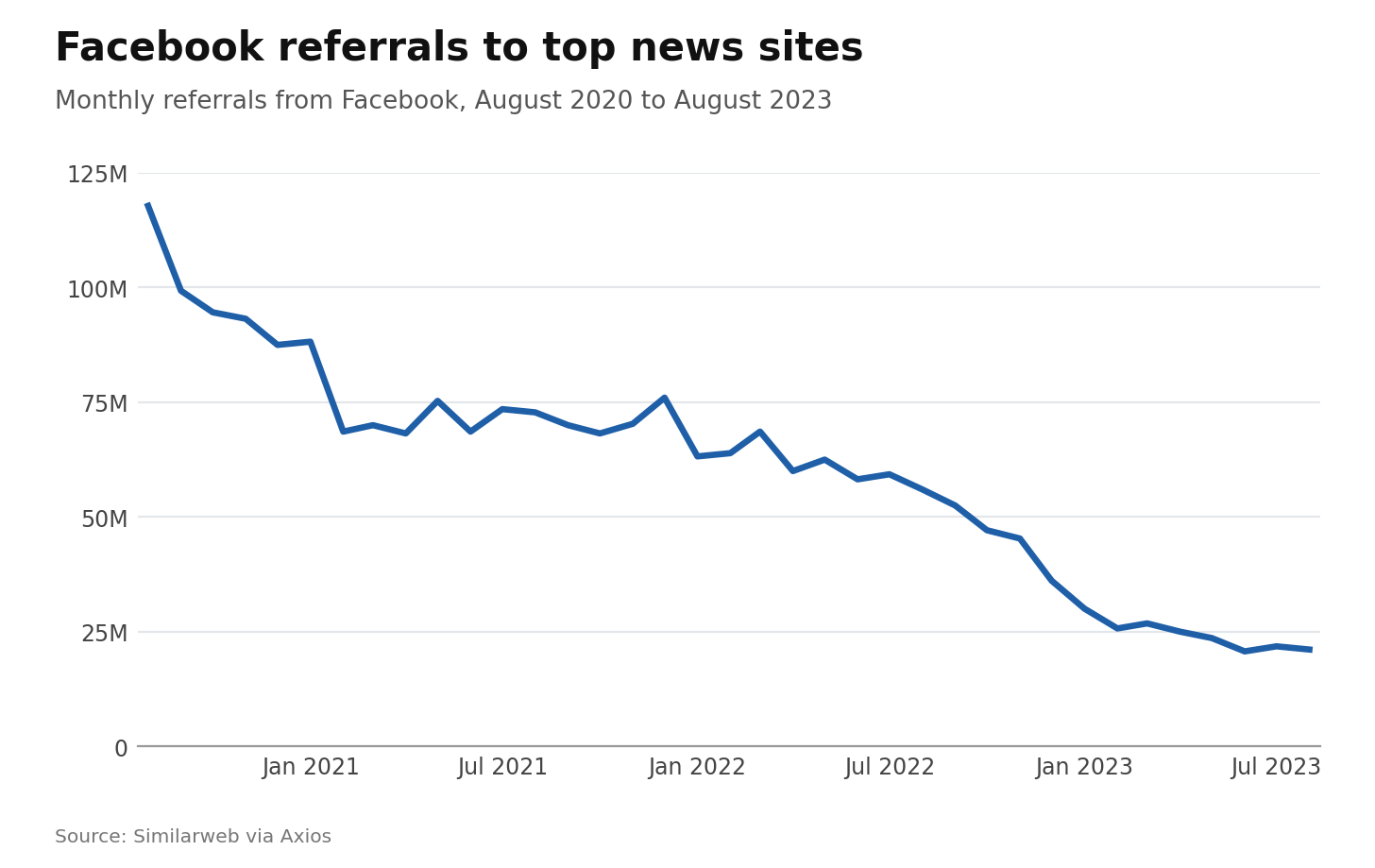
None of this meant I liked how the platforms ran their businesses. I hated the constant algorithm changes, and we had already felt Facebook pulling back from news. In 2022, in an internal memo reported by the Wall Street Journal, Facebook said it was shifting resources away from its news products. It began deprioritizing links in the algorithm to keep users on its platform.
Publishers everywhere could see it in their traffic. By 2023, Similarweb data showed Facebook referrals to the top global news sites falling sharply.
So at a time when Facebook’s interest in news was clearly waning, the Canadian government demanded it pay for news. Meta refused. Rather than pay publishers, it blocked them.
To be clear, I don’t like how Meta responded, and as you’ll see, how it carried out the block was inconsistent, opaque, and unfair. But I blame the government that passed the law for the damage it inflicted.
Within a week of the bill becoming law in June, Meta ended its programs supporting Canadian publishers, including the News Innovation Test I wrote about two posts ago. The Act wouldn’t take effect until December, but Meta didn’t wait. In early August, it began blocking Canadian news publishers from Facebook and Instagram.
The day blogTO was blocked, messages started flowing into our inboxes. Our followers didn’t understand what was happening. We were running an Instagram contest at the time, and people wrote in to ask why it was no longer working. We wrote back to explain that Instagram was preventing them from seeing or sharing content from blogTO and every other Canadian news publisher. We suggested they try a VPN set to a different country.
Users outside Canada could still see our content, but we primarily served a Canadian audience, so there was little point in continuing to post. Our ability to reach our nearly one million followers with live video, stories, reels, and images vanished overnight.
Facebook referrals to the website fell further, since nobody in Canada could share or see a blogTO link. For years, our news team had organized their day around Facebook posting slots and optimized headlines for Facebook distribution. None of that mattered anymore. Even our archive was hit: years of articles with embedded Instagram videos now showed blank boxes.
On August 14, I met with our team. They were concerned and in disbelief. We all were. I walked them through a presentation on how the Act would change how we worked, and urged them not to panic. The last slide had three words: “We got this.” Then I took questions, and there were a lot. The team wanted to know how long I thought the block would last. I said I didn’t know, but I couldn’t see it going beyond January. I didn’t know then how wrong I would be.
That day, we stopped making anything for the blogTO Instagram and shifted resources to other platforms, including TikTok, where blogTO had built a sizable audience. The web team changed focus too, optimizing articles for Google Discover and search, and leaning on channels we still controlled, like our email newsletters and push notifications.
My friends were as confused as our followers. They assumed a news ban meant newspapers, the CBC, and Global. Much of what we posted to Instagram wasn’t news, but the block applied to the whole account. A video about a new restaurant or event was restricted the same way as a story about the Eglinton LRT or the redevelopment of Ontario Place.
In Meta’s view, blogTO was a news publication. We had a dedicated news team. We posted news graphics. We were also a designated Qualified Canadian Journalism Organization (QCJO).
Meta set up a system that let publishers request a review if they believed they’d been blocked unfairly. We pursued those reviews aggressively. The first few times, we got the same two-sentence reply: “the account appears to be a news outlet or business producing news content within the meaning of the Canadian Online News Act” and “for this reason, the […] account will continue to be restricted from making news content available to persons in Canada on our platforms.”
Then, on October 20, 2023, we submitted yet another review, and this time the answer was different. Our request had been accepted. The blogTO Instagram was visible in Canada again. The team was thrilled, and so were our followers, who welcomed us back as we started posting videos again. We were nervous, though. We suspected that even a small slip, such as posting anything that could be considered news, might get us blocked again.
We didn’t slip, but within weeks, blogTO was blocked again. I reached out to our rep at Meta and demanded an explanation. He told me someone at Meta had made a mistake by unblocking us in the first place, and that blocking us again had corrected it.
The Meta block hurt most Canadian publishers, but not the way it hurt blogTO. For many, the main impact was lost referral traffic from Facebook, a channel that was shrinking anyway. Publishers that built their business on podcasts, paywalls, or email newsletters felt it even less.
blogTO was different. By the time I sold the company, Instagram was making us a lot of money. We were in the right place at the right time as Canadian marketers shifted significant spend to the platform, paying our team to create sponsored videos, posts, and stories. Few other Canadian news publishers monetized Instagram the way we did. So when Instagram was blocked, we lost a big part of our business.
The government was warned. In documents later obtained by Politico, Omri told the Prime Minister’s Office: “Jobs are going to be lost. Soon.” Narcity told the government it had already laid off more than 16 people.
ZoomerMedia was a public company at the time, and its filings show what followed. Each of its quarterly reports in fiscal 2024 named the Online News Act as a primary cause of lower revenue and singled out blogTO and Daily Hive because of their exposure to Instagram and Facebook.
While blogTO was blocked, news kept appearing on Instagram, courtesy of so-called shadow media: accounts that post news headlines and clips, often drawn from reporting they didn’t produce.
In the fall of 2023, 6ixBuzz was posting about the prime minister at the G20 and a salmonella outbreak to more than 2 million followers. Real Toronto Newz (RTN) published the prime minister’s comments on Gaza. Waveroom’s Toronto account posted about an arrest and a murder charge. Toronto Culture ran news graphics with small corner credits reading “via: Winnipeg Free Press” and “via Daily Hive.”
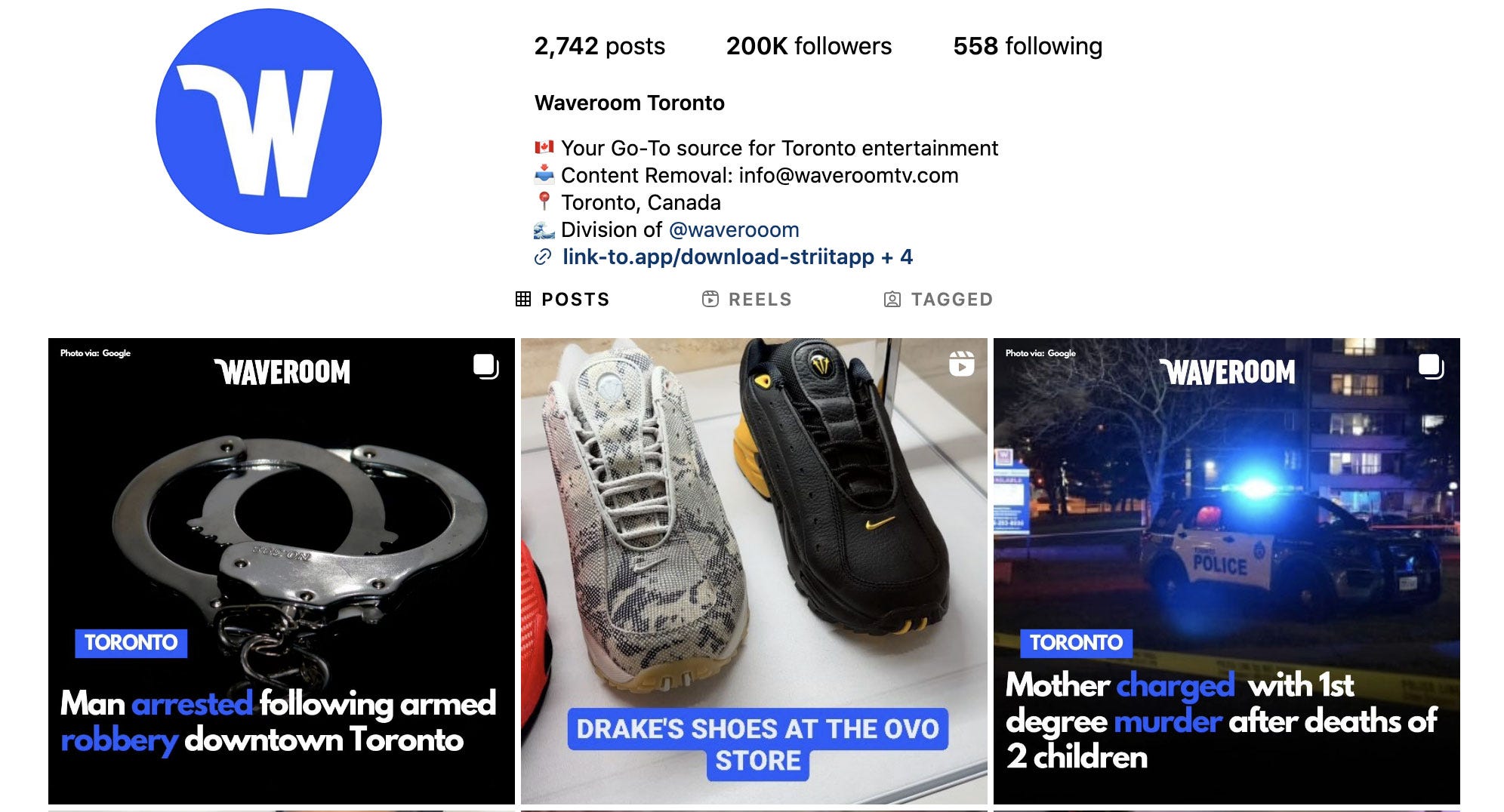
The publishers that did the reporting were blocked. Accounts like these were not, because Meta didn’t consider them news publishers under the Act. So they kept growing. Every follower they added was one blogTO couldn’t reach.
One publisher did find a way back. Narcity was blocked along with everyone else in 2023, but it had also spent years applying for QCJO status and being turned down because it didn’t produce enough original news. In 2024, Narcity sent the rejection letter to Meta. If the government didn’t consider Narcity a news organization, why should Meta? Within a week, Meta restored its accounts. Being officially not news turned out to be the best thing that could happen to a Canadian news publisher that wanted back on Meta’s platforms.
When blogTO received its QCJO designation in 2021, I called the tax credit it unlocked free money. It turned out to have a cost I never could have imagined.
Not every ZoomerMedia account was blocked. Accounts for brands that exclusively covered food, lifestyle, or sports stayed up, including two that came to the company with Daily Hive: Dished and Offside. Both had started as section labels on the Daily Hive website rather than distinct brands.
By the fall of 2023, the Dished Toronto accounts had come under my purview, and the food and restaurant videos our team used to make for blogTO started appearing there under the Dished name.
Our team was up for the challenge. The views and engagement of our Dished videos on Instagram were discouraging at first, far less than the levels we were used to with blogTO, but over time we saw steady growth. Within months, we’d figured out formats that worked, like the “green screen” videos that had been so successful on TikTok. When Hamilton’s Cowabunga Pizzeria won the prize for best cheese pizza slice in the world, Joshua’s video about it quickly racked up more than 2 million views.
We eventually landed on formats you can still see today, like Taylor’s video asking whether a Jamaican restaurant’s oxtail-stuffed patty was “worth the hype,” and series that explored Toronto’s “cheap eats” and “best kept secrets.”
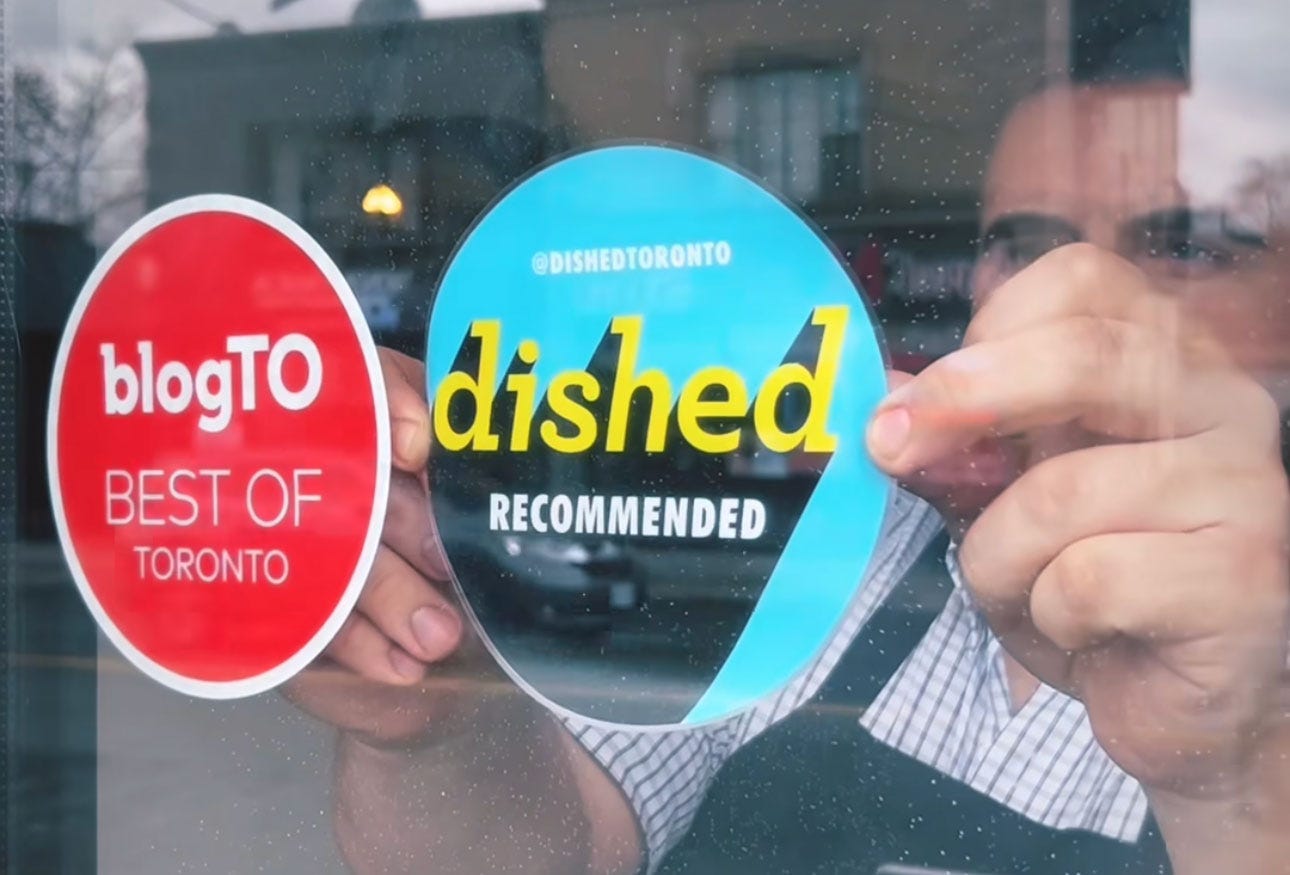
We built Dished the way we had built blogTO in its early years. We printed “Dished Recommended” decals and mailed them to our favourite local restaurants. Within months, you could spot them in windows across the city, sometimes right beside a red “Best of Toronto” decal.
By the following spring, Dished Toronto was running monthly food giveaways. The first was at Fruta Libre, a stand in the World Food Market near Yonge and Dundas. It started at 5 p.m., but people lined up 45 minutes early because the first 100 in line got a free Fruta Picada: a cup of fresh mango and other fruit with chili-lime seasoning and a drizzle of chamoy. To get one, you had to show us you followed Dished on TikTok or Instagram. Some of us worked the line checking phones, while others ran live streams or posted stories. The 100 cups went quickly.
Over the summer, the giveaways moved on to places on Ossington, the Eaton Centre, and the Fashion District.
The Google side of the story ended differently. In late November 2023, three weeks before the Act took effect, Google and the government reached a deal: Google would pay Canadian news publishers $100 million a year. The Canadian Journalism Collective, set up to distribute the money, didn’t make its first payments until March 2025.
The money is distributed by headcount, so the biggest legacy newsrooms get the most. What each publisher receives is published online. Over the first two years, Postmedia received $19.5 million, Bell Media $16.8 million, the CBC $13.9 million, and The Globe and Mail $7.8 million. By my count, the top 14 recipients, all legacy media companies, took about 60 per cent of the money. Freshdaily, the blogTO parent company bought by ZoomerMedia, received $454,701. Daily Hive received $942,136.
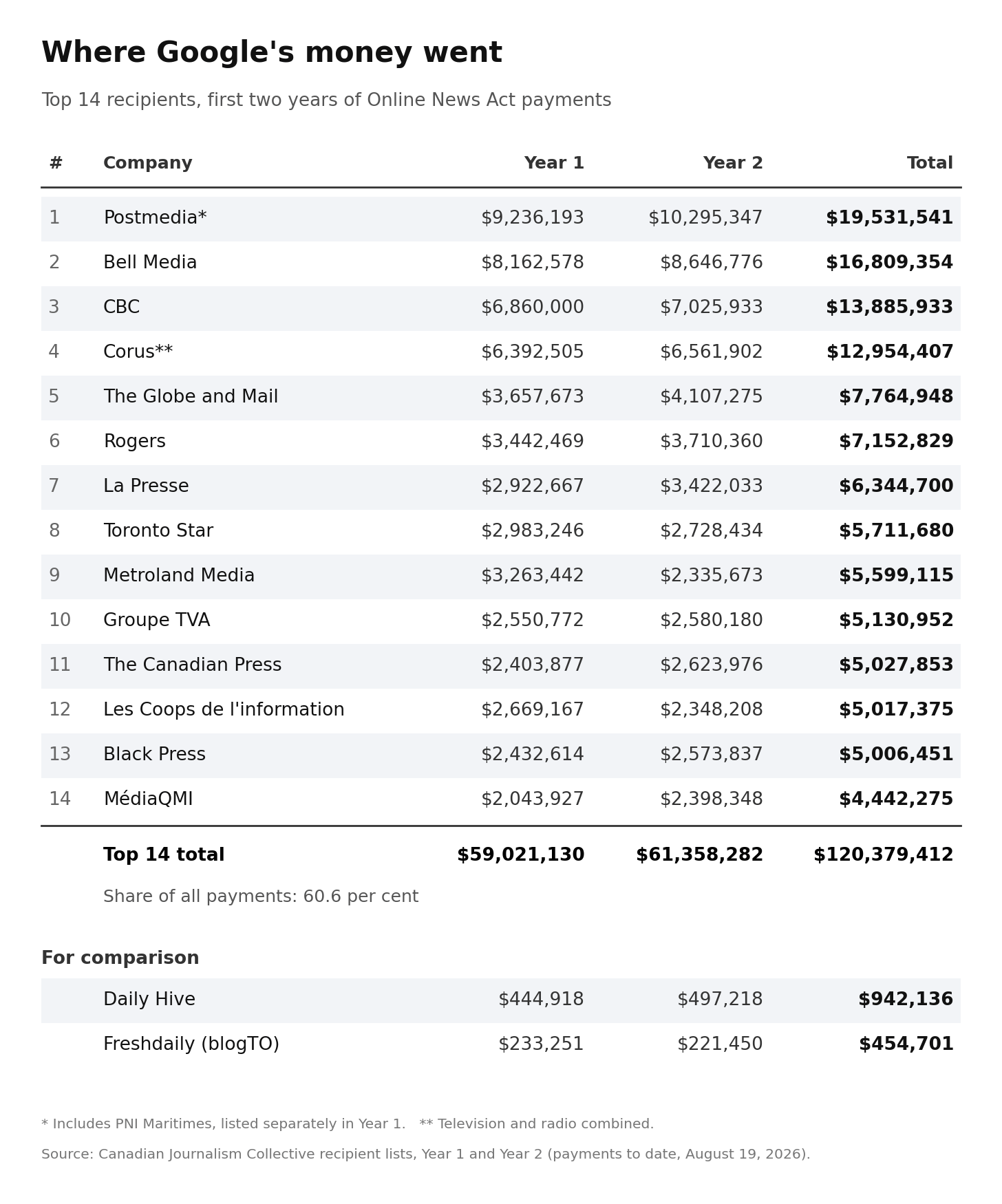
Whether intentional or not, the Online News Act erased the advantage digital-native publishers like blogTO had built by investing heavily in Instagram while newspapers clung to antiquated and failing models.
Before the Meta block, blogTO had a much larger, more engaged Instagram audience than our legacy media competitors, and that audience generated meaningful revenue at a time when newspapers argued only a government bailout could save the industry.
Consider the outcome. The legacy media companies that lobbied for the law that caused the block lost Instagram presences they had never really built or monetized, and collected most of the Google money. blogTO lost a core part of its business.
In my view, if Google hadn’t come to terms, the government would have had no choice but to abandon the Act. But Google compromised, the money reached the legacy media that lobbied for it, and the government declared a win. If a small group of digital publishers like blogTO got screwed along the way, I suppose we were just collateral damage.
At the time of this writing, the Online News Act is still in effect. A recent survey found that 78 per cent of Canadians under 35 consume news on social media, yet Canadian news publishers still can’t reach this audience on the two biggest social platforms. The government’s inaction suggests it doesn’t see this as an urgent problem.
Some of the Act’s proponents say digital publishers made a mistake by becoming dependent on Meta. We weren’t dependent. One reason blogTO is still around is that it was multi-platform with diversified revenue. Our key mistake was not anticipating that our own government would pass a law that made Canada the only country where news publishers are blocked on Instagram and Facebook.
Earlier this year, I saw a glimmer of hope when the United States named the Act as a trade irritant. Then, in August, the Toronto Star reported that some publishers had been told to prepare for the Act’s death as part of a trade deal. The next day, trade talks collapsed.
Supporters now frame the Online News Act as part of a broader push for digital sovereignty and see repealing it as a concession to Donald Trump. I see it as a chance to get rid of something that should never have been passed in the first place.
Eight months after the Act became law, ZoomerMedia made another acquisition. In February 2024, it announced it was acquiring a brand both blogTO and Daily Hive considered a competitor: Curiocity. The price was $5 million cash.
ZoomerMedia called it the “seventh acquisition in two years” and “the last piece in the puzzle.” Curiocity’s Instagram and Facebook accounts had never been blocked. Meta didn’t consider it a news publisher, and it had never been designated a QCJO.
What happened after that acquisition, in my final year at ZoomerMedia and right up to my last day at blogTO, is the story I’ll tell next.
Note to reader: The opinions in this post are my own. They don’t necessarily reflect the views of ZoomerMedia or anyone who works there.