


In the summer of 2017, our videos were regularly pulling in hundreds of thousands of views. We saw an opportunity to seize the momentum and expand the video operation, but first, we needed faces. As future blogTO owner Moses Znaimer might appreciate, we needed our own version of the Sook-Yin Lees, Monika Deols, Rick Campanellis, and Erica Ehms, who once defined Toronto culture as hosts of MuchMusic on Queen St. West in the 1990s.
So that’s what we did. Over the months that followed, we assembled the group of people who would shape the look and personality of blogTO’s video content for years to come.
Deepa Prashad was our first hire. Aaron and I met her in The Vault, the basement space in our office building at 250 University, a room originally built to store gold and bullion when the building belonged to the Bank of Canada. We could see she had star talent. She was relatable and had a natural energy on camera that you can’t teach. We offered her a role almost immediately, and she started with us a week later.
Deepa was a hit right away. She brought infectious energy to coverage of events like the Taste of Manila street festival. She dressed up as Wonder Woman to cover cosplay at Fan Expo. She tested the cast of Crazy Rich Asians on Toronto slang on the red carpet at the Toronto International Film Festival.
Our followers loved her. Advertisers took notice, too. Many of the brands that came to us for video wanted Deepa involved. Before long, she was being recognized on the street by people who knew her from our videos.
We proceeded to build a team around Deepa and Aaron. We needed more videographers to shoot and edit videos. That led us to bring on Adam Seward, Ron Quitoriano and Jason Pham, all key members of our team who contributed incredible work during their time with us.
Carrie Oehm initially applied for a writing role, and we turned her down. But she didn’t take no for an answer and pitched herself for a role on the video team instead. We quickly realized that her real strengths were on camera and that she could be a significant asset in a different capacity than what she had originally applied for. Within a few months, she was a regular presence in our videos.
Azalea Hart had already been creating video content on her own YouTube channel before joining the blogTO team. She had a natural on-screen warmth that made her a pleasure to watch, always with a big smile, and she was so easy to work with. Her coverage of events like Tamil Fest and Caribana showcased both her personality and her ability to connect with whatever she was covering.
Dhanung Bulsara, who goes by D, wrote to us out of the blue one day asking if he could join the team. D brought a contagious energy to everything he covered, whether it was the opening of Jollibee’s first Toronto location, a build-your-own bubble tea cafe or Salsa on St. Clair, where he showed off his dance moves. D was up for anything.
Darren (DKLO), our longstanding reporter who typically covered the food scenes in Scarborough, Richmond Hill and Markham, also began working with our videographers, helping to cover events like the Night It Up! night market and the opening of restaurants like Omni Palace, a Chinese hand-pulled noodle chain.
Video shoots were generally structured to stay under two hours, with edits held to roughly the same timeframe. This allowed us to keep our per-video production costs to a minimum since we produced a large volume of editorial videos that didn’t generate revenue. We knew that each video was an investment in building our following on Facebook and Instagram, which we’d ultimately recoup from selling videos, stories, and other social media posts.
It’s probably worth taking a moment to reiterate that we never spent money on advertising to promote blogTO. I always felt that investing money in creating editorial content was better than anything advertising could buy. Nothing did the job better than creating a great editorial video that generated hundreds of new followers and had dozens of potential advertisers see it and immediately want it for themselves.
Best practices for effective social video content are well-documented these days, but back in 2017, we were figuring them out through trial and error like everyone else. The format that we arrived at and that Aaron codified in the style guide was built around the first two or three seconds. That window determined success. Every video opened with the most compelling footage we had, overlaid with a bold, short sell in large type. “This is Toronto’s new CHEESE FOAM BUBBLE TEA.” “Now you can eat DEEP FRIED WHOLE CHICKEN.” If those opening seconds didn’t stop someone from scrolling past, nothing that followed mattered.
One thing we learned early on was that less polish often meant more authenticity, and authenticity mattered more to our followers than professional production value. When the Toronto Islands flooded in 2017, we posted raw, unedited clips of the flooding, and the views and engagement were enormous. We started referring to these internally as “raw clips,” and they became a regular part of our output alongside the more produced content. This less-polished approach was a harder sell to advertisers, who instinctively wanted something with commercial-grade production values and scripted messaging. We had to consistently make the case that platform-native content outperformed content that looked and felt like an ad.
While video was taking off, the website was also growing rapidly.
Phil Villeneuve joined as Events Editor. We had been familiar with Phil from his Dancing Phil videos on YouTube, where he’d film himself dancing in front of unsuspecting strangers in public places like the Eaton Centre. Before blogTO, Phil had been the Editor of FAB Magazine, a pioneering Toronto LGBTQ publication that ran for nearly two decades before closing in 2013. Everyone who worked with Phil liked him. His regular event round-ups became a staple of the site, and his curation of events for those lists was excellent. He also wrote about other topics, such as the thriving state of motorcycle culture in Toronto and a feature on the city’s independent record stores.
Amy Carlberg took on the primary food writing role after Liora left for Daily Hive. Amy was constantly out in the city with Hector or one of our other freelance photographers, covering restaurant openings, cafes, bakeries, bars and brewpubs. Many of the site’s Best of Toronto lists were written by her. She also covered business closures, which became some of the most consistently popular content on the site. Closure stories spread instinctively on Facebook. People would pile into the comments to mourn a favourite spot, complain about another rent increase, or vent about a condo development swallowing a neighbourhood institution.
Lauren O’Neil came to us from the CBC. She became our primary breaking news reporter and eventually the most senior editorial voice on the team. Lauren was prolific and possessed a writing style that felt made for blogTO: conversational, sharp, witty and deeply attuned to internet culture. She often covered the most viral stories, like the time a TTC rider was caught on camera screaming racist slurs, when selfie seekers shut down a sunflower farm near Toronto, or when a man was spotted riding an ostrich through the city. Lauren had a sense for what would resonate and had the speed to get it published before anyone else.
The video and website operations ran largely in parallel during this period. Aaron led the video side. Derek ran the website. Jaclyn managed social media, serving as the point where both content streams converged. Occasionally, a photographer or writer would cover the same restaurant or event as the video team and make a cameo in a video, but beyond that, the two teams mostly operated in silos.
As the team grew, the supporting infrastructure was maturing too. We started offering health benefits to full-time employees. Salaries were now at competitive rates for the industry. Full-time staff received annual raises, usually at least 15 percent. We still didn’t have anyone handling HR or recruiting tasks, which fell to me, but managing payroll had become such a time drain that I outsourced it to my accountant.
The internal documentation during this period reflected how seriously we took the craft of what we were building. We maintained a detailed style guide that often surprised new hires. Many found it overwhelming.
The guide started with the basics. The spelling of blogTO, which people routinely get wrong. Always lowercase “blog,” uppercase “TO,” one word. Not BlogTO. Not BlogTo. Not blog.T.O. Not Blog Toronto.
We maintained a list of words that were never to appear on the site. Most of these were just ones that personally annoyed me, like mouthwatering, eatery, resto, mobile kitchens (when referring to food trucks) or “strip” when referring to a street like “The Ossington Strip” (shudder). We also instructed the team to avoid industry jargon such as “quick service” and “fast casual” when referring to restaurant types. We had a 10-item checklist to keep in mind when writing headlines.
Writers were expected to assume that readers were familiar with their city. You couldn’t write something like “Toronto’s Beaches neighbourhood has no decent sushi restaurants.” Instead, you wrote “The Beaches has no decent sushi restaurants” because the reader already knows that The Beaches is a neighbourhood in Toronto. (Don’t get me started with The Beach vs. The Beaches debate).
Writers were instructed to avoid “we” when stating opinions or making assertions. When you wrote for blogTO, you spoke for yourself, not for the site.
Neighbourhood boundaries had their own detailed section. Writers needed to understand precisely where one neighbourhood ended, and the next began. Queen West runs between University and Palmerston. West Queen West ends at Dufferin, after which it becomes Parkdale, which is bookended by Roncesvalles. Getting these wrong in a city where people take their neighbourhood identity seriously was a reliable way to fill our comments section with corrections.
We also asked writers not to lean on stereotypes. The example in the guide: just because someone works in finance doesn’t mean they’re a douchebag.
Photography wasn’t treated as something used to fill a required slot on the page. It was a strategic tool. Because social feeds had become a primary driver of traffic to the site, the lead image on every article had a specific job: stop someone from scrolling past and compel them to click. We told the team to always choose the most arresting, engaging or provocative image available. We also had particular rules for food photography. Photos of food at restaurants had to look natural, as though taken by someone sitting at a table about to eat. Anything that looked staged or was missing table settings was off limits.
Beyond the main style guide, we had a separate 100-page document that covered headline strategy, URL formatting, SEO requirements and caption guidelines for every recurring content type on blogTO.
Everything we were doing seemed to be paying off. Page views climbed 50 percent from the previous year and eclipsed 15 million per month. By 2018, our Instagram had grown to 420,000 followers, and Twitter and Facebook to over 630,000 each. Our Instagram posts routinely generated upwards of 200,000 impressions.
In any given week, we published multiple articles that exceeded 100,000 page views: a raccoon causing a delay on the TTC; a hostage situation unfolding on King West; a map tracking Toronto home prices by subway station. These were the kinds of stories that could take off in a heartbeat and drive enormous traffic in a single day.
When new writers joined the team, they couldn’t believe how big the numbers were. Our internal baseline for a successful post was 20,000 page views. Anything below that threshold was considered to have underperformed, and its topic would face increased scrutiny in future pitches.
Beneath the topline numbers, the composition of our traffic was shifting. Best of Toronto content, which had been the backbone of the site for years, peaked in 2014 and had been declining slightly year over year, though the numbers remained solid. Traffic to the restaurants section was flat, but general food news, including openings, closings and other food-related coverage, was gaining momentum. The fastest-growing areas of the site were news and real estate. Home page visits were steadily rising, a sign that our direct audience continued to grow even as more readers arrived through social platforms and search.
One tool that proved indispensable was CrowdTangle, a Facebook-owned analytics platform that let publishers track how their content performed and, even more importantly, what competitors were posting, how frequently, and how much engagement they generated.
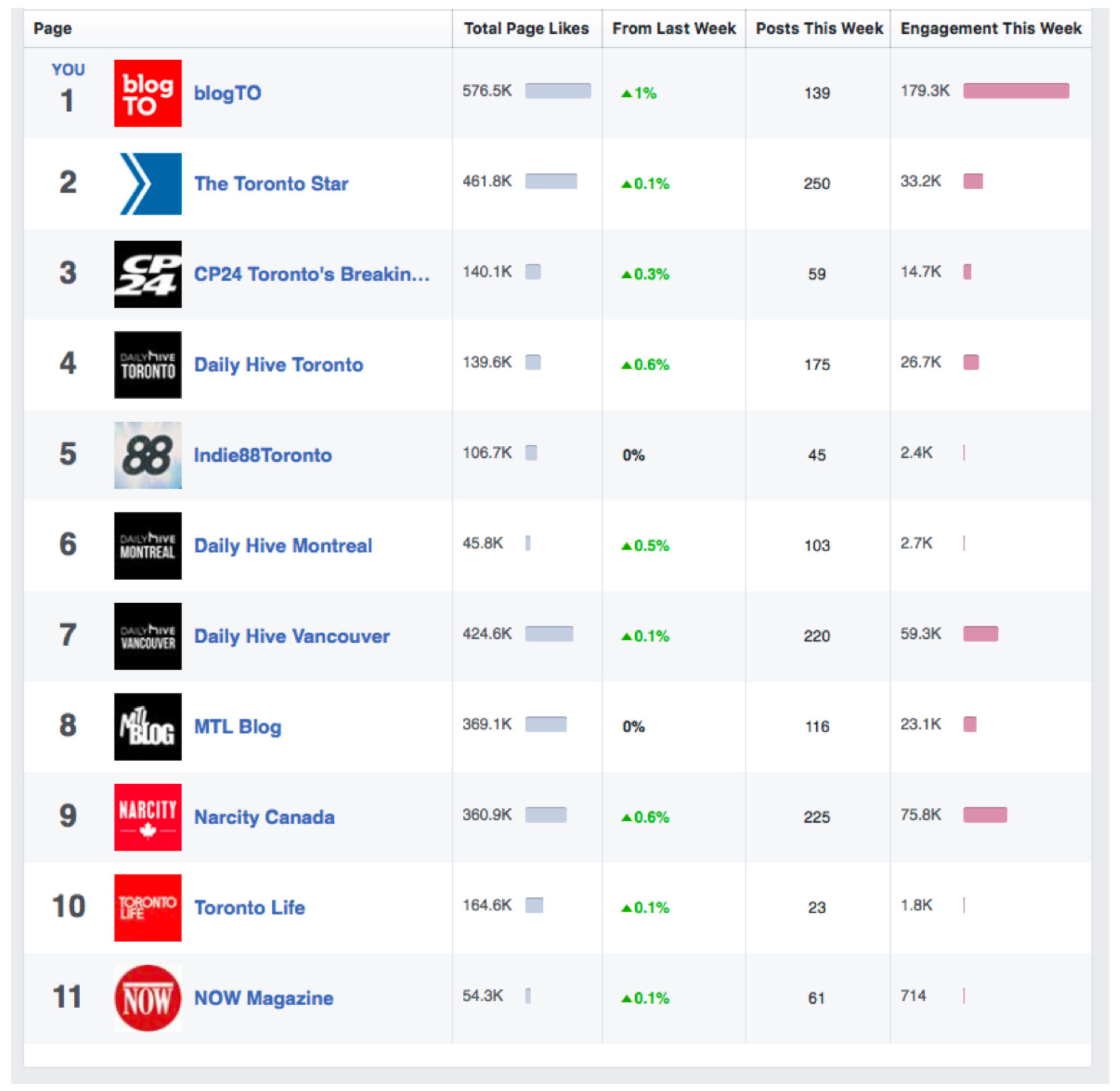
The data consistently confirmed what we already sensed: we were posting less frequently than competitors like Narcity, Daily Hive, and the Toronto Star, all of whom were publishing at least twice as much content, but we were generating significantly more engagement than any of them. Legacy media publications like Toronto Life and Now Magazine were not even remotely competitive in the digital space, producing a tiny fraction of the engagement we were seeing.
By 2018, it’s not a stretch to claim that blogTO had built the most comprehensive social media advertising offering of any media company in Canada. It’s also important to remember that the influencer economy hadn’t yet fully emerged. Social platforms were still building out their advertiser tools. Most digital ad spend was still directed at websites. Only the most forward-thinking marketers were spending meaningful money on Instagram.
I’ve often heard it said that blogTO was the original influencer account in Toronto, and with team members like Deepa, Carrie, Azalea, D, and DKLO, it’s a claim I think would be hard to dispute. We had figured out how to optimize video content for social media and monetize it before most of the industry understood that social video could be a core revenue stream big enough to build a business around.
In fact, legacy media executives were largely oblivious to how much we were making from our social accounts and, in an era when they were complaining that Facebook and Instagram were capturing all the advertising dollars, they were completely missing out on a golden opportunity to grow their business.
I once interviewed someone for a job who was, at the time, the Social Media Manager for the Toronto Star. I asked her why the Star’s Instagram was so underdeveloped. She told me the higher-ups at the paper gave her no resources for the account because, they said, Instagram couldn’t generate meaningful referral traffic to the website. They didn’t see the point.
What they obviously didn’t understand was that driving traffic to the website wasn’t the reason to invest in Instagram. We treated Instagram as distinct from the website, not something used to support it. We recognized it had its own audience, so we invested in creating original content native to that environment, with no expectation that the audience would leave the platform.
The strategy seems obvious now, but it took many years for most Canadian media companies to figure this out. Now, with Canadian media blocked on Instagram due to the Online News Act, they can at least take these lessons to TikTok.
One loose end I should probably mention before I go any further. In late 2016, we spent about $50,000 to update the blogTO iPhone app to match the new website design. This project was a breeze, and the app continued to grow its user base and get high ratings in the App Store.
The corresponding Android app finally went live in 2017, but it was plagued by crashes and persistent bugs. We spent nearly two years trying to resolve the issues, but the app received low ratings, and the number of users never came anywhere close to that of the iPhone app. I had grown increasingly frustrated by our inability to bring it to the quality I wanted, despite years of investment, and decided to cease supporting it. I pulled it from the Google Play Store in 2019. blogTO lacked an Android app until 2025, when ZoomerMedia released a new version.
After all these years and countless dollars spent on app development, maintenance, and upgrades, my appetite for spending significantly more on apps had waned. Instead, I was interested in devoting time and resources to growing audiences on other platforms. One of these new platforms actually didn’t cost us any money at all.
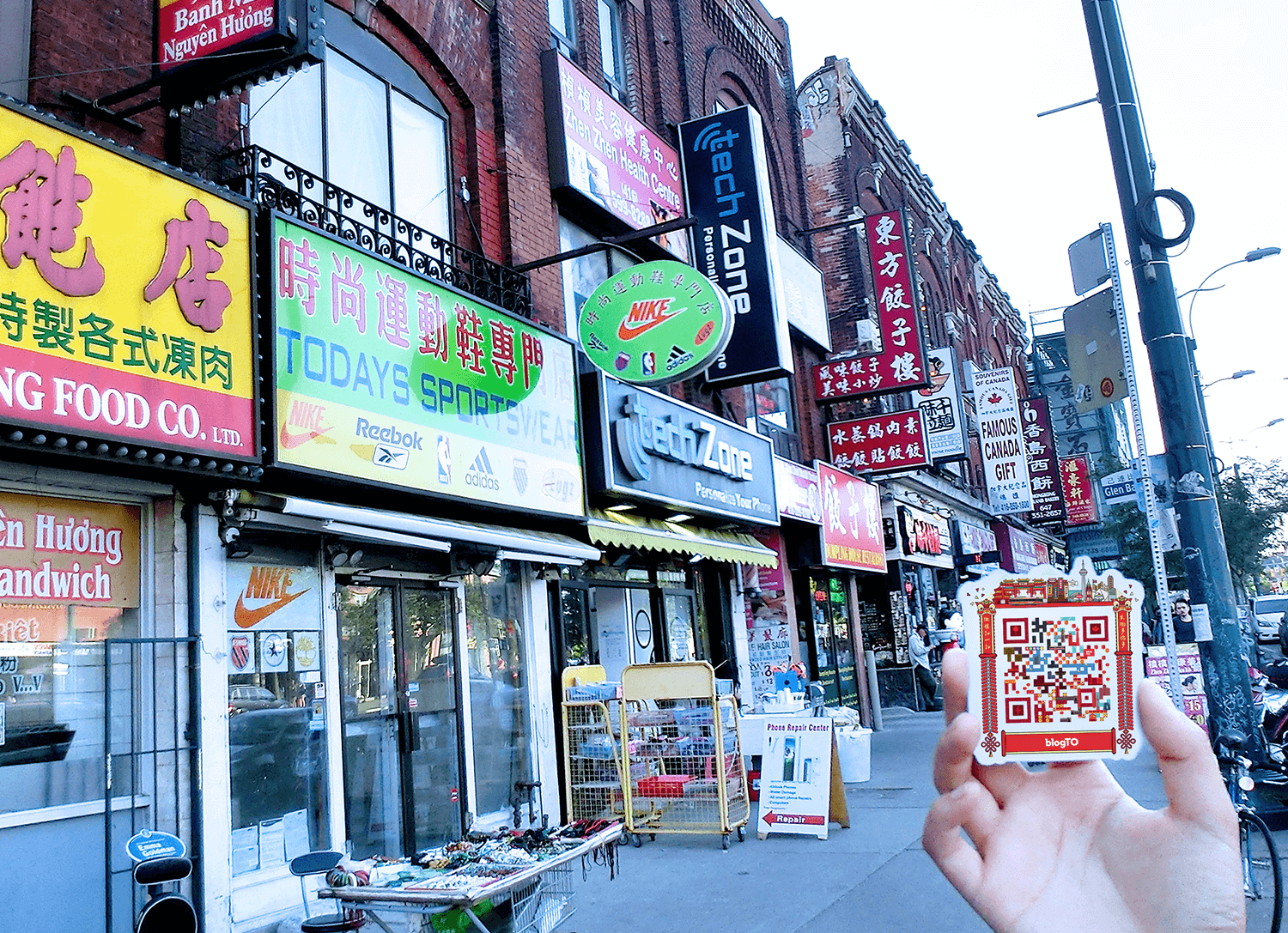
Toronto’s large Chinese-speaking population is relatively underserved by food and lifestyle media as well as local news. Years earlier, we had discovered that yorkbbs.ca, a popular Chinese-language forum for Chinese Canadians and students in the GTA, had been translating large volumes of our content into Chinese and presenting it as their own work. If nothing else, this demonstrated there could be demand for blogTO content among Chinese-speaking audiences.

So we partnered with a company in Richmond Hill to manage blogTO accounts on WeChat and Weibo, the two most popular Chinese-language social platforms of the day. A selection of our content was translated into Chinese daily, and fun graphics and illustrations were created specifically to resonate with audiences on these platforms.
The arrangement cost us nothing since the partner handled everything in exchange for a share of whatever revenue we generated on these platforms. Follower growth and engagement were respectable, but the revenue never materialized into anything meaningful. It was a no-risk experiment that we kept going for a few years before our partner folded their operations and moved on to other things.
Thirteen years after launching blogTO, the impact we were having on the city was hard to miss. After we posted videos featuring local businesses, some owners told us their businesses had boomed so much that they had to temporarily close their doors to manage the demand.
Many promoters who tracked how attendees heard about their event now cited blogTO as the number one source of referrals. A keepsake I still have from this era is a photo the organizers of the Wychwood Old Book and Paper Show sent me, showing their handwritten results from an informal survey they conducted, asking attendees how they had heard about the event. blogTO was the number one source by far.
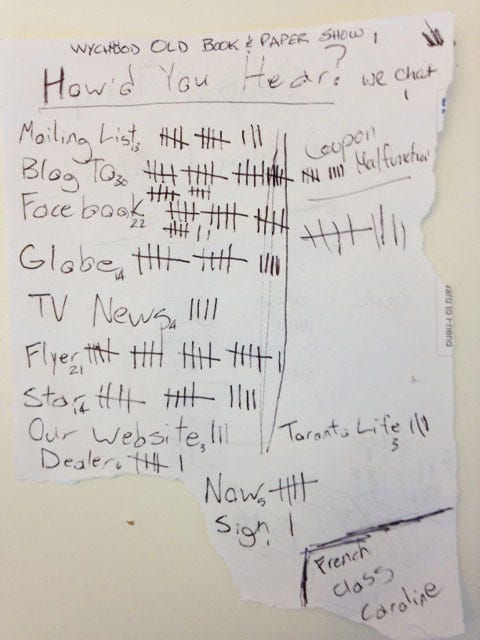
These were small but tangible confirmations of something we could feel more broadly. When people in Toronto wanted to know what was happening in their city, blogTO was where they went, on whichever platform they preferred.
So where did we go from here? In my next post, I’ll pick up the story in 2018 when we got back into podcasts for the first time since the early days. That, and Narcity makes an unsolicited offer to buy blogTO.