


Rob Ford was the Mayor. A participatory journalism startup called OpenFile promised to reinvent how news got made. And blogTO was entering 2011 with momentum on every front: growing traffic, rising revenue, an app in development, and plans for major website upgrades that hinged on our ability to finally resolve the technical issues that had been plaguing us for years.
It was also the era of Groupon, a chapter of internet history that’s been mostly forgotten. Daily deal sites were popping up everywhere, and for a brief window, it seemed like every media company was scrambling to launch some kind of coupon offering. We flirted with the idea. A local site called TeamBuy wanted us to white-label their platform. Another company offered us an equity stake if we partnered with them. I considered all these options carefully but turned them down. My instinct was that the daily deals would be a fad and that the smarter move was to keep investing in what we were already building.
That same year, Bronwyn and I welcomed our second child. The demands at home had multiplied, and blogTO was only becoming more consuming. There wasn’t a day that went by without something requiring my attention. Nights, weekends, holidays, vacations, it didn’t matter. And that wasn’t counting whatever time and energy I could spare for the Freshdaily sites in Montreal and Vancouver. Something had to give.
Help came first on the advertising side. A handful of companies had been approaching me about representing blogTO for ad sales. One was Olive Media, which I dismissed immediately because of its affiliation with Torstar. Another was Suite 66, a firm led by the affable Marc Thomas. I’d already booked a few campaigns through them, and the relationship had been productive.
I decided to give Suite 66 the exclusive right to sell blogTO and the other Freshdaily sites. I’d continue handling our existing clients, but they would now be out in front of the agencies and media buyers I’d spent years working alongside in my previous career. Every campaign they brought in still required my sign-off. If the advertiser wasn’t right for the brand, or if they were asking for something that would compromise the reader experience, I’d kill the deal. Suite 66 never pushed back on this. They understood that I’d rather walk away from revenue than erode the trust we’d built with our community.
Suite 66 also wasn’t going to take on any local ad sales. With the exception of our printed neighbourhood maps, we had never solicited advertising from local restaurants, shops or other small businesses. If they reached out to us, we’d happily sell them something. But I’d learned early on that closing a $500 sale from a neighbourhood cafe required as much effort as landing a $10,000 campaign from a national brand. I’d also learned, from years of going door-to-door with the maps, that small business owners were relentlessly targeted by salespeople, and I didn’t want blogTO lumped in with that crowd. I wanted the relationship to flow the other way: large advertisers would fund our operations, and we’d use that revenue to produce the editorial coverage of local businesses, culture and events that our readers valued. blogTO would be something that supported local businesses and asked for nothing in return.
Which is why it always stung to see, over the years, comments on Reddit accusing us of shaking down small businesses for money in exchange for coverage. It was completely false. I corrected it every time I encountered it.
The Suite 66 relationship would endure for more than a decade, lasting through the acquisition of blogTO by ZoomerMedia.
On the editorial side, the team kept evolving in interesting directions. Chandler Levack came on to cover arts, film and culture. I’d become an admirer of her writing after reading her hot take on King West for Toronto Life. She wrote for us briefly before going to film school and becoming a celebrated director, known for films such as I Like Movies and Mile End Kicks.
Rooftopping had become a minor obsession in Toronto. A small community of photographers was scaling restricted vantage points on skyscrapers and half-finished condo towers to capture vertigo-inducing images of the city from angles nobody had seen before. It followed in the tradition of Jeff Chapman’s Access All Areas: A User’s Guide to the Art of Urban Exploration, an influential book that came out around the time I started blogTO. Tom Ryaboi, one of the most recognized names in the rooftopping scene, joined us as Photo Editor and launched a series called “Through the Lens Of” that profiled some of the city’s most talented photographers.
Jesse Milns also came aboard, gradually taking over the bulk of our photography assignments from the rotating cast of contributors who’d been handling them, such as Dennis Marciniak, Ryan Bolton and Roger Cullman. He became our first official Staff Photographer and would remain a key member of the team for years. Like other photographers who shot for us, he caught the attention of the wider industry with his work for blogTO and eventually landed higher-paying commissions from magazines and other clients.
Jesse’s arrival coincided with a significant shift in how we covered restaurants. In the early days, we’d done it the old-fashioned way: show up anonymously, order a meal, pay the bill, write a review. The approach had integrity, but it had two problems. First, restaurant criticism was democratized by platforms like Yelp, making the traditional model feel increasingly outdated. Second, it was expensive and limiting. We couldn’t photograph interiors or dishes the way we wanted, and we couldn’t afford to cover the volume and variety of restaurants we needed, particularly the more expensive ones.
So we evolved. We stopped calling them reviews and started calling them profiles, because the emphasis shifted from judgment to documentation. We’d reach out to a restaurant in advance and ask permission to visit. Nearly all of them agreed. During the visit, we’d sample a range of dishes, photograph the food, the space, sometimes the kitchen and the staff. The restaurant typically covered the meal, though on rare occasions when they presented a bill, we paid it. We instructed our writers to avoid commenting on service, since a pre-arranged visit wouldn’t reflect what an ordinary customer would experience.
The new model had obvious advantages in scale and visual quality. But it came at a cost I didn’t fully appreciate at the time. Looking back, our restaurant coverage lost something with this change. I came to miss the old reviews, the ones where a writer would note that the menu was nonsensical, that the table smelled like bleach, or that the fries likely came out of a freezer bag. Those pieces had a candour that the polished profiles, for all their usefulness, could never quite match.
The technical failures of 2010, such as the abandoned Talk! forum and the unsolved comment-moderation problem hadn’t broken our momentum. Bronwyn introduced me to a developer named Taylan Pince, a former colleague of hers. Taylan would prove transformative, rebuilding our technical infrastructure in ways that would underpin the site for years to come. He later founded his own company, which helped build Robinhood, the popular commission-free stock trading app. He’s now an SVP at a crypto company called Polygon Labs.
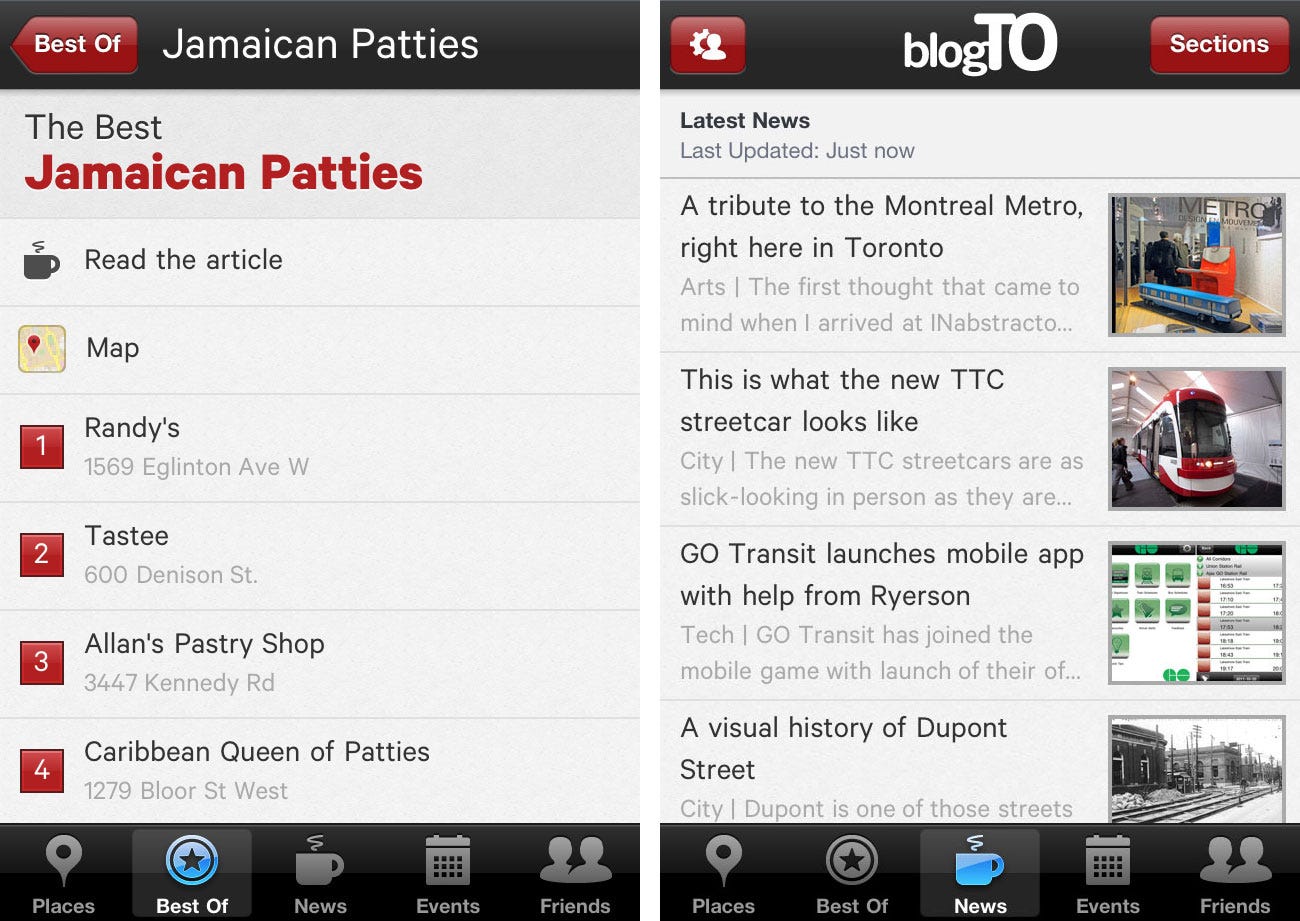
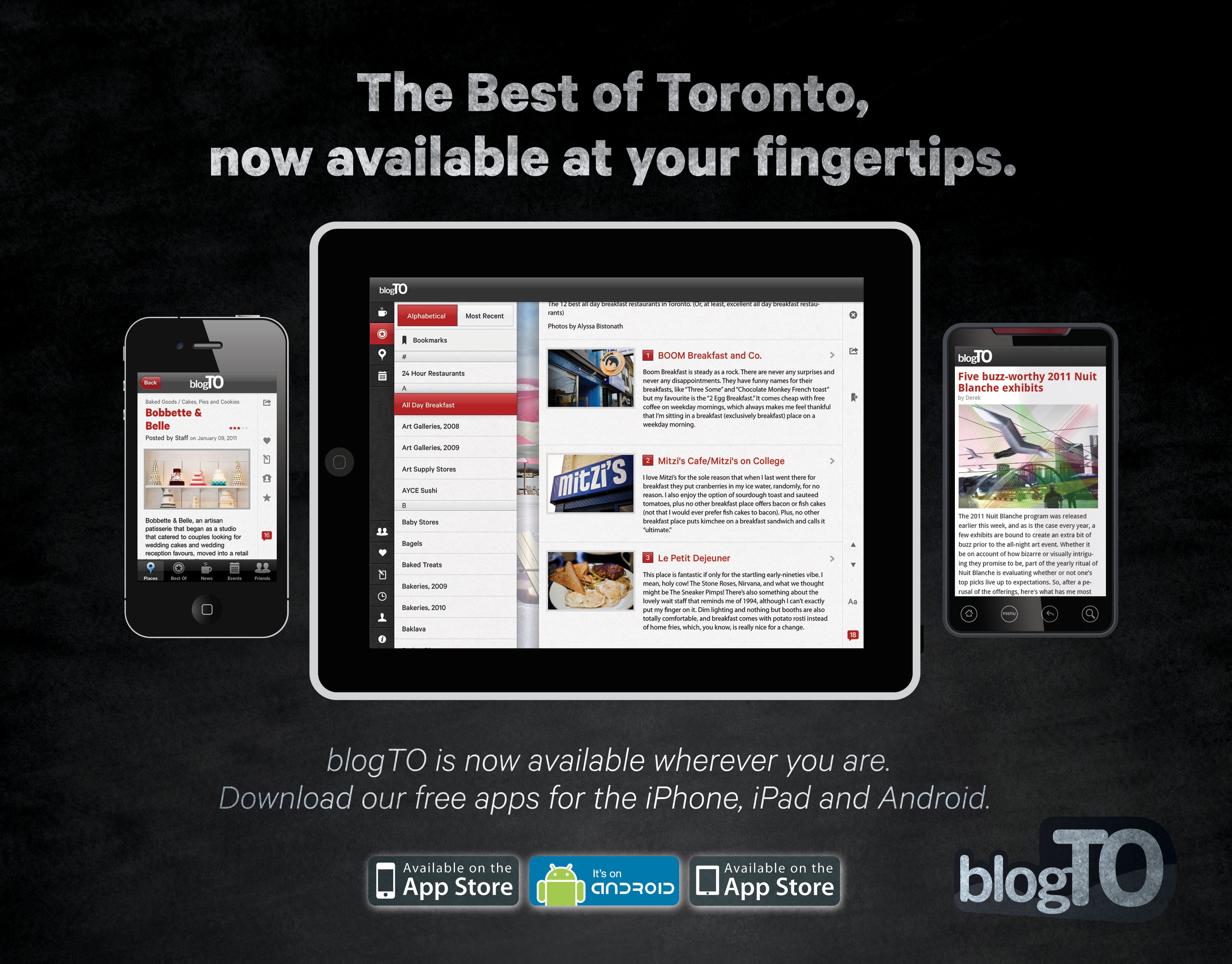
Taylan’s first major contribution was the blogTO iPhone app, followed by an iPad version later in the year. The iPad was still new, but many media companies were betting that it would become a widely adopted device for consuming content. Those bets turned out to be wrong, but at the time, it wasn’t unusual for publishers to develop an app specifically tailored to this device. We hired Lee Dale and Matt Rintoul at Say Yeah! for the design. The iPad version landed so well that we immediately circled back to redesign the iPhone app to match some of what users liked most about it.
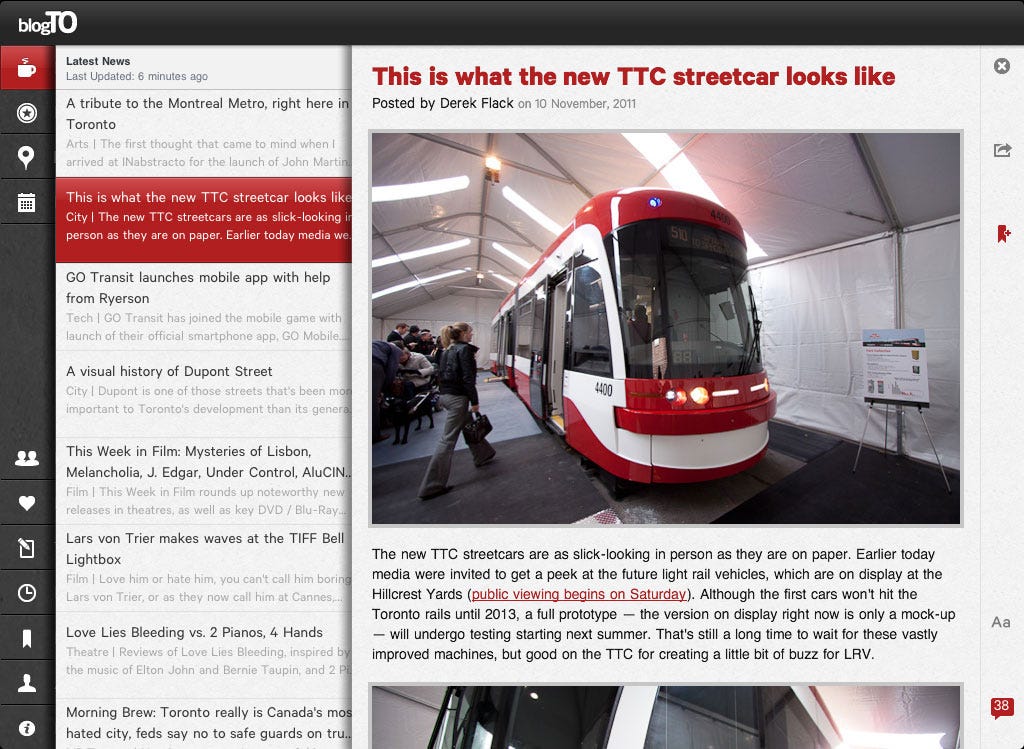
Say Yeah! also completed designs for an ambitious, re-imagined user profile system: a feature set that would have allowed users to connect with friends, check in to places, rate businesses, build to-do lists and track favourites, with a friends feed showing activity across the site and apps. The whole thing was aimed at keeping pace with well-funded U.S. companies like Foursquare, which I considered more serious competitive threats than any of the local digital or legacy media brands. We weren’t able to release a full version of it until many years later due to ongoing technical challenges, but the thinking behind it reflected how broadly I was defining the competitive landscape and the need for great functionality and technology, not just great content, to compete.
Taylan also built a custom data system outside of Movable Type, using Django, to house all the structured information for our business directories: addresses, phone numbers, neighbourhoods, and categories. The website and apps drew on an increasingly complex web of APIs and third-party integrations. We were still maintaining the Facebook apps we’d built years earlier with the help of a local tech company called Shiny. The technical surface area of blogTO had expanded well beyond what our original infrastructure could support.
The editorial workflow, everything from drafting to editing to publishing, still ran through Movable Type. Replacing it had been a priority for years. WordPress was the obvious candidate, the industry standard by that point. Abraham managed to replicate our entire setup in WordPress, migrate all the content, and get it up and running in a development environment. But by year’s end, integrating WordPress with everything Taylan had built in Django remained stubbornly problematic. After investing substantial time and money in the migration, we were confronting an uncomfortable possibility: WordPress might not be the answer. We might need to build a CMS entirely from scratch.
In the meantime, the site was suffering. blogTO was crashing regularly, sometimes several times a day. Pages loaded slowly for readers and even slower for writers working in the back end. Internal server errors were a daily occurrence.
We moved our hosting to Amazon Web Services (AWS) at a cost of roughly $1,000 a month, a figure that would only climb. And we brought on Kevin Kutzko on a retainer to manage server monitoring, security, maintenance and emergency support around the clock. Kevin would remain part of the operation for years. He outlasted me, in fact. ZoomerMedia ended his contract shortly after they let me go in 2025.
The competitive landscape in Toronto continued to shift in 2011.
The Toronto Standard arrived with a design that turned heads across the industry. This was the dawn of responsive web design, and most publishers still maintained separate desktop and mobile layouts. Seeing the Toronto Standard’s site fluidly adapt to any browser window felt like a glimpse of the future. The operation behind it appeared well-funded. Lee Polydor, the founder, ran Queen Street Capital Partners, a real estate firm that owned the Burroughes Building on Queen West, where the Toronto Standard would have their offices. They hired a strong team, anchored by editorial director Chris Frey, who also served as the Toronto correspondent for Monocle Magazine, and assembled a roster of established writers at rates competitive with legacy media. I admired the editorial quality, but the cost structure looked precarious from the start. I had doubts it could hold.
On May 5, Eye Weekly published its last print issue. For decades, it had been one of Toronto’s two dominant alt-weeklies and one of the publications blogTO had set out to replace from the very beginning. Its disappearance felt inevitable, though I was personally a fan of the publication. I still consider the weekly columns by Denise Benson a treasure, a historic document of Toronto’s nightlife scene from a certain era.
The following week, Torstar unveiled its successor, The Grid, a redesigned alt-weekly on heavier stock in full colour that almost looked like a magazine. Like the Toronto Standard, it would collect design awards. But it was clearly a print-first venture, seemingly as invested in staging recurring events like Burger Week as in producing journalism tailored for a digital audience. Launching an expensive new print product while the print advertising market was contracting struck me as a characteristically Torstar miscalculation.
OpenFile, barely a year old, was already faltering. Its model, in which readers propose stories, journalists develop them, had attracted admiration and plenty of media coverage when it launched. The site had expanded to six Canadian cities and paid freelancers competitive rates. But the audience was not materializing. Traffic was low. The community hadn’t produced enough compelling story ideas to break out beyond its niche audience. And the economics depended on continued support from benefactors whose patience had limits. David Topping, the former Torontoist editor who’d been briefly running OpenFile’s Toronto operation, was already exploring other options. Derek and I approached him about joining blogTO. We spoke for several months, but he ended up taking a job at The Grid.
OpenFile shut down in 2012. The Grid ceased operations in 2014. The Toronto Standard published its final story in 2015.
That year also introduced me to something that would shape the business for the next decade: the value of maintaining a direct relationship with Google.
They contacted us to participate in a search initiative aimed at “improving local search results for users in the GTA.” Google had expanded rich snippets to include local events and wanted to ensure that the listings in our events directory were surfaced prominently. We implemented the markup and watched referral traffic to our events section climb noticeably. It was significant because event listings would become one of the most competitive content categories in the years ahead.
It also foreshadowed a pattern. Over the following decade, Google, Facebook, Twitter, TikTok and Snap would all cultivate relationships with handpicked Canadian publishers, offering access to exclusive events, training and revenue-generating partnerships. Sometimes blogTO made the list. Sometimes we didn’t. There was never transparency about who was included or what we might be missing. You’d only find out you’d been excluded when someone else mentioned it.
I had always been focused on digital, but 2011 was the year I formally stepped away from some of the offline initiatives that had defined blogTO’s early brand-building efforts.
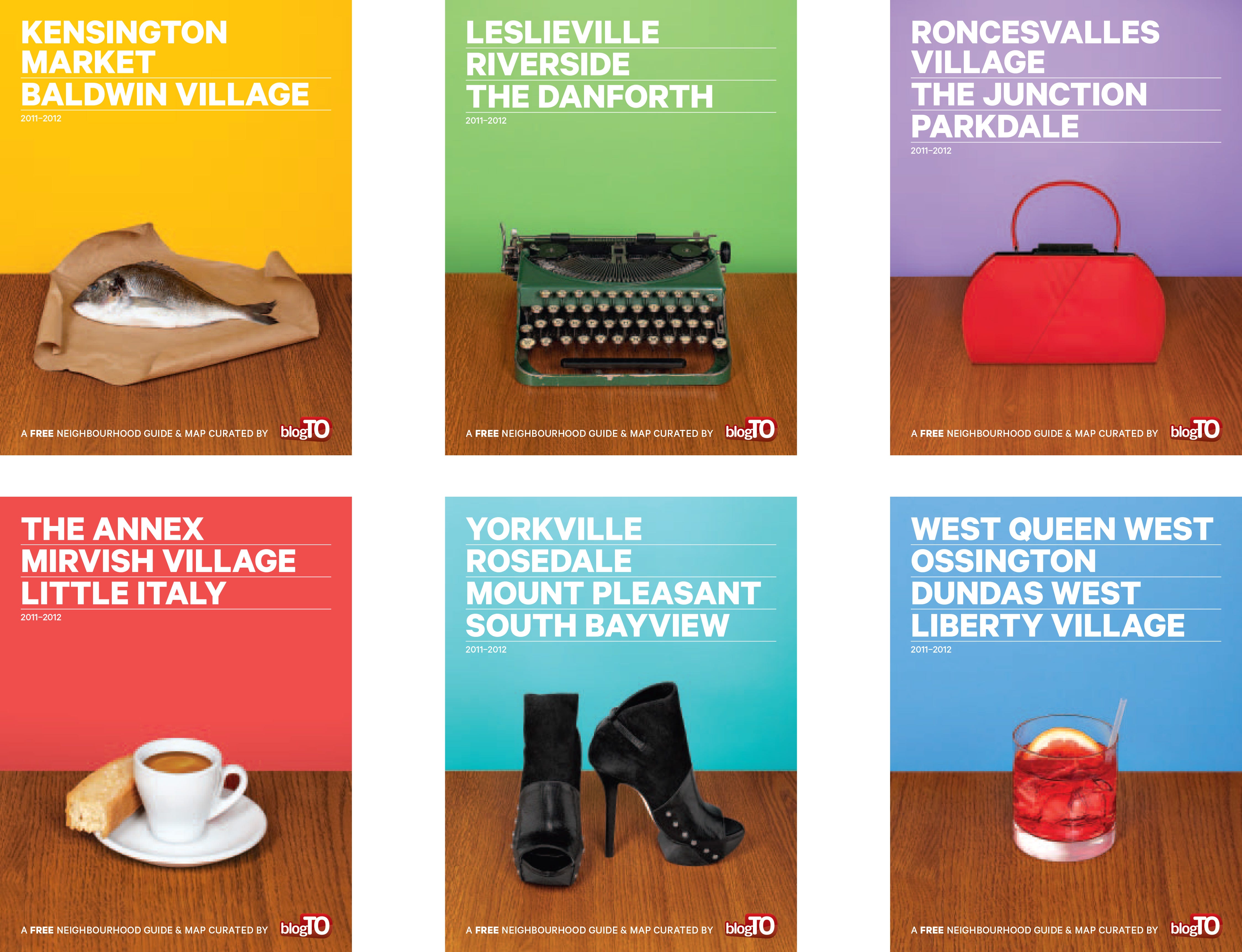
The neighbourhood maps, a fixture since 2007, ended. I’d started delegating parts of the process, sales calls to local businesses, distribution runs, but the people I hired didn’t execute the way I needed them to, and the economics deteriorated. Revenue dropped. Costs rose. And the case for printed maps was weakening by the month. Google Maps was now on every smartphone. Yelp, Foursquare, and now our own iPhone app were doing, at least in part, what the maps had done on paper. By fall, I decided not to produce another edition.
We also retired our annual photography exhibitions with the Contact Photography Festival. The openings were well attended and offered a rare opportunity to bring our online community together in person. But they consumed time and energy I could no longer spare. In their place, we expanded our media sponsorships. Rather than producing our own events, we’d increasingly lend our promotional reach to other people’s. Film festivals like Inside Out, Hot Docs and the Images Festival became recurring partners, alongside events spanning food, music, fashion and culture, such as Wavelength, Fashion Art Toronto (FAT), and Night It Up!, to name a few.
By year’s end, annual revenue had surpassed $500,000. We turned a slight profit. The majority of our spending went to editorial production and the mounting investment in technology, design and development for the website and apps. Everyone was still on contract. A few contributors were approaching full-time hours, but blogTO officially had zero employees. The traffic kept climbing. The infrastructure kept straining. The competition kept arriving.
The following year, we’d make our first acquisition.
I think this needs to be turned into a documentary-series I would absolutely watch
Indeed. Awesome to look back...